
Bath time has a reputation problem. For some families it is the easiest fifteen minutes of the day. For plenty of others it is the part everyone braces for, the bit with the arching back, the shampoo standoff, and a toddler who wants out roughly four seconds after going in.
Here is the thing worth noticing: you already have a warm, contained, waterproof space that your child is in every single evening anyway. No setup table to clear. No sticky floor to mop. Nothing to find a home for afterward. Bath time sensory play works because the hardest parts of messy play, the cleanup and the containment, are already solved before you start.
Below are 25 ideas built for children aged roughly 1 to 3, each with what you need, how to set it up, and what to watch for. Most use things already in your kitchen or bathroom. A few take under a minute to prepare. You will not need all of them, so skim, pick one, and save the rest for a harder evening.
Table of Contents
Before You Start: Bath Safety for Ages 1 to 3
This part is not optional, and the activity you choose should bend around it rather than the other way round.
An adult stays within arm’s reach, eyes on the child, the entire time. Not in the doorway, not folding towels, not answering one quick message. Drowning is silent and fast, and it can happen in very little water. Keep the water shallow, roughly hip height when your child is sitting, and check the temperature with your wrist or elbow before they get in. Warm, not hot.
A non-slip mat matters more once you add soap, foam, or anything slippery to the tub, because toddlers stand up without warning. Drain the water as soon as play is finished, and never leave a filled tub unattended with a mobile toddler in the house.
Three things from popular bath activity lists are worth skipping at this age. Water beads absorb liquid and swell after being swallowed, which makes them a serious ingestion hazard and a repeated subject of safety warnings.
Glow sticks contain liquid that can leak when chewed or snapped. Loose glitter and tiny confetti pieces get into eyes and are not worth the clean-up. Essential oils are also best left out of the water for children under three, since undiluted oils can irritate skin and some are not recommended for young children at all.
If your child has eczema, broken skin, or reacts easily, keep soaps and any fizzing mixtures out and stick to the plain-water ideas. Our guide to sensory play safety for toddlers covers material choices in more detail if you want the longer version.
What to Keep in a Bath Play Basket
Keeping a small basket or mesh bag beside the tub is the difference between doing this and meaning to do it. Nothing here needs buying specially.
Kitchen scoops, a small jug, a slotted spoon, a funnel, two or three plastic cups of different sizes, a turkey baster or large pipette, a few sponges cut into chunky pieces, a silicone cupcake tray, an empty squeeze bottle, a small whisk, and a handful of waterproof toy animals or cars. Add a plastic colander if you have a spare one. That is a working kit.
Store it somewhere it can drip dry, and tip the water out of anything hollow after each bath so it does not grow mildew inside.
□ Funnel, slotted spoon, small whisk
□ Turkey baster or large pipette
□ Chunky sponge pieces, 3 or 4
□ Silicone cupcake tray, small colander
□ Empty squeeze bottle
□ Waterproof animals or cars
1. Color-Changing Bath Water
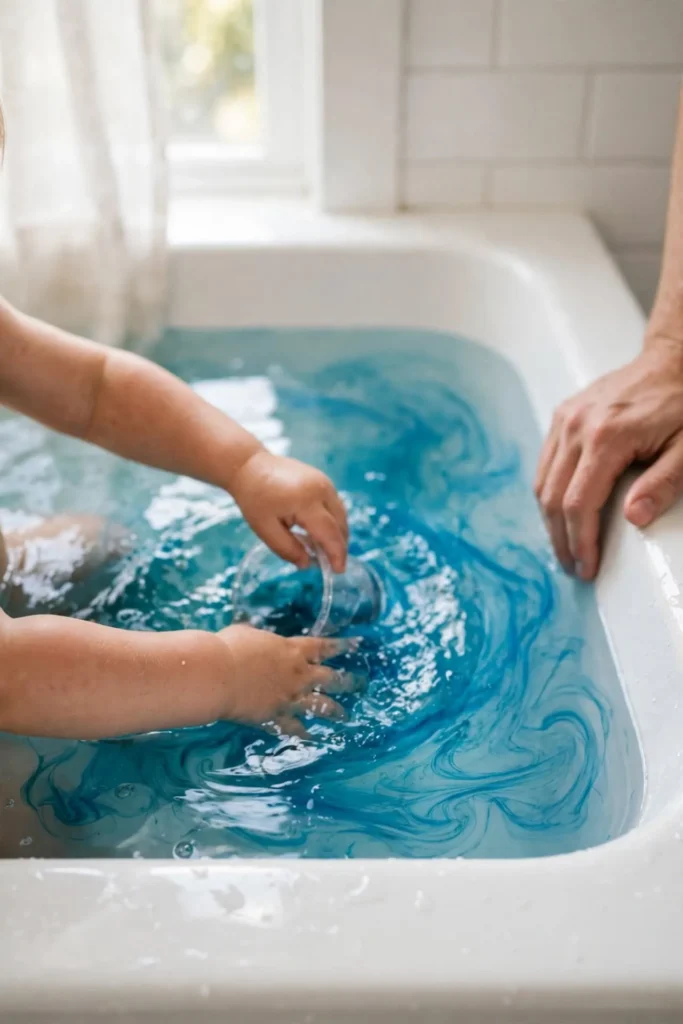
Few things hold a one year old’s attention like water that suddenly turns green. Drop a bath colour tablet into the filled tub, or stir in two or three drops of food colouring, and let your child watch the colour spread and swirl before it evens out.
The learning here is quiet but real: cause and effect, and some early colour language while you name what you see. Older twos can choose the colour themselves, or hand you two tablets to make a new one.
Food colouring can tint a very pale or textured tub, so test one drop first and rinse afterwards. Bath-specific tablets are formulated to rinse clean and are usually the safer choice for older enamel.
2. Soap Foam Mountain
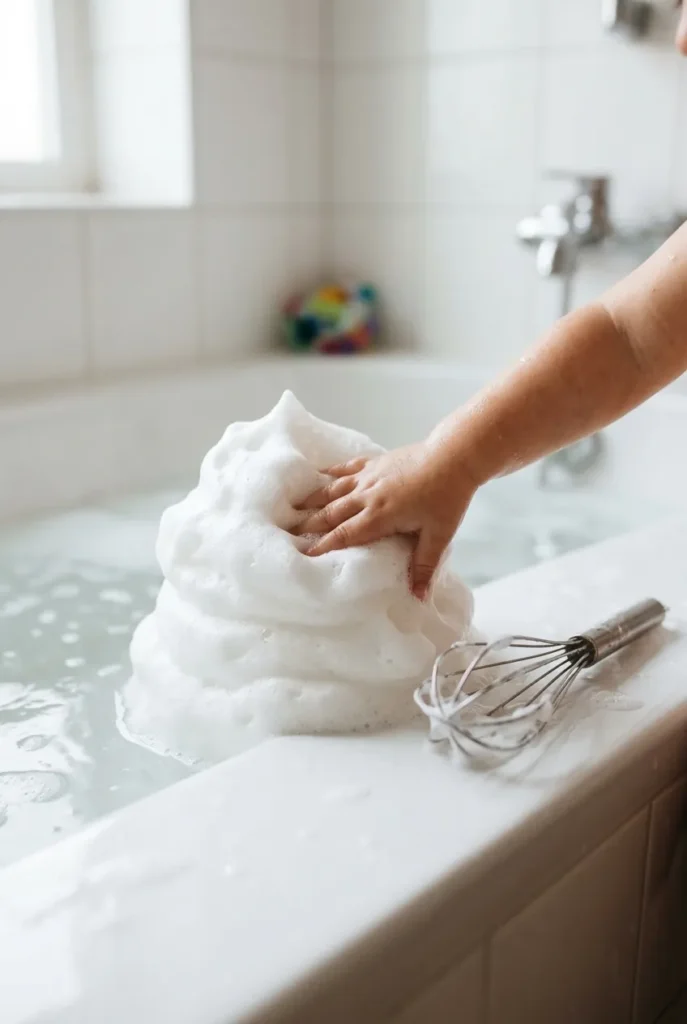
Soap foam is one of the best textures you can offer a toddler, and the bath is the only place it does not become your problem afterwards. Whisk a tablespoon of tear-free baby bath or soap flakes with a small amount of water in a bowl until it holds peaks, roughly a minute with a hand whisk, then tip it into the tub.
What makes it worth doing is how differently it behaves from water. It holds a shape, it squashes, it sticks to hands and walls, and it disappears slowly. Children who dislike wet textures often accept foam first.
Use the smallest amount of soap that still foams, and keep it away from faces.
- One tablespoon tear-free bath soap into a bowl.
- Add two tablespoons warm water, no more.
- Whisk fast for about a minute until stiff peaks form.
- Tip into the tub in one mound so it stays tall.
3. Homemade Bath Paints
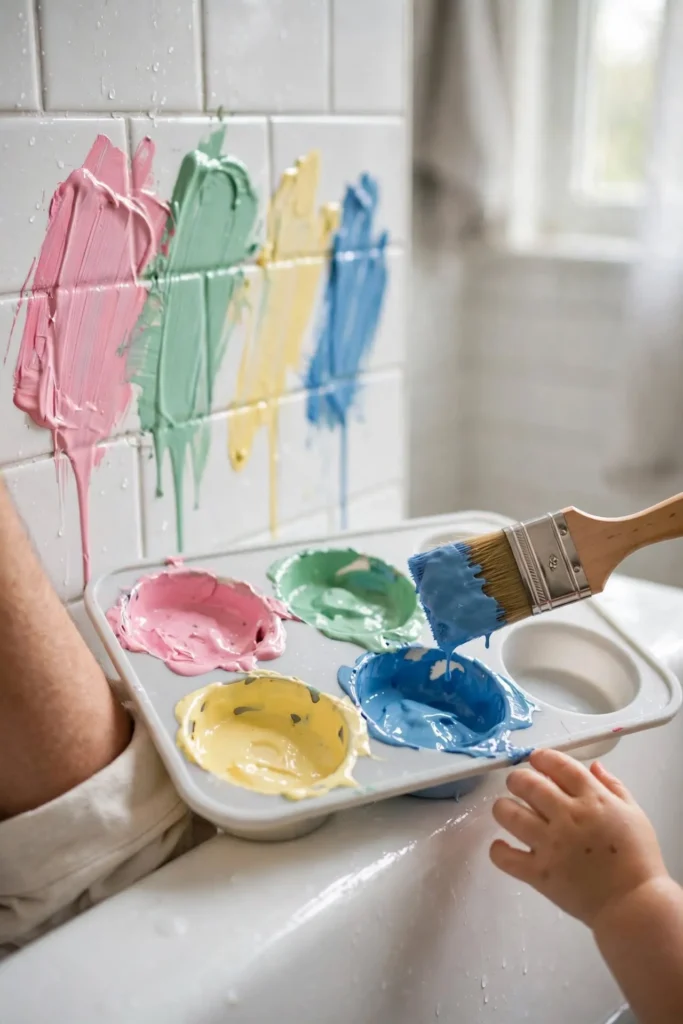
Shop-bought bath paint is expensive for what it is, and the homemade version takes three minutes. Mix two tablespoons of cornflour with one tablespoon of tear-free bath soap and a splash of warm water, then divide it between the cups of a silicone tray and stir a drop of food colouring into each.
The result is thick enough to brush onto wet tiles and stay put, which is the whole appeal. Hand over a chunky brush or let fingers do the work. Streaks, handprints, and one enormous smear are all legitimate outcomes at this age.
Rinse the tiles down before the paint dries, and skip this one if your child has sensitive or broken skin.
4. Bath Crayons on the Tile Wall
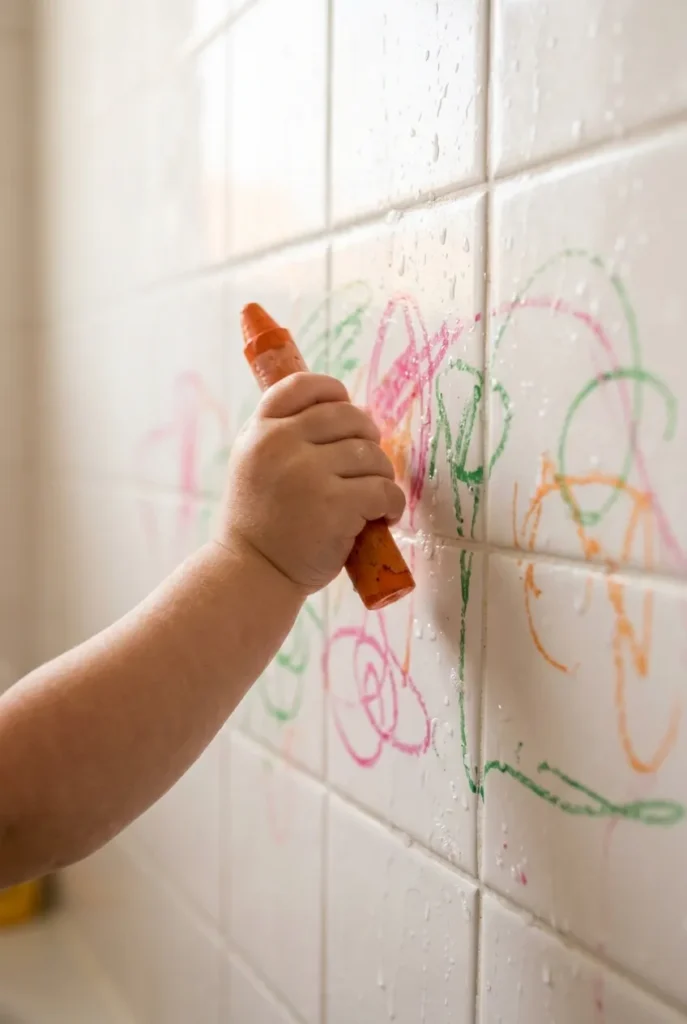
A tiled bath wall is the largest drawing surface most toddlers ever get, and it wipes clean. Bath crayons are soap-based sticks that mark wet tile and rinse off with water, usually sold for a few pounds and lasting months.
Mark-making at 1 to 3 is not about drawing anything recognisable. It is about the shoulder and arm movement, the resistance of the crayon against a vertical surface, and the discovery that your hand leaves a trace. Big sweeping scribbles are exactly right.
Test one small patch first. Textured tile, grout, and natural stone can hold pigment, and some older acrylic tubs mark more easily than modern ones.
5. Ice Cube Chase in Warm Water
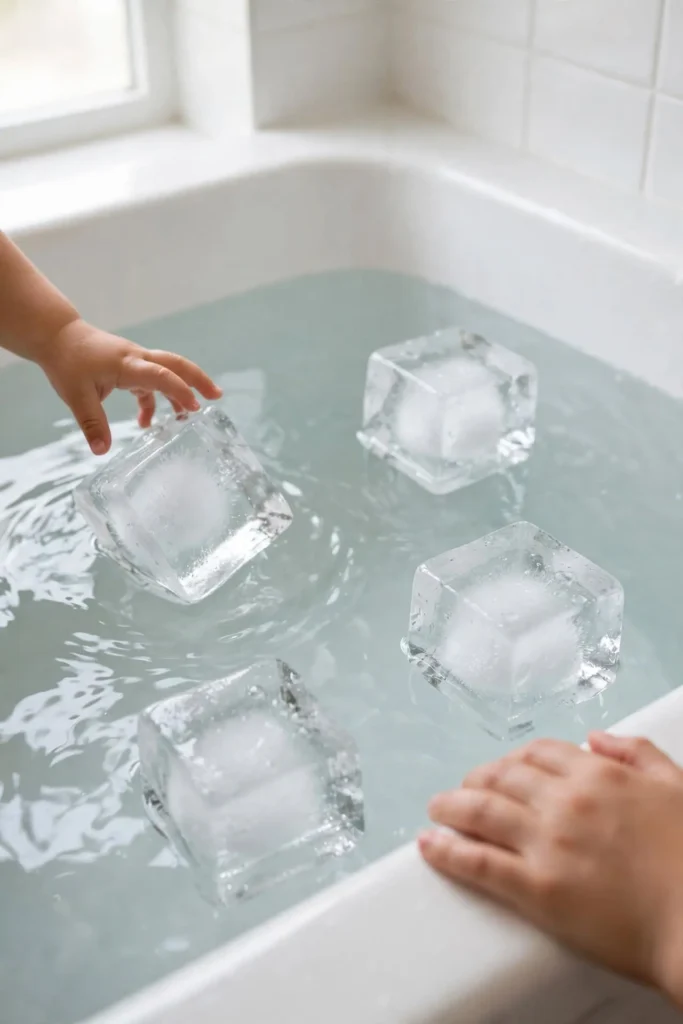
Warm water plus one cold ice cube is a complete sensory experience with no preparation at all. Drop three or four cubes into the bath and let your child chase them, hold them, and watch them shrink.
Temperature contrast is genuinely interesting to a young toddler, and ice is slippery in a way nothing else in the tub is, so catching one takes real hand control. The cubes also disappear, which gives you a natural, argument-free ending.
Keep cubes standard size or larger, never small chips, and take them out if your child starts putting them in their mouth. Cold can be uncomfortable against gums and a cube can be bitten into smaller pieces.
6. Frozen Rescue Block
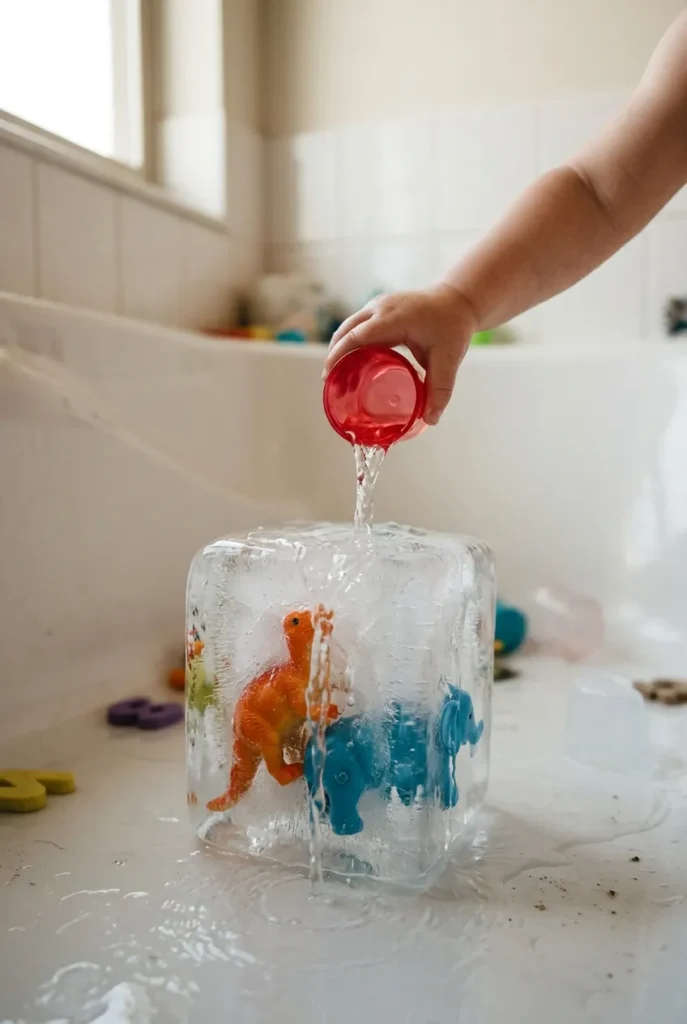
Freeze two or three small waterproof animals into a plastic tub of water the night before, then tip the block into the bath and let your child work out how to get them out. Warm water does most of the job, but pouring cups of water over the top speeds it up, which is the discovery worth waiting for.
This one buys you real time, often ten minutes or more, which makes it useful on an evening when you need the bath to stretch. Use a smaller container for a younger toddler so the wait is shorter.
Only freeze toys too large to swallow, and check nothing has cracked in the freezer.
7. Pouring and Funnel Station
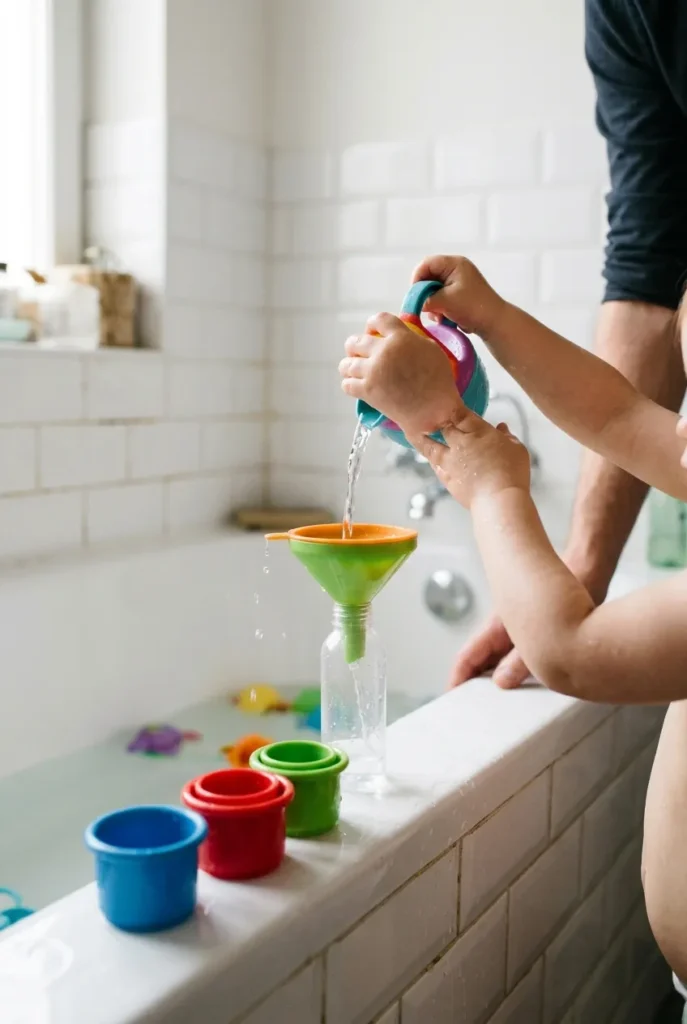
Most toddlers will pour water between containers for longer than they will do almost anything else, and the bath removes every reason to stop them. Set out three containers of different sizes, a funnel, and a jug with a handle they can actually hold.
Pouring is harder than it looks. It needs two hands doing different jobs, a sense of when to stop tipping, and some aim. A funnel makes success more likely early on, which keeps a younger toddler at it rather than giving up.
Swap one container each bath rather than offering everything. A fresh item in a familiar set is more interesting than a full tray.
8. Sponge Squeeze and Soak
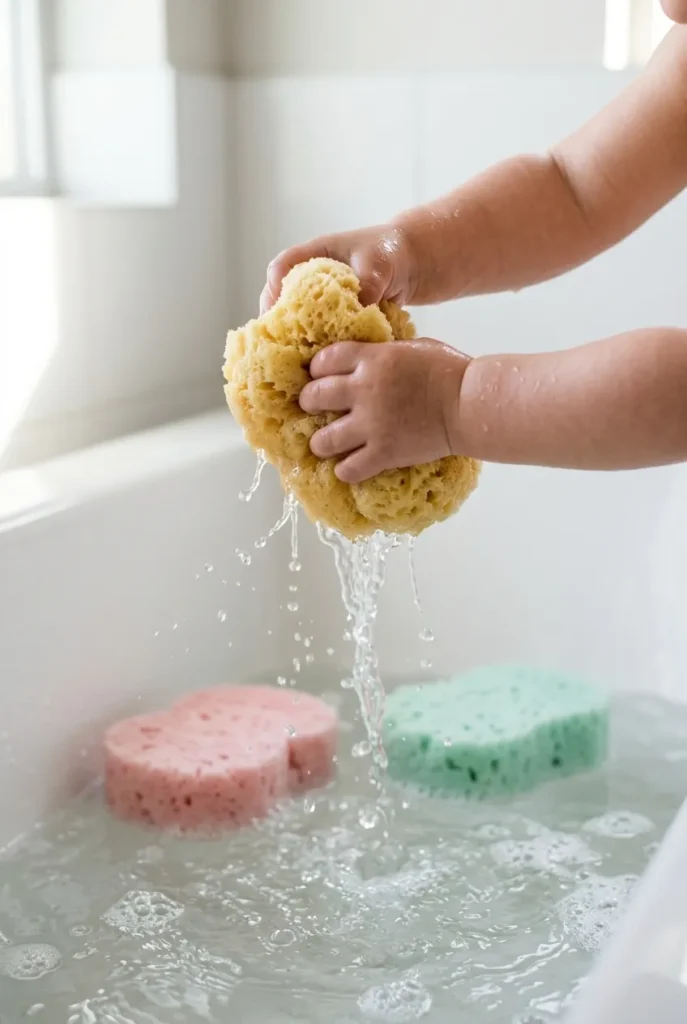
The squeeze is the point here. Cut a cellulose sponge into three or four chunky pieces, let them soak until heavy, and show your child how to press one between both palms so the water runs out.
Hand strength builds through exactly this kind of repetition, and squeezing a soaked sponge gives immediate, visible feedback for the effort. A sponge that drips onto a knee is funnier than anything you could plan.
Cut pieces large, at least the size of your palm, and bin them once they start tearing. Small torn fragments are a mouthing risk, and old sponges hold bacteria. Keep the pieces chunky and replace them often.
✓ Plain cellulose, no scouring backing
✓ Squeeze into a cup for a target
✓ Squeeze over the tile wall for drips
✓ Bin them the moment they tear
9. Tile Water Wall
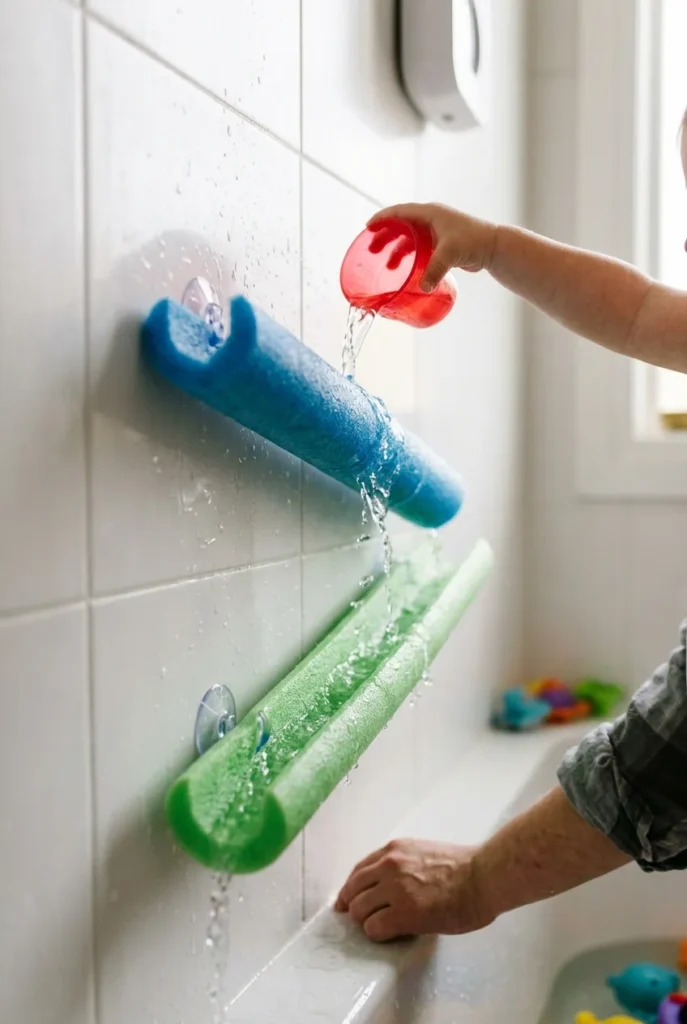
Three suction hooks and a pool noodle cut lengthways give you a water wall on the bath tiles. Press the noodle halves onto the wall at angles so they form a run, then pour water in at the top and watch it travel down.
Watching water move along a path is genuinely absorbing, and changing the angle changes the speed, which three year olds will test repeatedly. A younger toddler is happy just pouring at the top.
Suction cups fail on grout lines and textured tile, so press them onto flat, wet, clean tile and check they hold before you fill a jug. Take the whole thing down after the bath rather than leaving it to drop.
10. Bubble Catching
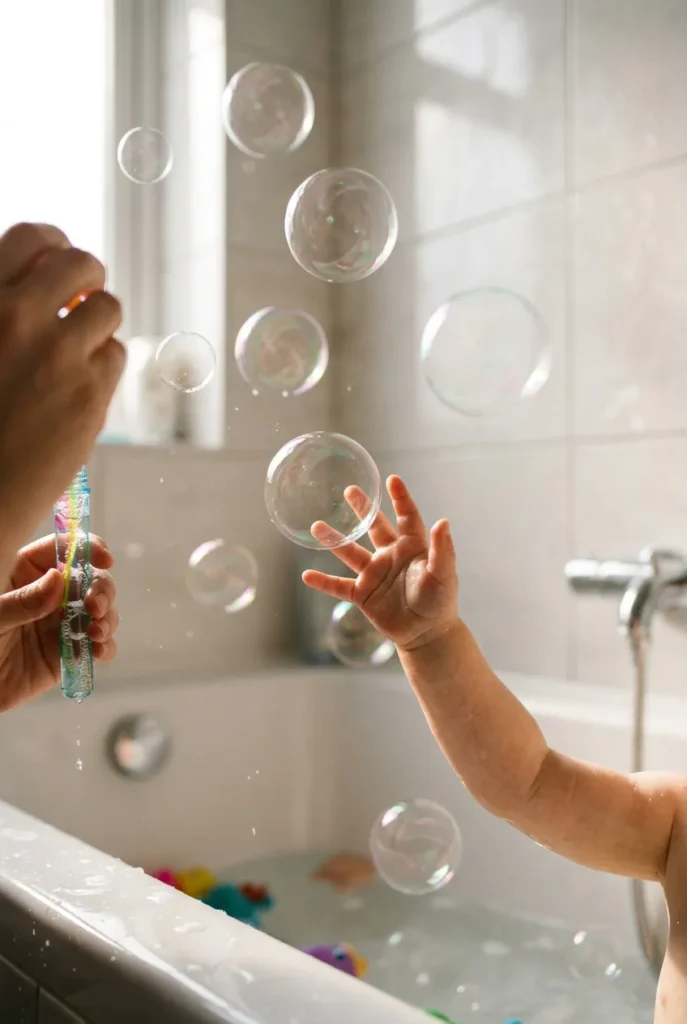
Bubbles move slowly enough for a toddler to track, which is precisely why they work. Blow a few over the tub with a wand and let your child reach, swipe, and pop.
Tracking a moving object and reaching for it accurately are early visual and motor skills, and the pop gives instant feedback. For a one year old, blow them higher and slower. For a three year old, call out where to pop one, on the wall, on a knee, in the water.
Keep the bubble solution out of reach and out of the water, and never let your child blow through the wand themselves. Bubble mixture is not meant to be swallowed, and a mouthful causes stomach upset.
11. Scoop and Strain
A common mistake with scooping play is offering a tiny spoon and a lot of small objects. At 1 to 3 that combination is both frustrating and a choking risk. Use a slotted spoon or small colander instead, with four or five chunky floating items, and the activity works immediately.
The skill being practised is coordinating a tool with a target while the target drifts away, which is harder than catching something still. Straining also shows water leaving while the object stays, a small idea that holds up to a lot of repetition.
Every item in the water must be too large to swallow. Nothing smaller than a toilet roll tube’s opening.
4 to 5 large floating items
A bowl to collect them in
Let them tip it all back and restart
Beads, pom poms, small counters
Twenty items at once
Correcting their technique
12. Fizzing Bath
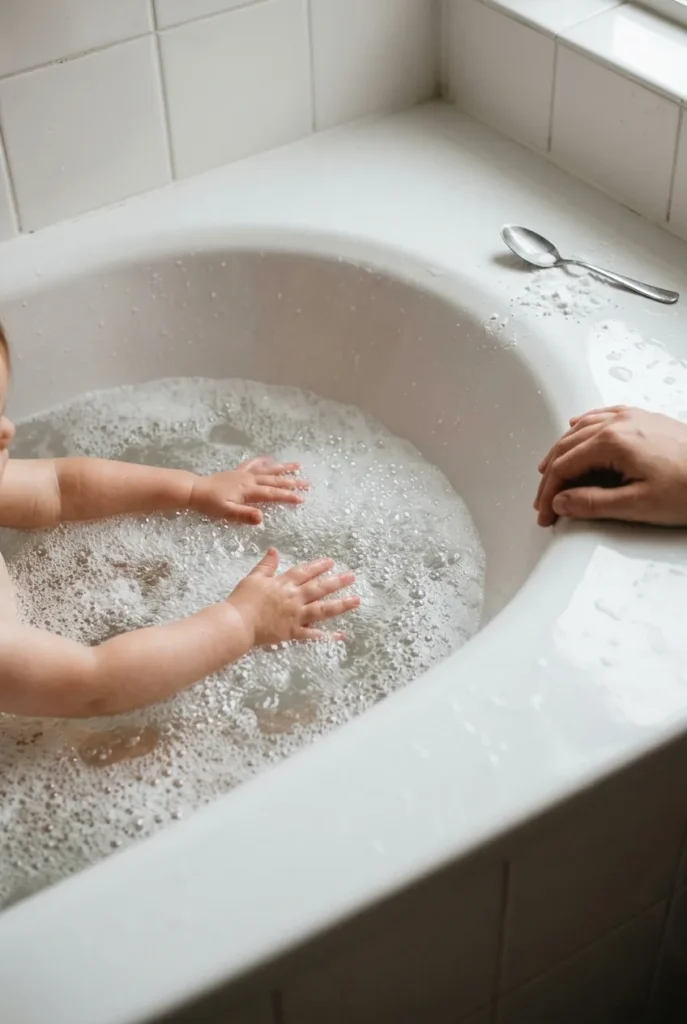
Fizzing is a sound activity as much as a visual one, and most children go quiet listening to it. Stir a tablespoon of bicarbonate of soda into the bath, then sprinkle in a little citric acid and let your child feel the water fizz around their hands.
Making a change happen and then hearing it is a satisfying loop for a two year old, and the bubbles tickle, which is often the main attraction. Keep the quantities small. More fizz is not better, and it alters the water.
Skip this entirely for eczema, broken skin, or any history of skin reactions, keep it well away from eyes, and limit it to a short soak. Mix it yourself rather than letting your child handle citric acid powder.
□ Citric acid, 1 tsp, adult handles it
□ A small spoon for stirring
□ Plain water bath, no soap or bubble bath
13. Cornflour Goop in a Tray
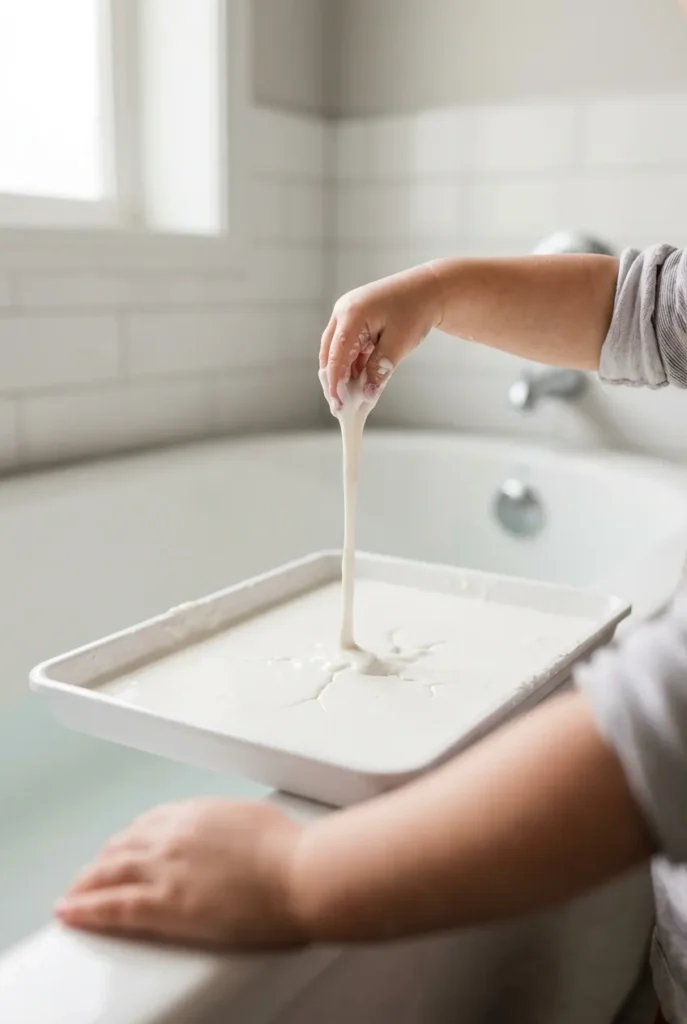
Oobleck in the bath sounds like a terrible plan, and loose in the water it is, because cornflour makes a tub genuinely slippery. Contained in a shallow tray balanced across the bath, it is one of the best textures available.
Mix roughly two parts cornflour to one part water until it runs when poured but resists when poked. That contradiction is the whole experience, and toddlers test it over and over.
Keep the goop in the tray, not the water, and rinse hands before anyone stands up. Cornflour is not toxic but it is not food, so redirect tasting. For other textures worth trying, our guide to safe sensory bin fillers for toddlers sorts them by age.
Holds attention: long
Needs: a tray, kept out of the water
Best for: 2 and up who will not mouth it
Holds attention: medium
Needs: nothing extra, goes in the tub
Best for: 1 and up, including cautious hands
14. Doll Washing Station
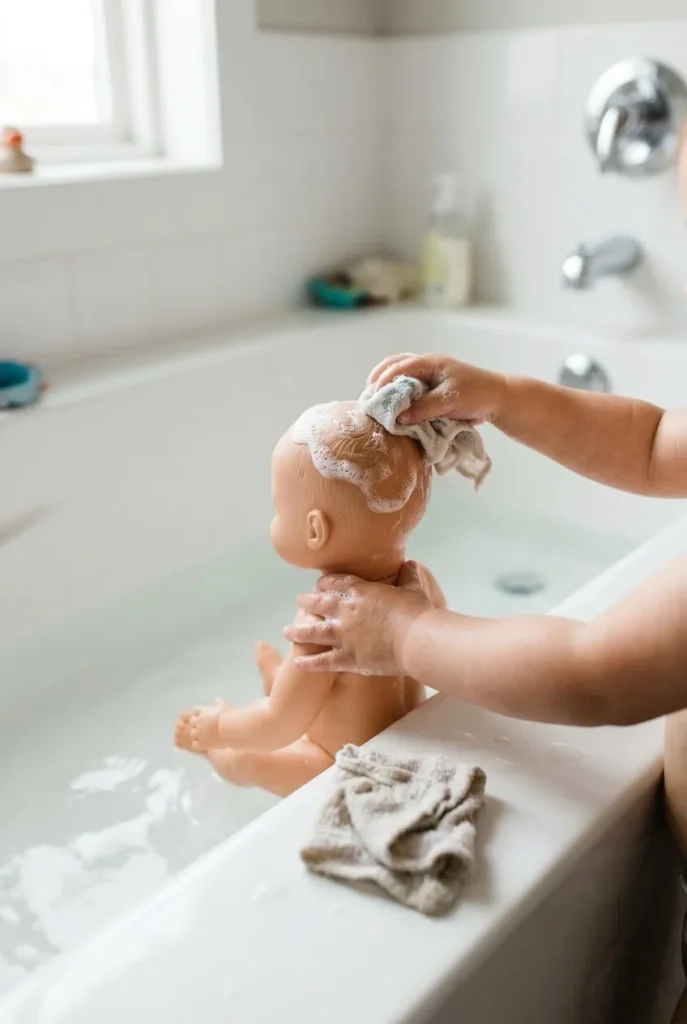
Hand a toddler a doll, a flannel, and a squeeze of soap and you will usually get careful, absorbed, surprisingly gentle play. Add a small towel on the bath edge for drying afterwards.
Caring for something else in the same way they are being cared for is meaningful at this age, and it often makes the real hair wash easier because the sequence becomes familiar. Wash the doll’s hair first and your own child’s second.
Choose a plastic doll with no battery compartment, no fabric body that will stay damp, and no small removable accessories. Check nothing has come loose before it goes in the water.
- Your child washes the doll’s hair.
- Your child rinses it with a cup.
- You say what comes next, then do the same to them.
- They dry the doll while you dry them.
15. Toy Car Wash
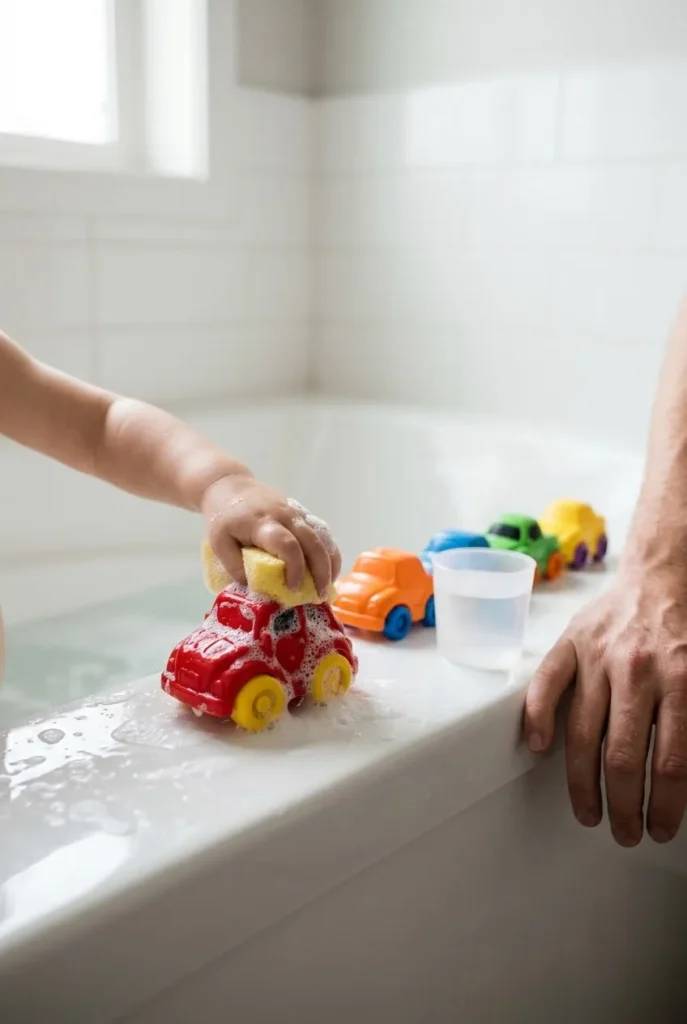
Car wash play works better than it sounds because it gives the water a job. Line up three or four plastic cars on the bath edge, hand over a sponge and a cup, and let your child soap, scrub, and rinse each one before parking it at the other end.
Compared with free splashing, this has a start, a middle, and an end, which helps a toddler who flits between things. The sorting that happens naturally, washed cars here and dirty ones there, is early categorising without any prompting.
Metal cars rust and chip, so use plastic only, and check for small wheels or parts that can detach in water.
16. Color-Matching Sponge Sort
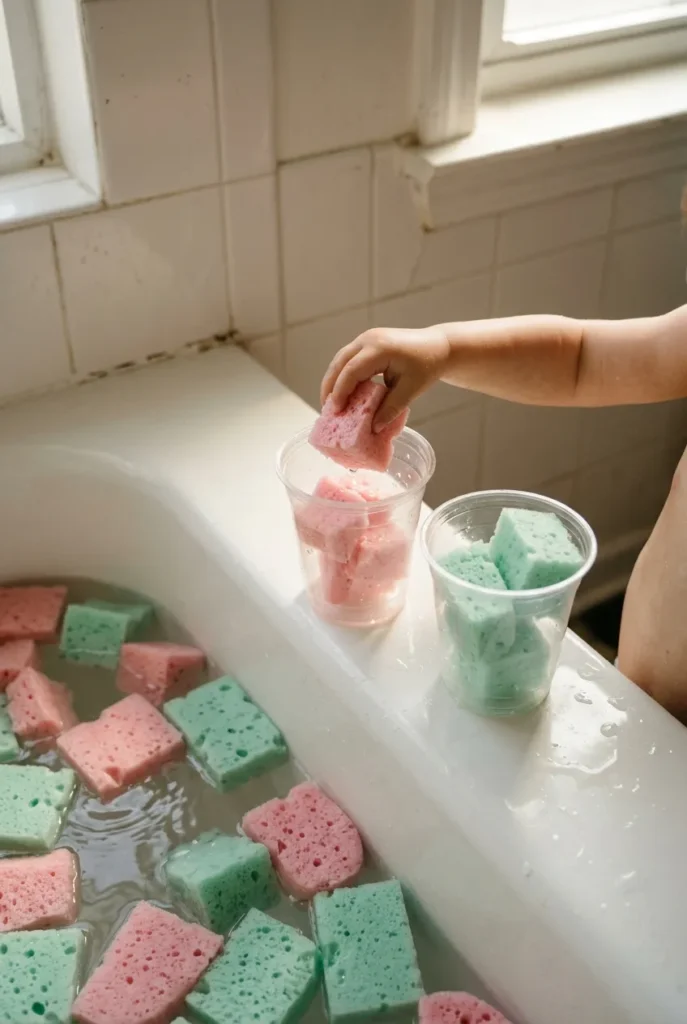
Sorting by colour arrives later than most activity lists suggest. A one year old will move sponges from one place to another, which is the real precursor skill, while matching by colour reliably comes closer to three.
Cut sponges into chunky pieces in two or three colours, float them all, and put out two cups. Say the colour as you drop one in, then let your child take over. Two colours, not six.
If matching does not land, do not push it. Moving, dropping, and filling are worthwhile on their own, and the colour language still goes in while you narrate.
| Age | What to expect | Set out |
|---|---|---|
| 1 to 18m | Moves pieces, drops them, fills and tips | One cup, all colours |
| 18m to 2 | Matches with help, enjoys hearing colour names | Two cups, two colours |
| 2 to 3 | Sorts independently, may name the colours | Three cups, three colours |
17. Float or Sink Tray
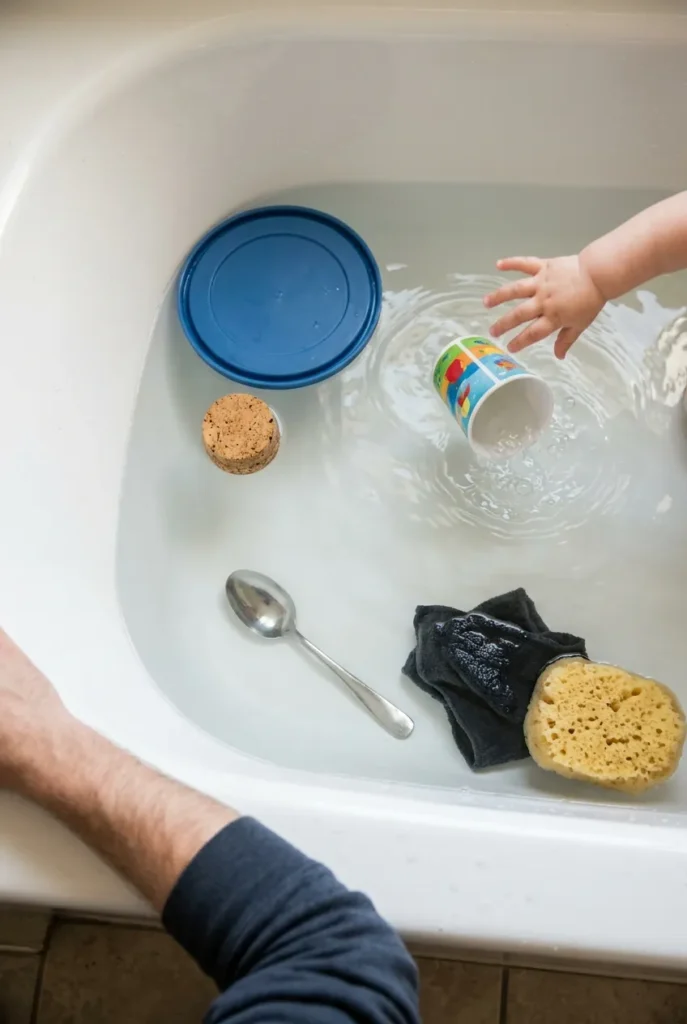
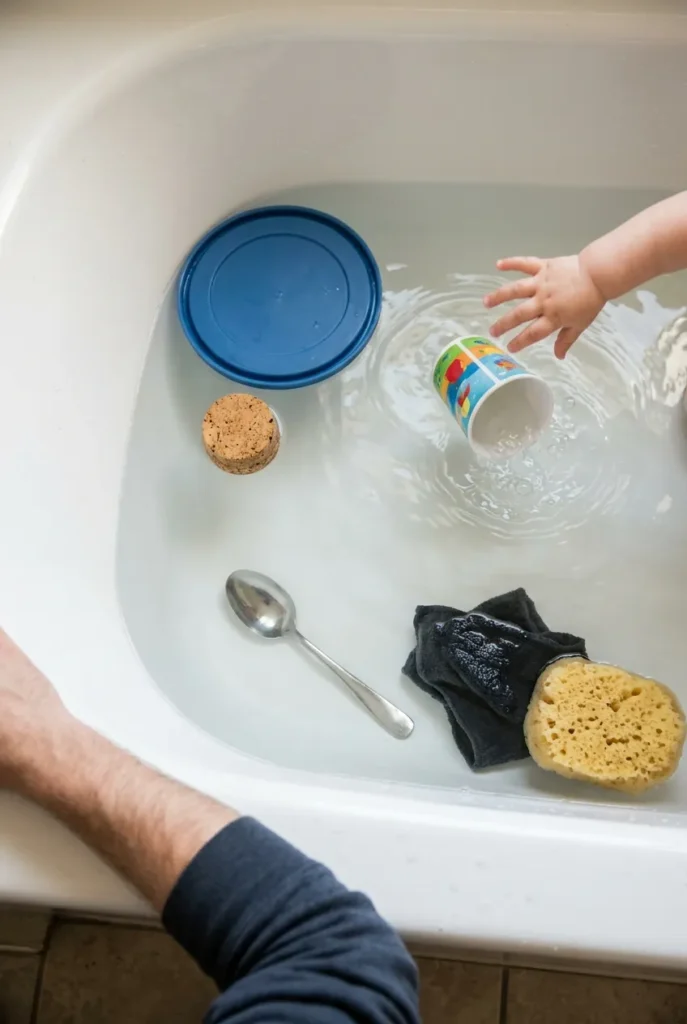
Collect six safe household items with obviously different weights, a plastic lid, a metal spoon, a cork, a sponge chunk, a plastic cup, a small flannel, and let your child drop them in one at a time.
Predicting and then checking is a real thinking exercise even at two, and the answers are sometimes surprising, which is what makes it stick. Ask which one will float before each drop, and accept any answer without correcting it.
Everything must be too big to swallow and must not break down in water. Skip coins, batteries, magnets, and anything with a seam that could split.
18. Pool Noodle Ring Stacking
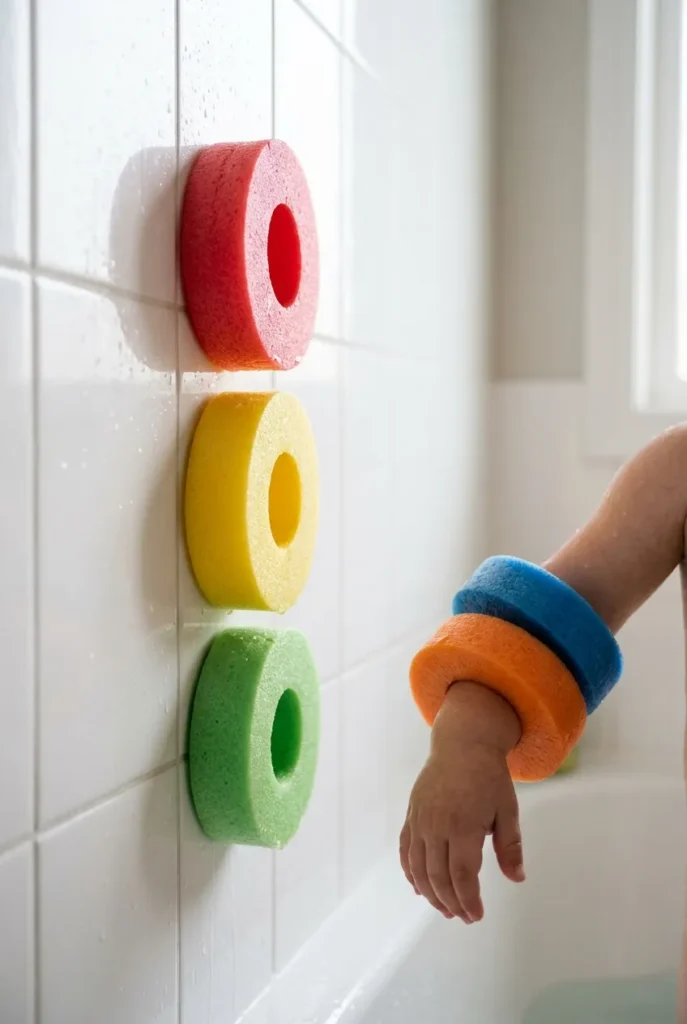
Cut a pool noodle into thick rings, roughly as wide as your hand, and they become wet stacking pieces that stick to tiles and thread onto an arm. Wet foam clings to a smooth tile wall, which surprises most toddlers the first time.
Threading rings onto a forearm or a bath toy takes two hands working together, and the foam is forgiving when the aim is off. Stacking them wet is harder than dry, which makes it interesting for an older two.
Cut the rings thick. Thin rings and offcuts are a choking hazard, and foam that is bitten can come away in small pieces. Check them each bath and replace any that are chewed.
19. Bath Soup Kitchen
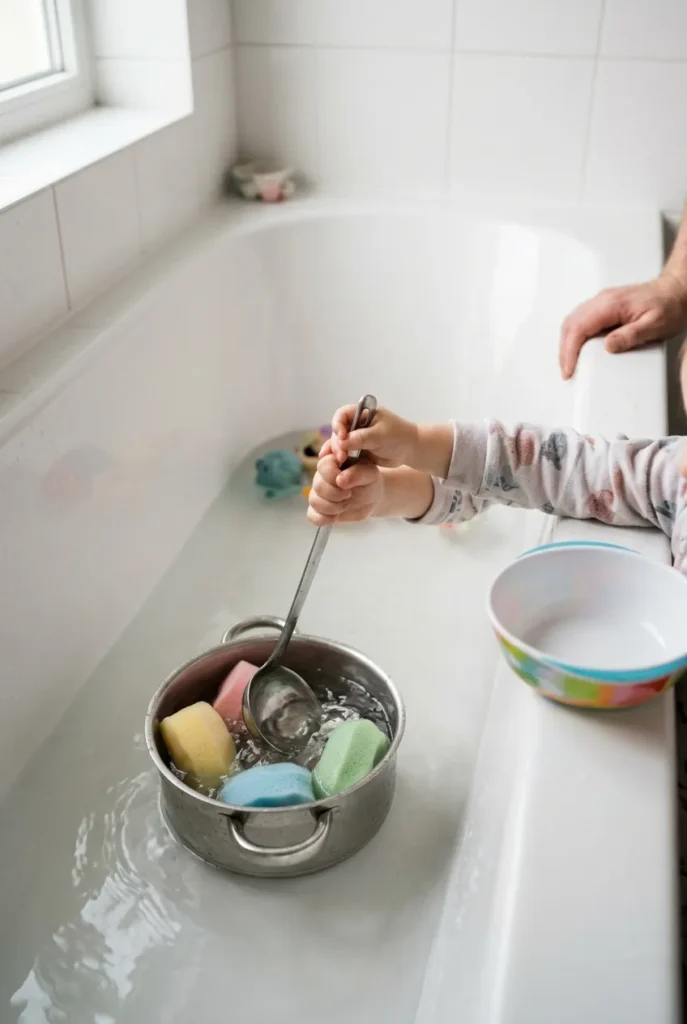
A pot, a ladle, and a handful of large waterproof bits turn the bath into a kitchen. Add a few chunky sponge pieces as vegetables and let your child stir, serve, and offer you a taste.
Pretend play at this age runs on repetition and real actions, and stirring a heavy ladle through water is physically satisfying in a way stirring an empty pot is not. Three year olds will narrate it. One year olds will mostly stir, which is fine.
Keep the pretend food too large to swallow, and be clear that nobody drinks the soup. Bath water is not clean, even with soap in it.
20. Herb and Petal Mesh Bag
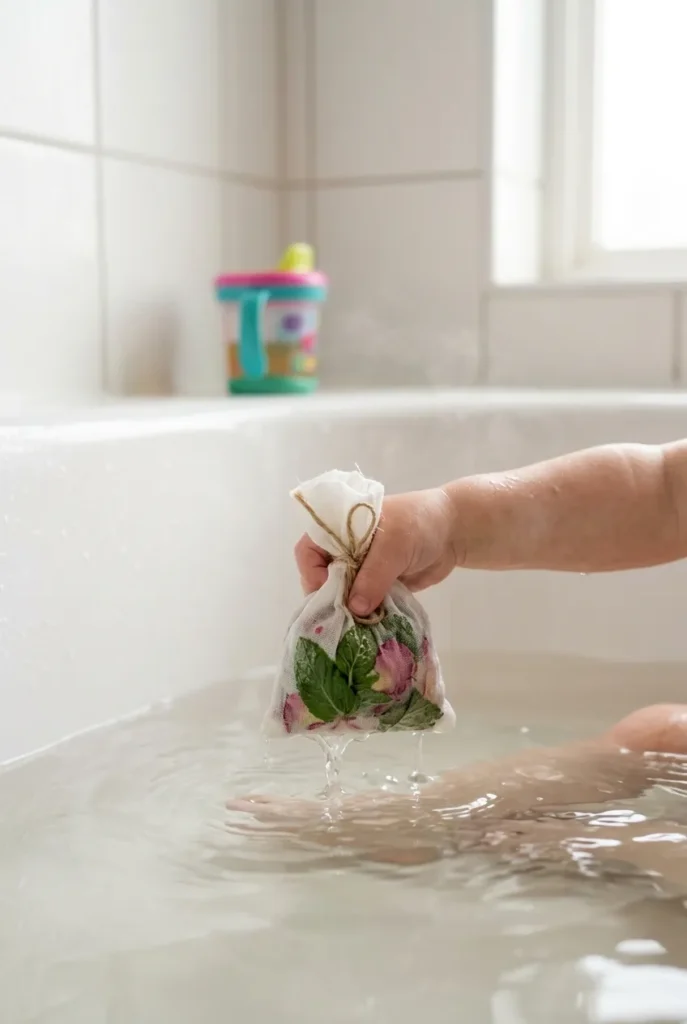
Scent gets left out of most bath activity lists, which is a shame because smell is immediate and calming. Put a few sprigs of fresh mint, a little dried lavender, or a handful of rose petals into a muslin square or mesh laundry bag, tie it closed, and drop it in the warm water.
Squeezing the bag releases more scent, so it holds up to handling. The texture through the mesh is interesting too, soft and lumpy rather than smooth.
Tie the bag securely so nothing escapes into the water, use food-safe herbs rather than essential oils, and keep it to one short bath. Stop if you see any redness, and leave this one out if there is a known plant allergy in the family.
21. Foam Shapes on the Wall
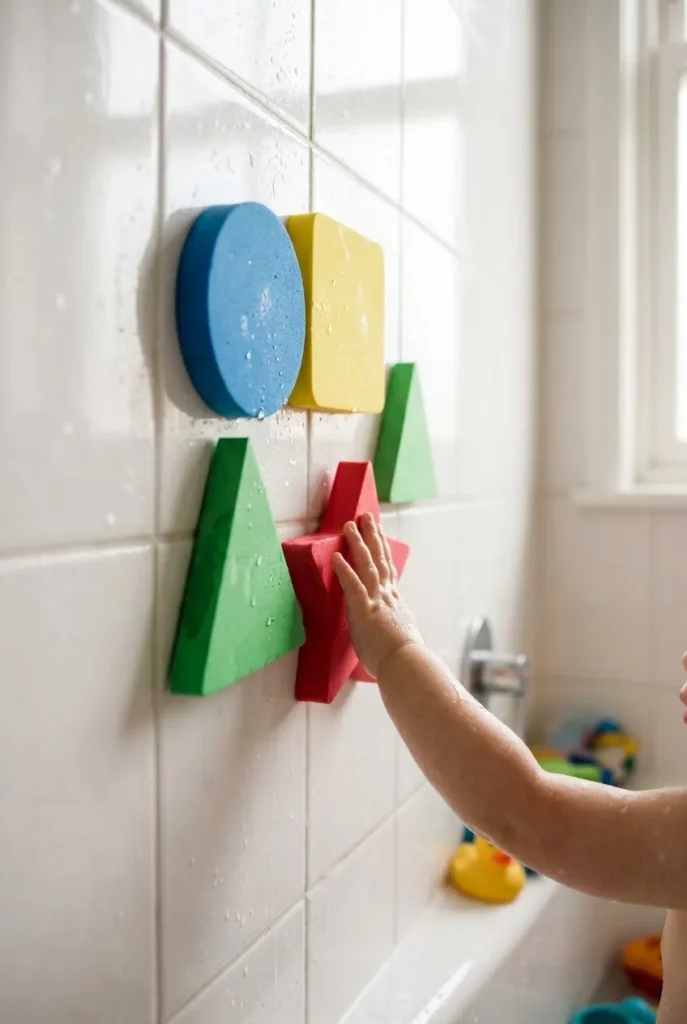
Wet foam shapes stick to tile without any adhesive, which gives a toddler a vertical surface they can arrange and rearrange themselves. Shop-bought bath foam shapes work, and so do thick pieces cut from a craft foam sheet.
Pressing a shape onto a wall and having it hold is a satisfying, repeatable result, and it pulls play upward and out of the water, which is a useful change of position halfway through a bath. Build a tower, make a line, or press them around a bath crayon circle.
Use large shapes only, and keep an eye on edges. Thin foam tears into small pieces once it is chewed.
22. Low-Light Calm Bath
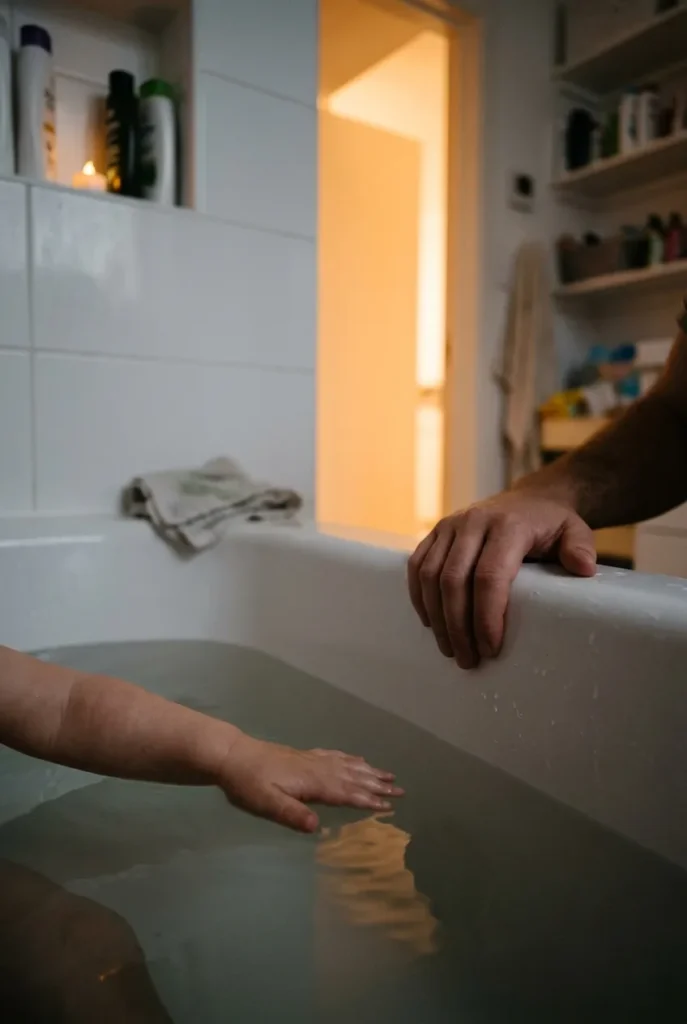
Some evenings the bath needs to wind a child down rather than wake them up. Turn the main light off, leave a hallway light on or stand a battery tea light safely outside the tub on a shelf, and let the water be quiet.
Reduced visual input changes how a toddler behaves in water, often noticeably. Splashing settles, hands move more slowly, and the whole bath gets quieter. For a child who finds bath time overwhelming, this is worth trying before any of the busier ideas on this list.
Keep every light source outside the tub and away from water, use battery lights rather than candles, and keep the room light enough that you can see your child clearly at all times.
23. Animal Rescue in the Foam
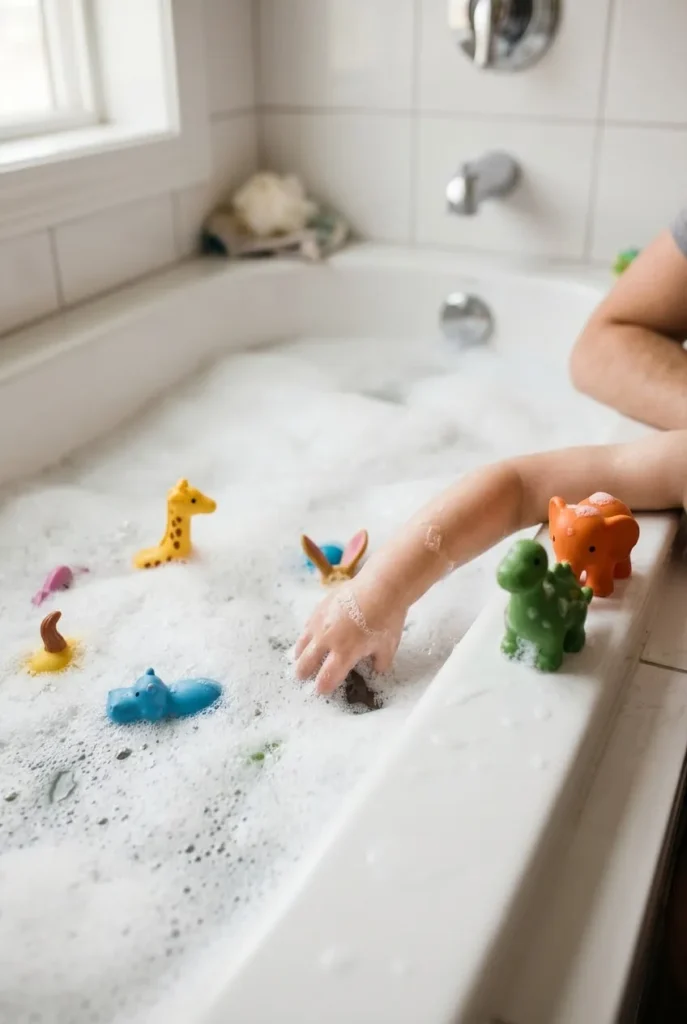
Hide six waterproof animals inside a mound of soap foam and ask your child to find them. The foam hides things completely, so this is a genuine search rather than a pretend one.
Reaching into a texture you cannot see through takes a bit of nerve, and finding something hidden is reliably exciting for a two year old. Counting them out as they appear gives you some easy number language without making it a lesson.
Keep the animals large and solid, with no small parts. Count them back out at the end so nothing is left to block the drain, and rinse the foam away rather than letting it sit.
24. Foam Letters and Numbers
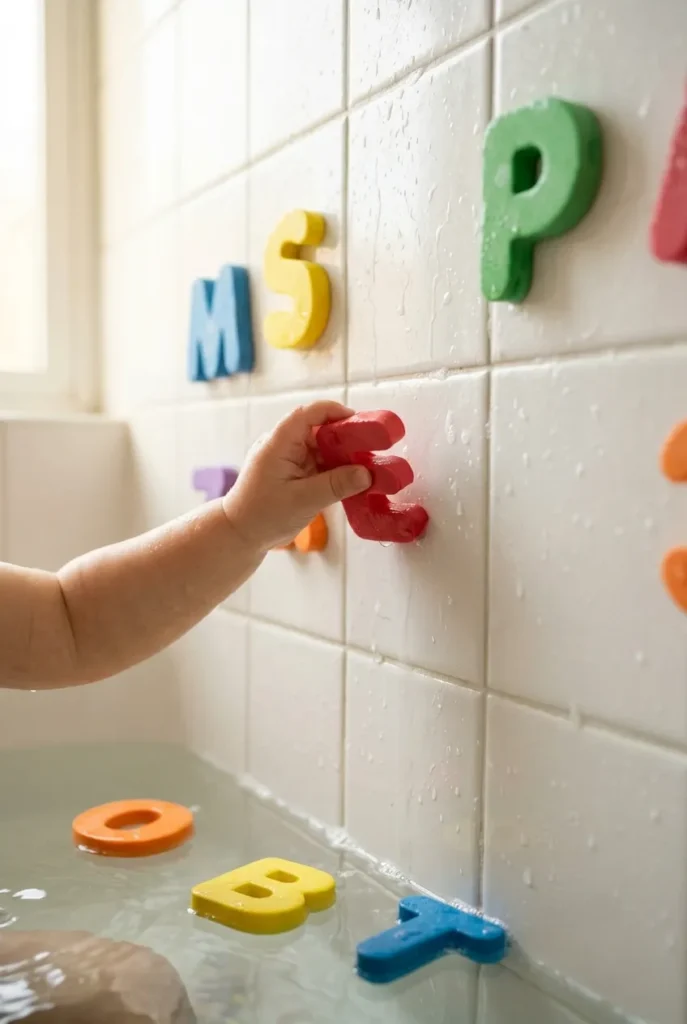
Foam letters are on every bath toy list, and they are better than they get credit for, as long as nobody turns them into a quiz. Wet them and they stick to the tile, which makes them sorting pieces, stacking pieces, and things to peel off a wall.
At 1 to 2 the appeal is entirely physical: press on, pull off, repeat. By three, a child may pick out the first letter of their name if it is pointed out casually once or twice. Hearing letter names in passing is the realistic goal here, not reading.
Squeeze the water out of each piece after the bath, since enclosed foam letters can hold water and grow mould inside. Bin any that look discoloured.
✓ Spread them out to dry, do not bag them wet
✓ Check monthly for dark spots inside
✓ Throw away any that are discoloured or torn
25. Warm Towel Wrap Wind-Down
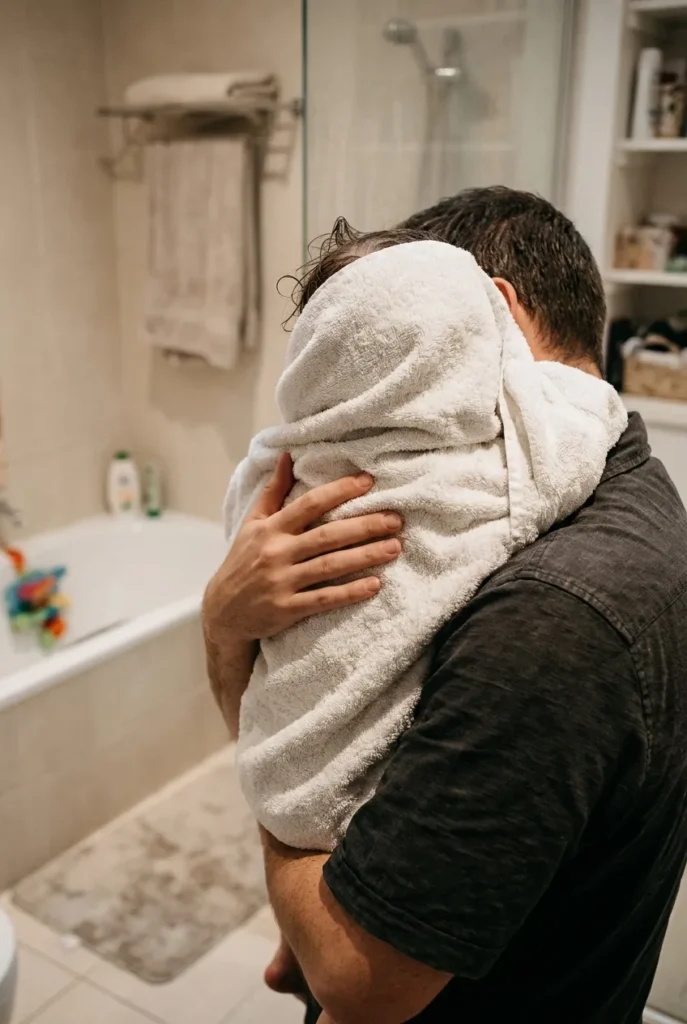
The bath does not really end when the water drains, and the last two minutes shape how the rest of the evening goes. Warm a towel on a radiator or in the dryer for a few minutes, wrap your child firmly, and sit with them before moving on to pyjamas.
Deep, even pressure and warmth help many toddlers settle after a stimulating bath, and it builds a predictable ending into the routine, which tends to reduce the fight about getting out. A slow count or a short, quiet song gives the moment a shape.
Check the towel is warm rather than hot against your own wrist first, and keep the wrap snug but never tight around the chest or face.
Common Questions About Bath Play
How long should bath play last for a 1 to 3 year old?
Ten to twenty minutes suits most toddlers, and shorter is fine. Watch the water temperature rather than the clock, since it cools faster than you expect, and get them out once it does or once skin starts to wrinkle noticeably.
Is it safe to do sensory play in the bath every night?
Water play itself is fine nightly, but soaps, fizzing mixtures, and bath paints are not. Frequent soaping can dry young skin, so keep most baths plain and save the soap-based ideas for two or three nights a week.
My toddler hates bath time. Where should I start?
Begin with the calm end of this list rather than the exciting end. Low light, plain water, and one familiar cup. Resistance is often about too much happening at once, not too little.
At what age can a toddler be left alone in the bath?
Not at 1 to 3. Children this age need an adult within arm’s reach for the entire bath, every time, without exception.
Pick One and Keep the Rest for a Hard Evening
You do not need twenty-five ideas tonight. You need one, and the one that works will usually be whichever takes the least preparation at the point in the evening when you have the least patience left.
Start with something from your kitchen: a jug, a funnel, and three cups will carry a bath on their own. Add foam or colour when you want it to feel like more. Keep a basket beside the tub so the decision takes seconds, and keep the plain-water nights in the rotation so skin and routine both get a break.
Bath time sensory play earns its place because it fits into something you are already doing. Save this list for the evening when the bath feels like one task too many, and come back to it when you need a fresh idea. Our guide to sensory play safety for toddlers is worth a read before you try the soap and fizzing ideas.
| If tonight is… | Go to | Prep |
|---|---|---|
| Zero energy | #5 Ice cubes, #7 Pouring station | Seconds |
| An overtired child | #22 Low light, #25 Towel wrap | None |
| A long bath needed | #6 Frozen rescue, #15 Car wash | Night before, or 1 min |
| A texture day | #2 Foam, #13 Goop tray | 2 to 3 min |
| Bath time resistance | #1 Colour water, #14 Doll washing | 1 min |