
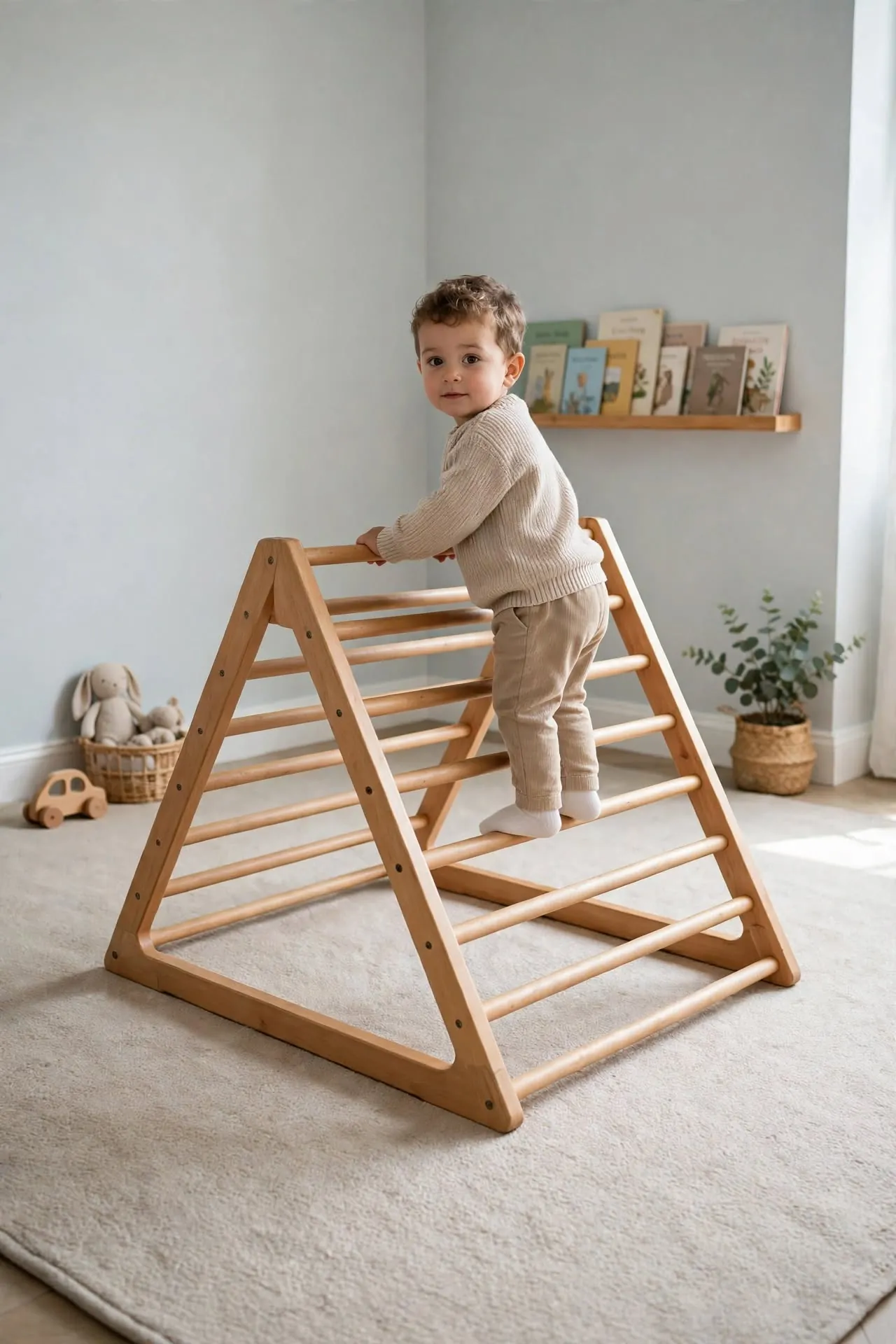
Most climbing setups you find online were built for a 7-year-old. That’s the problem. A parent of a 20-month-old scrolls through lofted beds and ceiling-mounted monkey bars, saves three photos, and still has no idea which ones her child can actually use.
So I’ve sorted these by age and by room instead of by looks. An indoor jungle gym playroom ideas can work in a rented apartment, a shared bedroom, a basement, or a four-foot strip of hallway. It just won’t be the same setup in each one.
Fifteen years of watching kids climb taught me one thing: a confident two-foot climb beats a nervous four-foot one every time. Height is not the goal. Repetition is.
Each idea below tells you who it suits, roughly how much space it needs, and whether it requires drilling. Nine of the twenty need no holes in your walls at all.
Start with the picker, then jump to the number that matches your room.
Table of Contents
How to Pick the Right Setup for Your Room and Your Child’s Age
Three questions settle it faster than scrolling.
How old is your climber? Under two, keep everything at floor level. Two to three, a low triangle or ramp. Four to six, hanging and traversing become possible.
Can you drill? Renters, skip to ideas 3 through 9. Everything there is freestanding, tension-mounted, or removable.
What’s your ceiling height? Under eight feet rules out most swings and hanging bars. Idea 18 is built for that.
If you have a one-year-old and a five-year-old sharing the space, split it. Give the baby a floor zone with a visible edge, like a rug or a line of foam mats, and put the older child’s equipment past it. Mixed-age setups fail when both kids use the same landing area.
Start Here: Which Setup Fits You?
If your child is 1 to 2
Keep everything at floor level. Go to ideas 1, 2, 6 and 13.
If you rent
No drilling needed in ideas 3, 4, 5, 6, 7 and 9.
If space is tight
Ideas 7, 8, 9, 18 and 19 fit corridors, closets and aisles.
If you have a whole room
Ideas 10 through 17 need real floor area and height.
Mixed ages? Give each child a separate landing area. Shared mats are where collisions happen.
1. Floor-Level Soft Block Course (Ages 1 to 2)
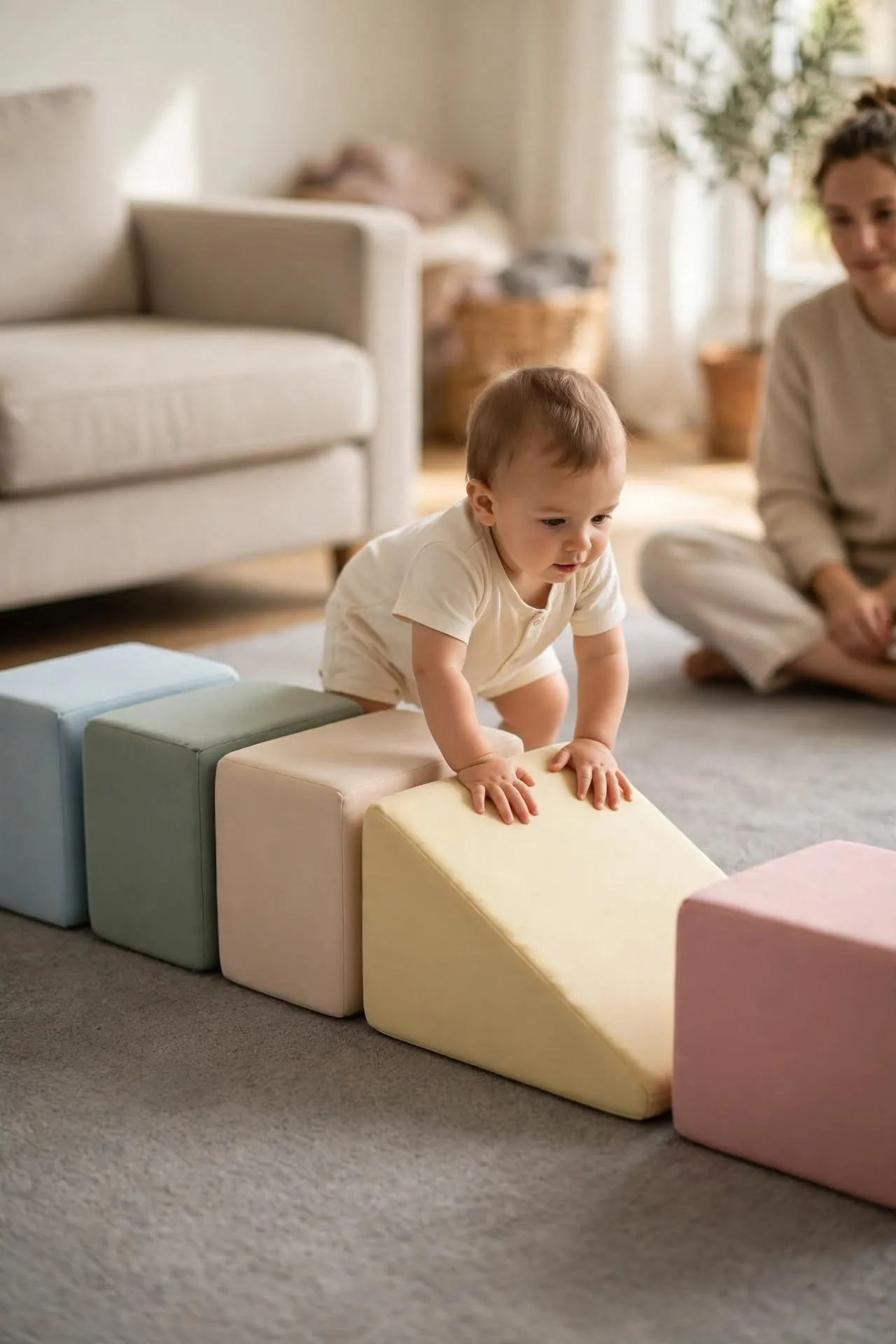
New walkers need something to climb over, not up.
Four or five large foam blocks in a loose line give a one-year-old a low step, a wedge to crawl up, and a flat top to stand on. Nothing is more than a few inches off the floor, so a tumble is a sit-down, not a fall.
Rearrange the blocks every few days. Same pieces, new puzzle, and interest comes back.
Keep the line away from radiators, door swings, and furniture corners. The blocks slide on hard floors, so a thin rug underneath helps them stay put.
Gather These
- 4 to 5 large foam blocks, at least one wedge shape
- One non-slip rug or 4 interlocking floor mats
- A clear corner with no furniture edges within arm’s reach
- Nothing else. Resist adding height
2. Low Climbing Triangle in a Corner (Ages 1 to 3)
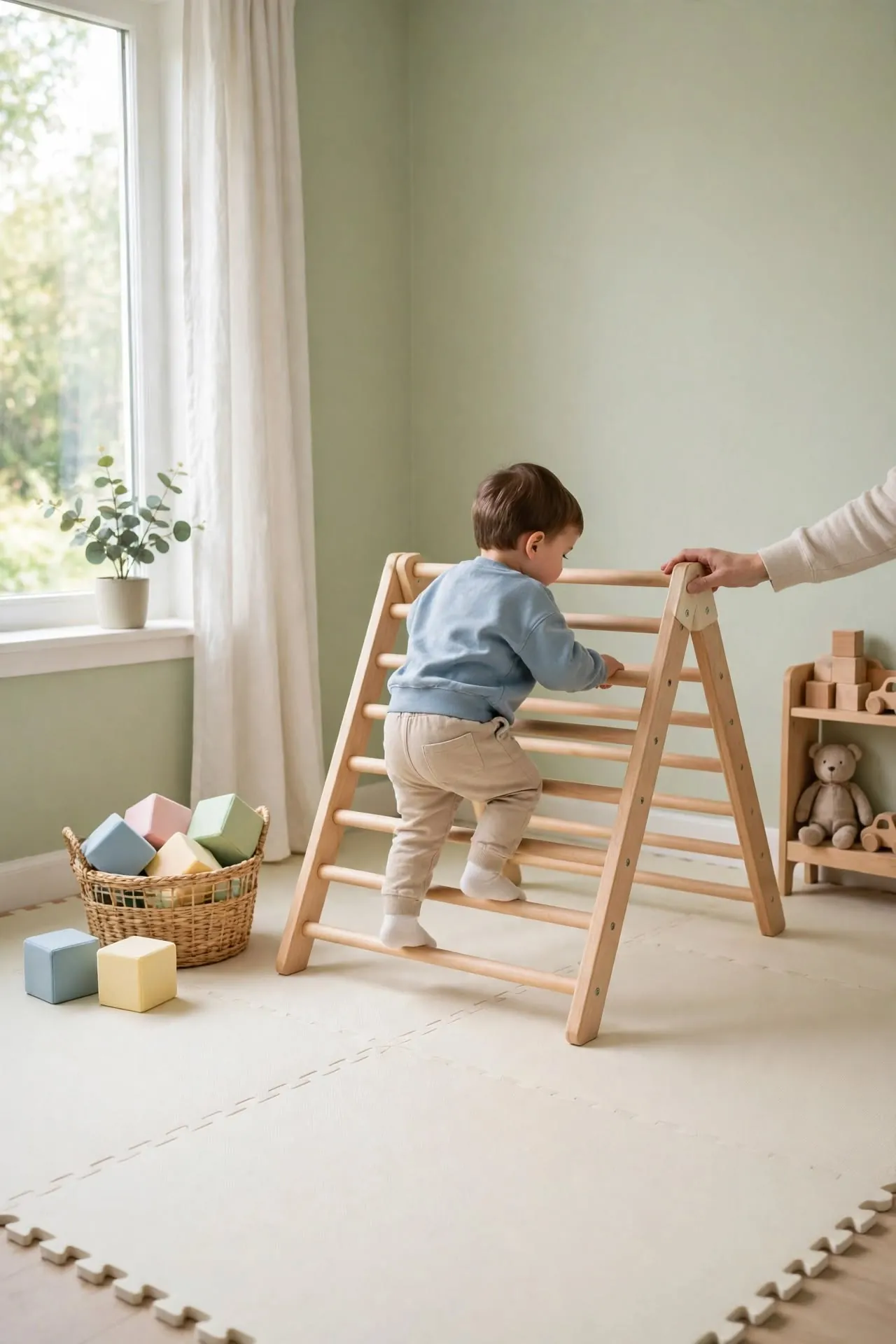
The folding wooden triangle is the single most useful piece for this age, and it takes up about the footprint of a laundry basket when closed.
Set it in a corner with the open sides facing into the room. Add a thick rug or two interlocking mats across the whole area a child could land in, not just directly underneath.
For toddlers, playground guidance puts the maximum fall height for free-standing climbing structures at 32 inches, which most of these triangles fall under at their lowest setting. Start there even if the frame allows higher. open-exam-prep
3. Tension-Mounted Doorway Bar (No Drilling)
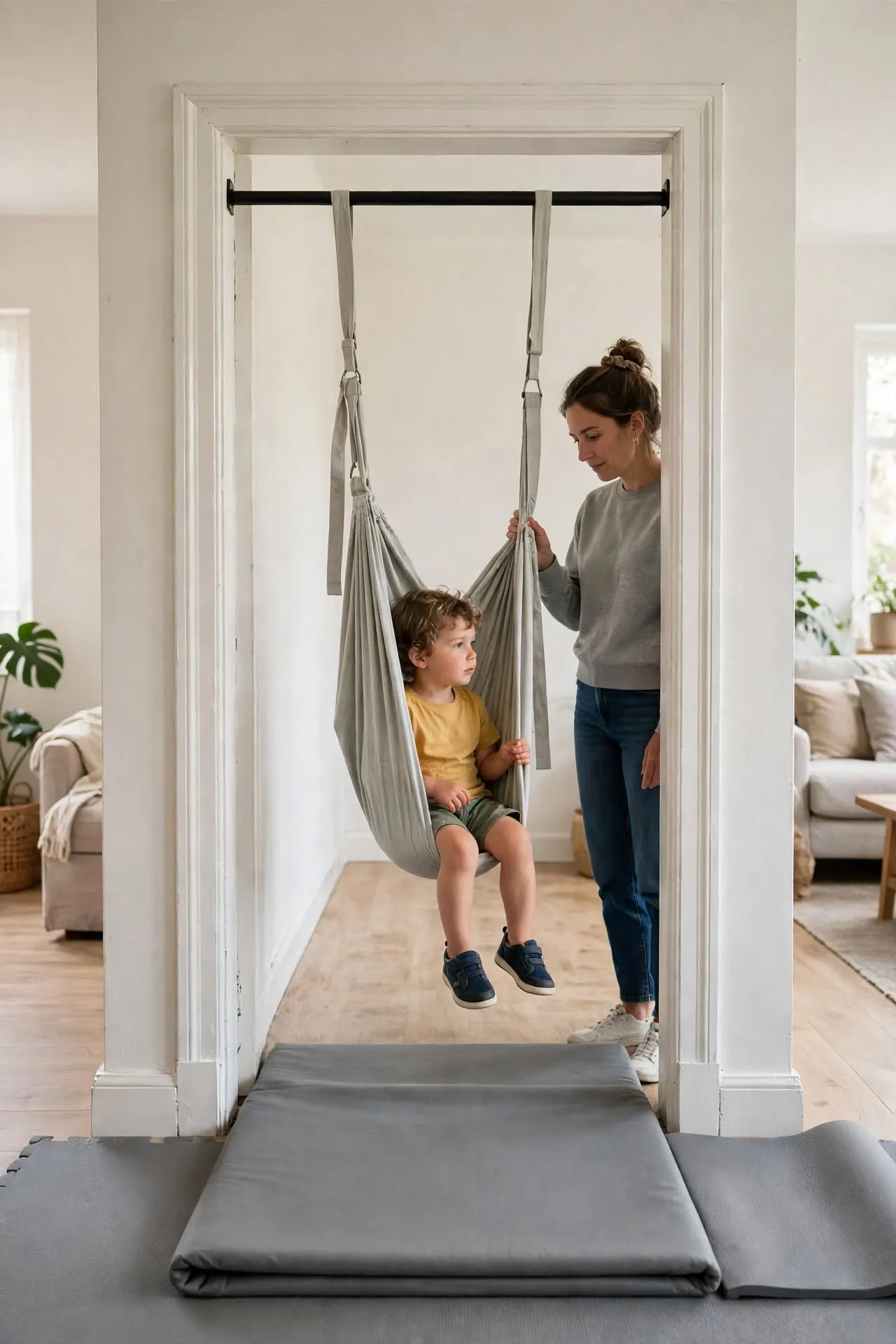
Renters get told to anchor into studs in almost every climbing guide, which is useless advice if your lease forbids it.
A doorway pull-up bar that tightens against the frame, paired with a removable fabric swing or a set of rings, gives a three-plus-year-old something to hang from with no hardware in the wall.
Test it with your own full body weight before a child touches it, every single time you reinstall it.
Avoid this one if your door frame is hollow, trimmed in thin molding, or already loose. A bar that shifts under load is worse than no bar.
Do this
Hang from it yourself before every use. Mount it in a solid hardwood frame. Put a mat underneath even for hanging.
Avoid this
Hollow or thinly trimmed frames. Leaving it installed unsupervised. Adding a swing to a bar meant for hanging.
4. Freestanding A-Frame with Reversible Ramp (Renters)
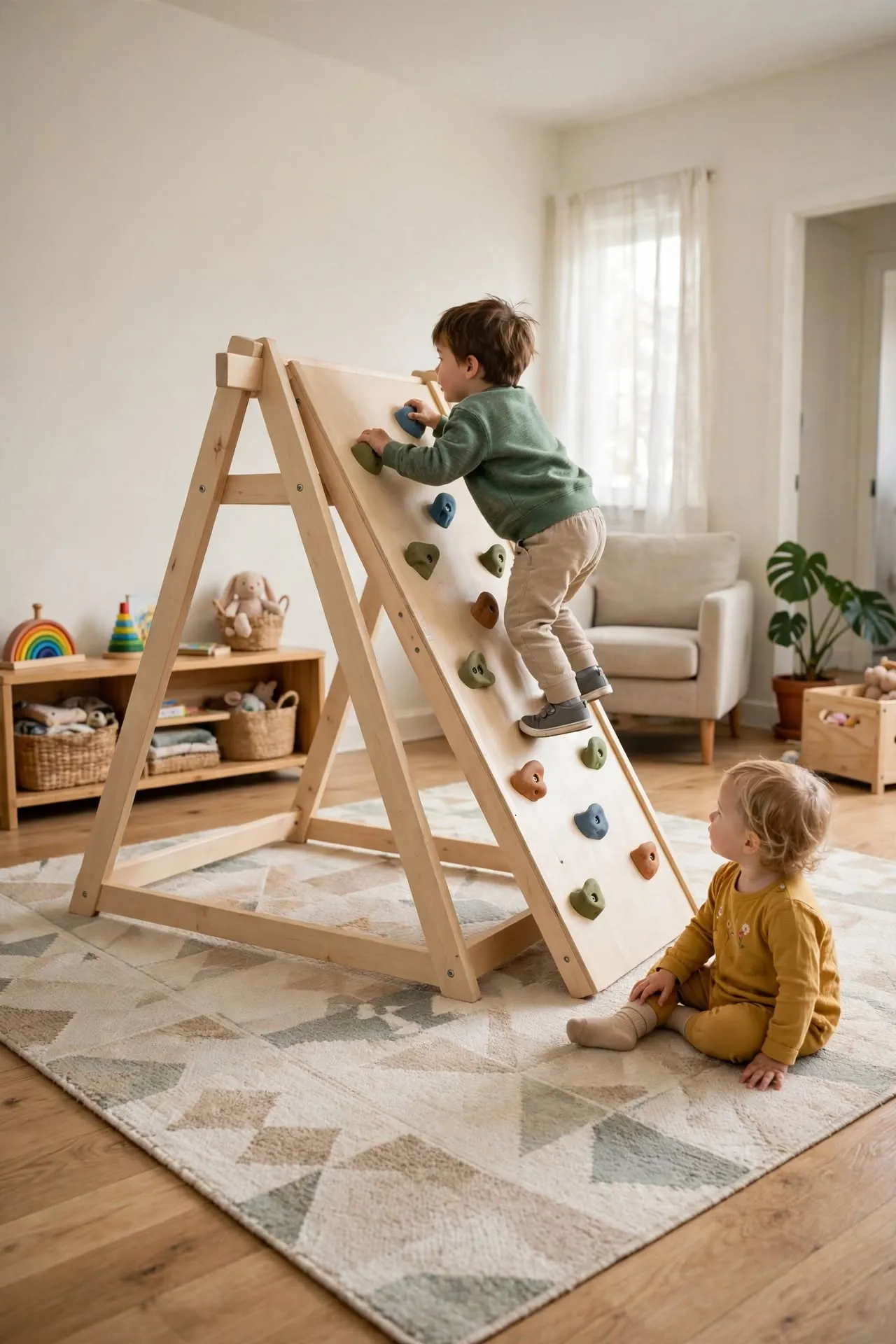
Here’s the appeal: nothing attaches to anything. The frame carries its own load, and you can move the whole thing to vacuum.
Most A-frames come with a ramp that flips between a smooth slide side and a rock-hold climbing side, which quietly doubles the lifespan as your child grows.
Before the first use, push hard on the top rail from each side. If it rocks or walks across the floor, it needs a wider stance or a grippier rug.
Check the listed weight limit against the heaviest kid who will realistically pile on, including an older sibling.
The 4-Point Tip Test for Any Freestanding Frame
1
Push the top rail hard from all four sides. No rocking.
2
Hang your weight off one corner. The feet should stay down.
3
Check the weight limit against your heaviest likely climber.
4
Re-test monthly. Bolts loosen as children use it.
5. Mattress Crash Corner That Packs Away by Dinner
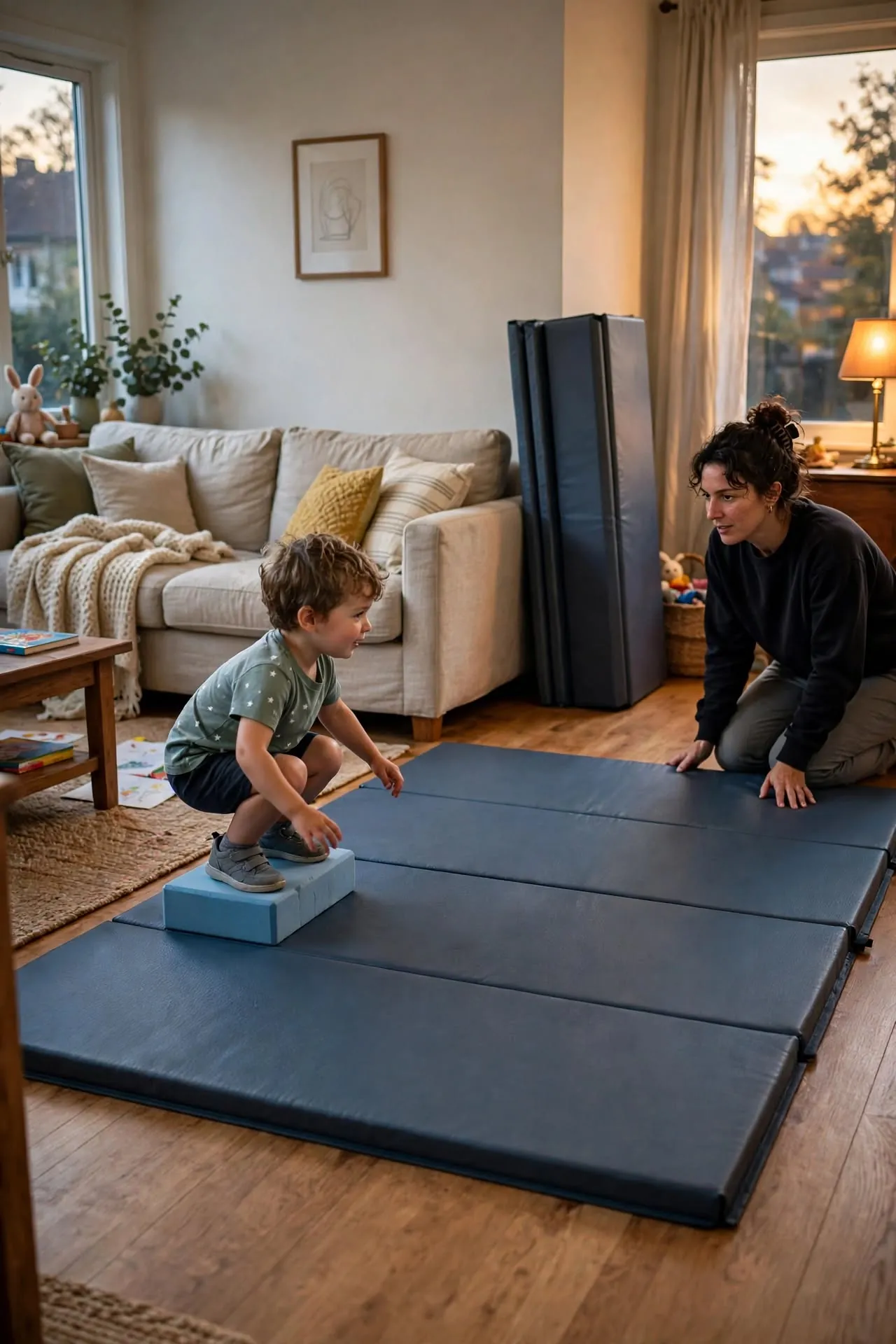
Not every family has a room they can leave set up. If your play space is also your living room, the setup has to disappear.
A folding gym mat or a spare twin mattress stood against the wall during the day, laid flat for an hour of jumping, covers most of what a toddler wants from a crash pad.
Pair it with two foam blocks to jump from. No higher.
Teach one rule from the start: jumping happens onto the mat, never off the couch toward it.
Clear It in Under Two Minutes
- Blocks go back into the basket by the wall
- Mat folds in thirds and stands behind the sofa
- Rug gets a quick shake and goes back flat
- Child does step one. Make it part of the game
6. Peel-and-Stick Climb Path (No Holes in the Wall)
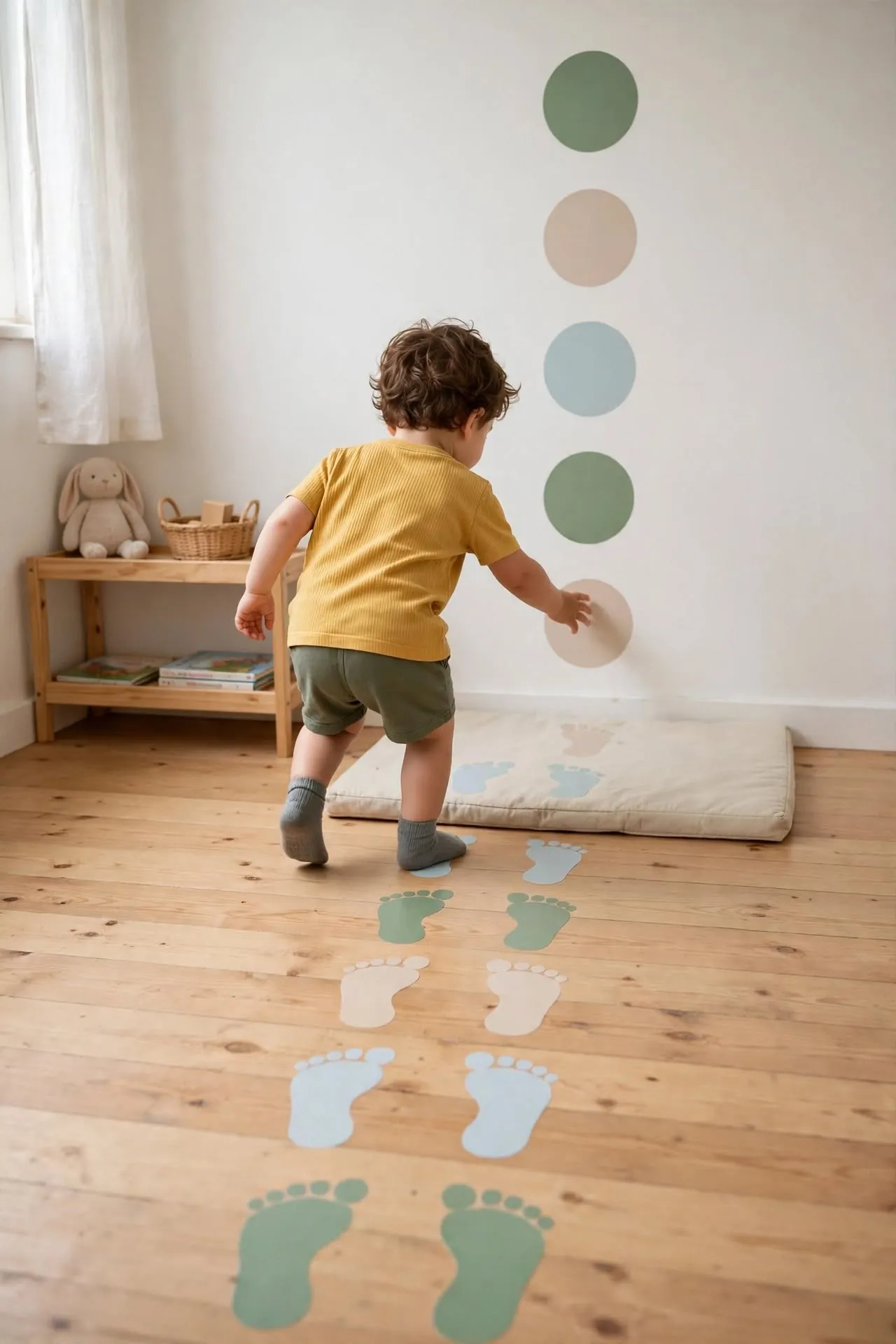
This is the cheapest idea on the list and the one most parents skip.
Removable wall decals at hand height plus footprint shapes on the floor create a route a two-to-four-year-old follows on their own feet, with no equipment and no load-bearing anything. Stepping stones, a taped balance line, a wall of flat shapes to touch in order.
It builds the habit of moving in a defined zone, which pays off later when you do add real equipment.
Test one decal in a hidden spot first. Some peel paint on older walls.
7. Under-Window Balance Line (Narrow Floor Strip)

Long thin spaces are usually written off, but they suit balance work better than open rooms do.
A low wooden beam, two inches off the floor, with a few river-stone style domes leading up to it, fits a strip of floor under a window where nothing else will go.
Leave clear floor on both sides, and keep it well away from the window itself. Blind cords are a strangulation risk, so tie them up high and out of reach before you put anything a child climbs underneath them.
Lower the challenge by having them hold your hand along the beam.
Make It Easier or Harder
Easier: hold one hand, or swap the beam for a taped line on the floor first.
Harder: space the stepping domes slightly further apart, or ask them to carry a soft toy across.
8. Closet Converted to a Climb Nook (Tiny Bedrooms)
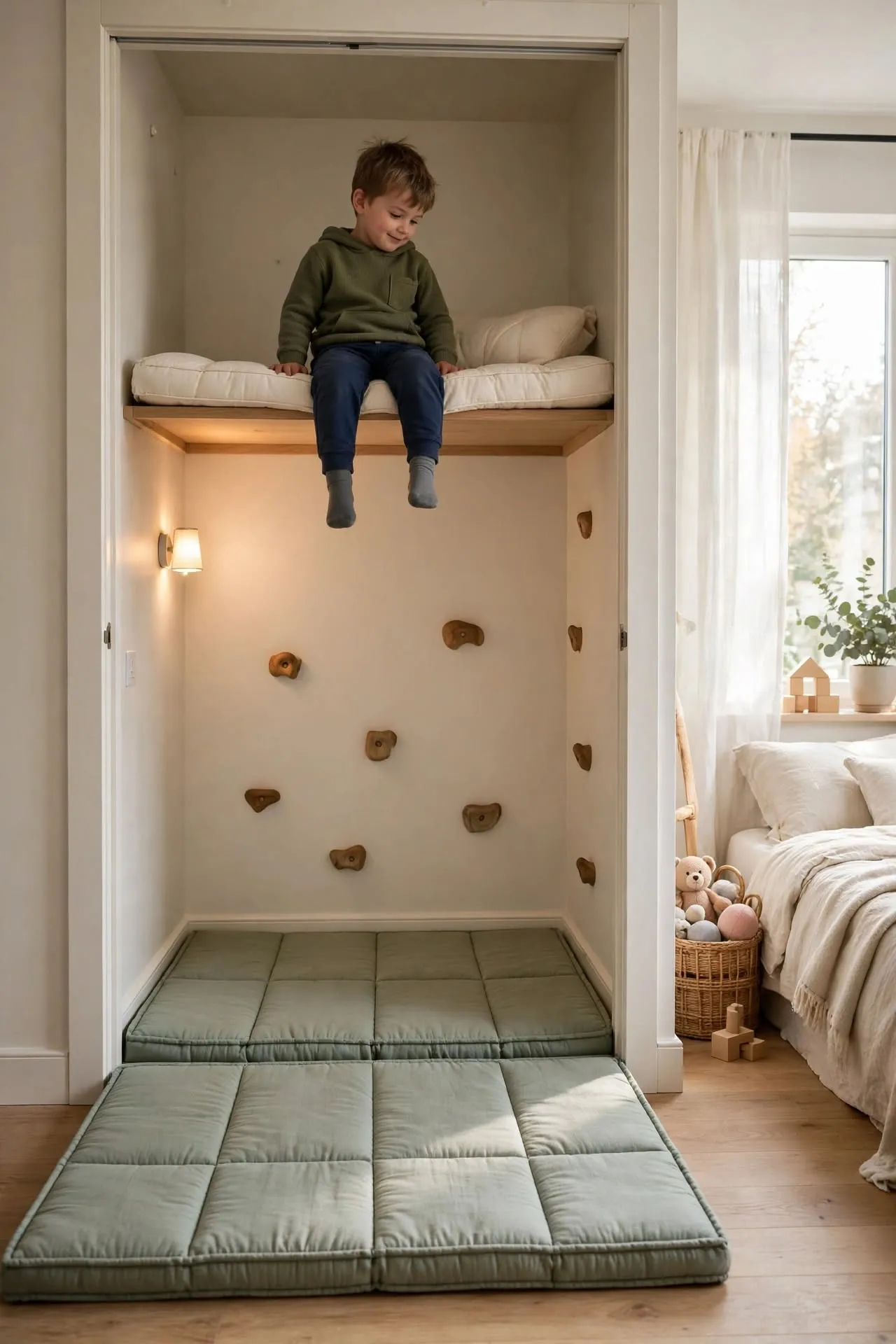
Take the doors and the clothes rod off a reach-in closet and you have a contained, three-walled play bay roughly three feet deep.
Low holds on the back wall, a mat on the floor, a small cushion shelf at the top to sit on. The side walls do the work a guardrail would do in an open room.
Keep the top surface low. For ages 2 to 5, playground guidance limits an elevated surface without guardrails to about 20 inches, and about 30 inches where a barrier surrounds it. open-exam-prep
Light it properly. A dark nook gets abandoned.
Closet Nook, Zone by Zone
Back wall
Low holds only, anchored into studs. Lowest hold within easy reach from the floor.
Floor
Mat wall to wall, plus one mat extending out past the opening.
Top perch
A sitting cushion, kept low. Side walls act as the barrier an open room would need.
Add a plug-in light or a stick-on battery light. Kids abandon a dark nook.
9. Shared Bedroom Movement Strip Between Two Beds
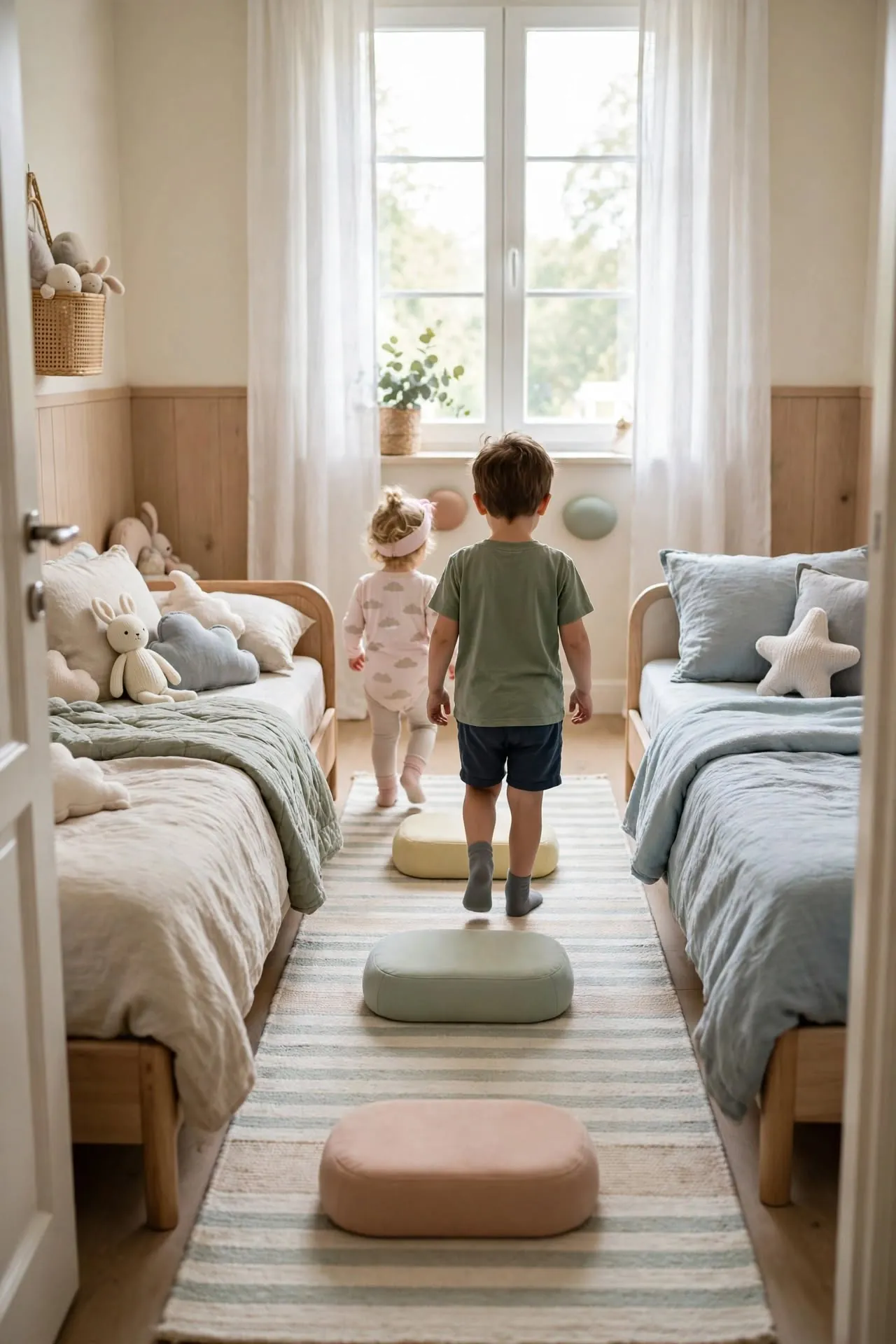
Siblings sharing a room usually have one usable rectangle of floor, and it’s the aisle.
A runner rug, a line of low foam steps, and two wall-mounted holds at each end turn that aisle into a there-and-back course. No equipment sits where either child walks at night.
Everything here needs to be low and soft, because this strip gets crossed in the dark half-asleep.
Nothing with a hard edge, nothing left out overnight, nothing taller than the bed frames.
Shared Bedrooms: Nothing Stays Out
This strip of floor gets crossed at night by a half-asleep child heading for the door. Everything soft, everything low, and everything packed away before lights out. Anchor both dressers to the wall while you are in there.
10. Full-Wall Climbing Panel with a Measured Fall Zone (Ages 3 to 6)
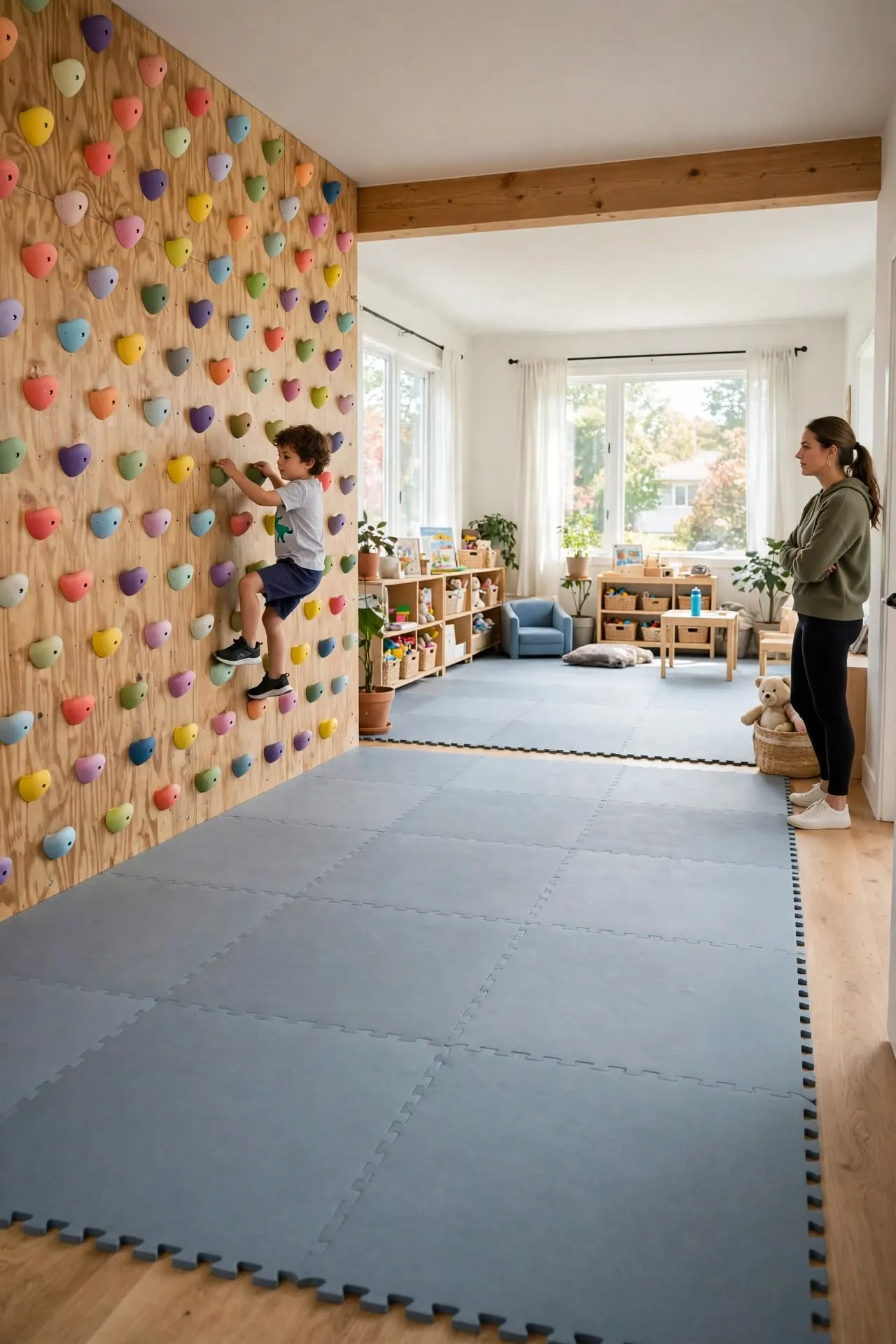
If you own your walls, this is the setup worth doing properly.
A plywood panel of holds across one wall, anchored into studs, gives years of use and reads as part of the room rather than equipment parked in it.
The part most guides leave out is the floor. CPSC guidance for playground equipment calls for protective surfacing extending at least six feet in all directions from the equipment. In a bedroom you may not have six feet, and that is a real reason to keep the holds low rather than to skip the mats. cpsc
Mount the top row of holds so the highest standing point stays modest. Height can come later.
11. Low Monkey Bar Frame at Child Height (Ages 4 to 6)
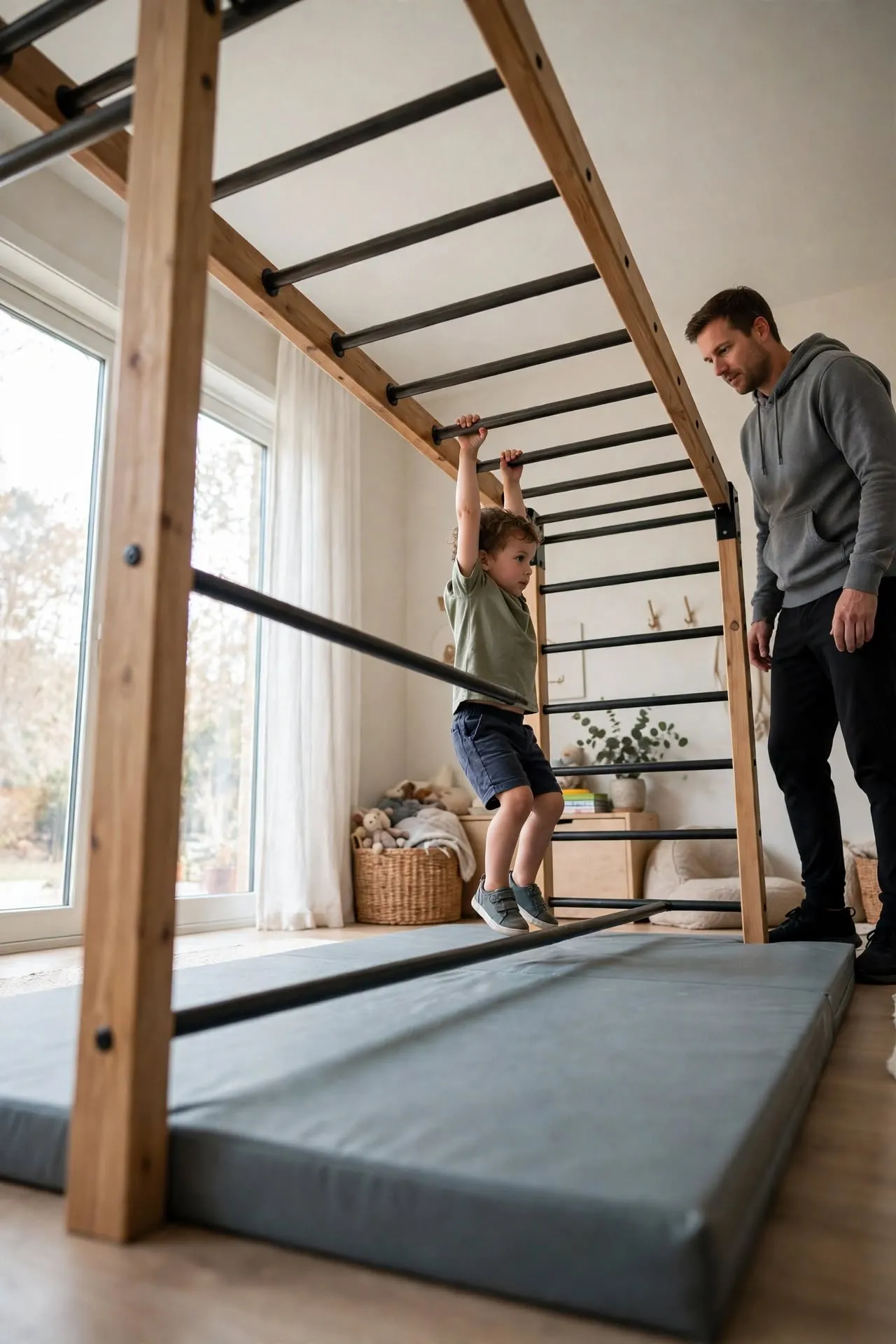
Hanging is a four-plus skill, and most home setups hang the bars too high for the child who needs them.
A freestanding frame where your child can reach the first rung with feet still touching the floor lets them practice dropping safely before they practice swinging.
Playground guidance puts the maximum grasping height for preschool-age children at around 60 inches, with rungs no more than 12 inches apart and adjacent rungs more than 9 inches apart so a head cannot get caught between them. open-exam-prep
One firm rule: CPSC advises removing swings and other suspended parts attached to monkey bars, because a child can be hurt falling from the bars onto them. Bars or a swing. Not both on one frame. cpsc
| Signs they are ready to hang | Signs to wait |
|---|---|
| Can reach the first rung with feet on the floor | Needs lifting up to reach it |
| Lets go and lands on their feet on purpose | Hangs on until their grip fails |
| Usually around age 4 and up | Under 4, stick to climbing and balance |
12. Slide and Platform Matched to One Landing Mat (Ages 2 to 5)
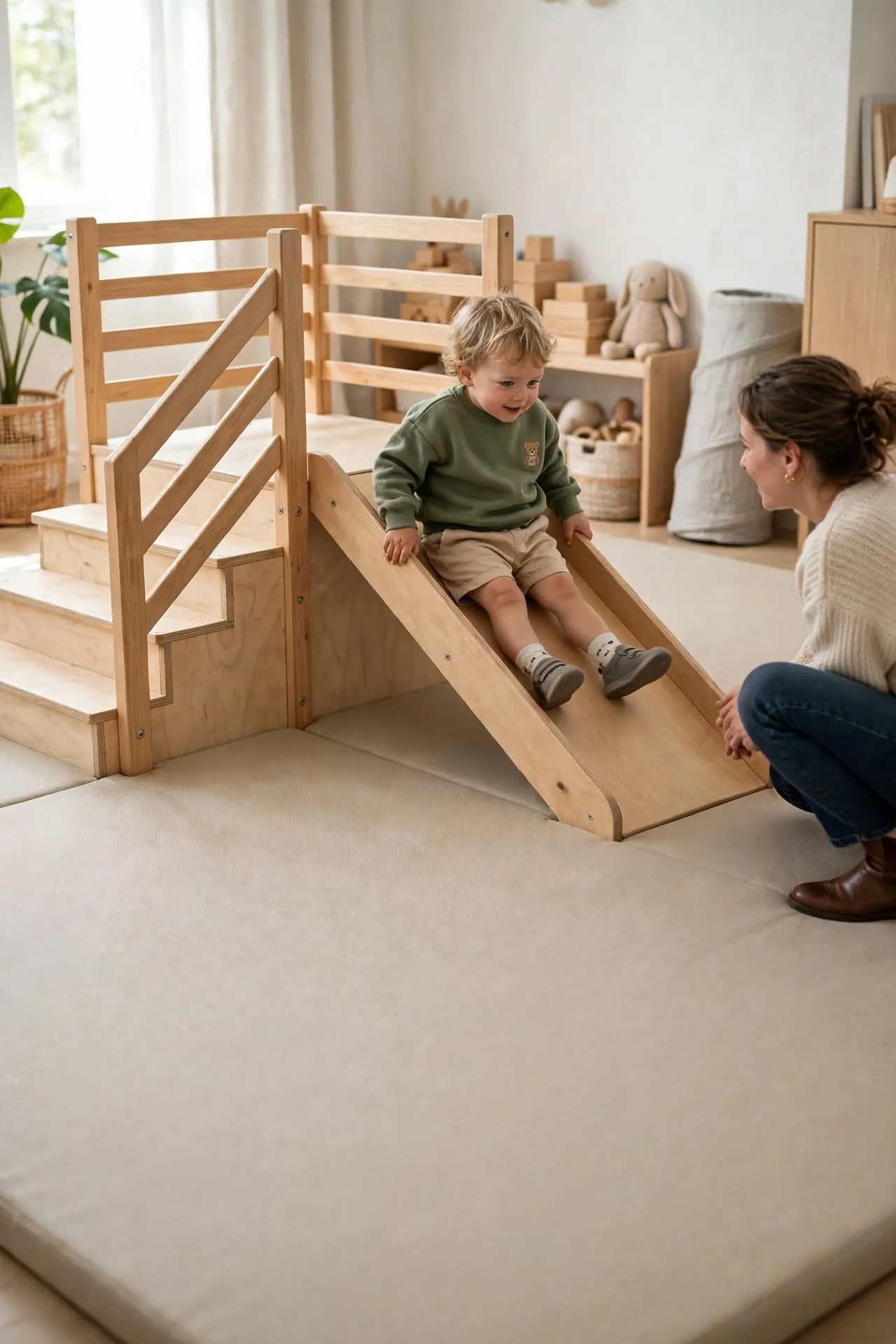
The common mistake is buying a slide and a platform separately, then discovering the slide exit sits six inches above the mat.
Measure the platform height first, buy or build the slide to match it, and then size one continuous mat that covers the full run-out at the bottom plus the area beside the steps.
A gap between mats is where ankles roll. One large mat beats three small ones every time.
Children under three do better on a slide they can climb without help from you.
Measure in this order
Platform height first. Slide second. Mat last.
13. Ball Pit with a Step-In Edge (Ages 1 to 4)
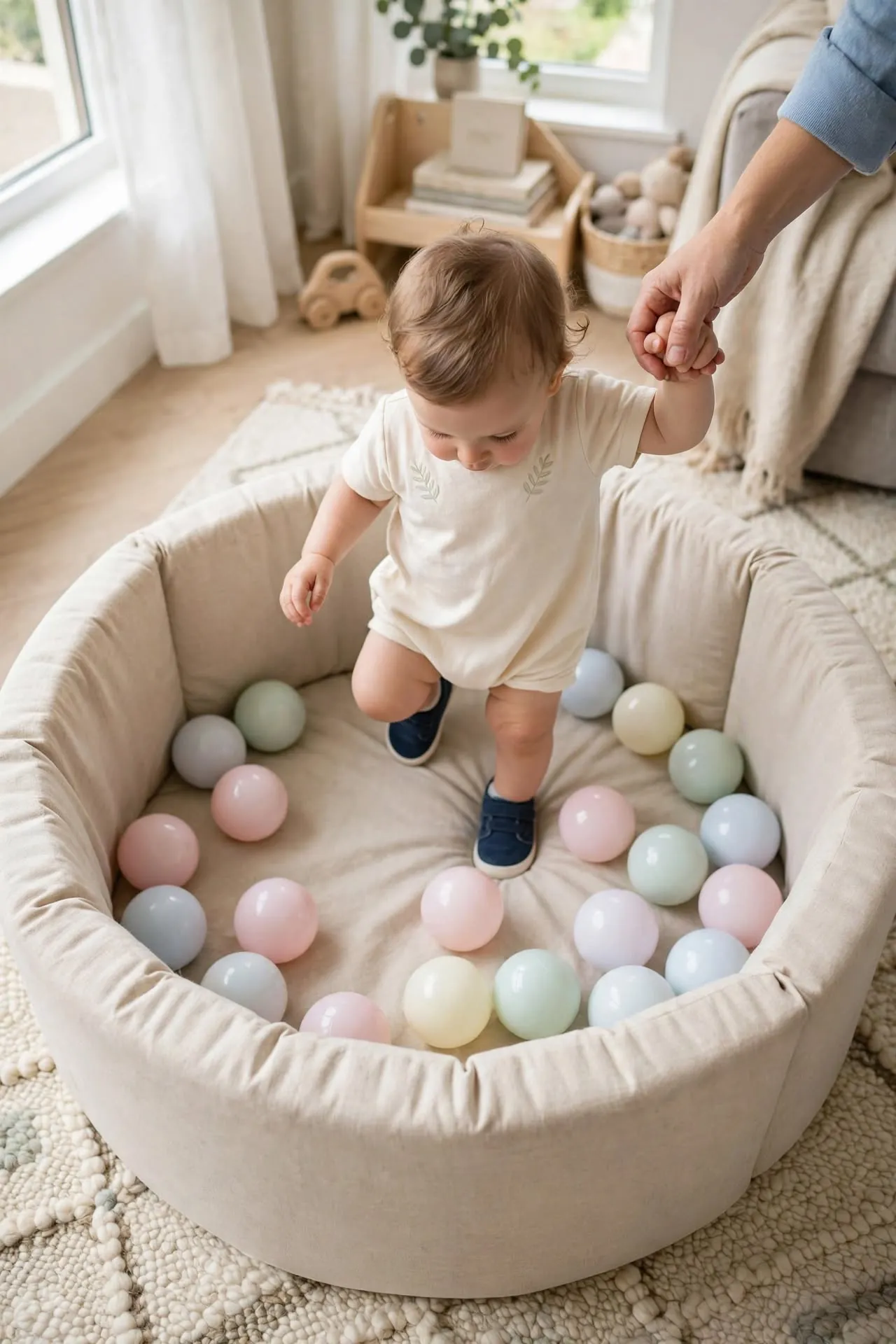
Most ball pit setups online show a slide dropping into the balls. I’d skip that.
Balls shift under a landing foot, so a child cannot judge the surface. A low-walled pit a child steps into deliberately gives the same sensory pleasure with none of the uncontrolled landing.
Use a pit small enough that you can see the floor through the balls. A deep pit hides a child’s position, and that matters more than it sounds with a one-year-old.
Count the balls back in at cleanup, and check sizes against your youngest child’s choking risk rather than the box’s age label.
Keep the Pit Shallow
If you can still see the floor through the balls, you can see where your child’s feet and hands are. With a child under three, check ball size against choking risk yourself instead of trusting the age printed on the box, and count them back in at cleanup.
14. Nest Swing with a Measured Swing Zone (Ages 2 to 6)
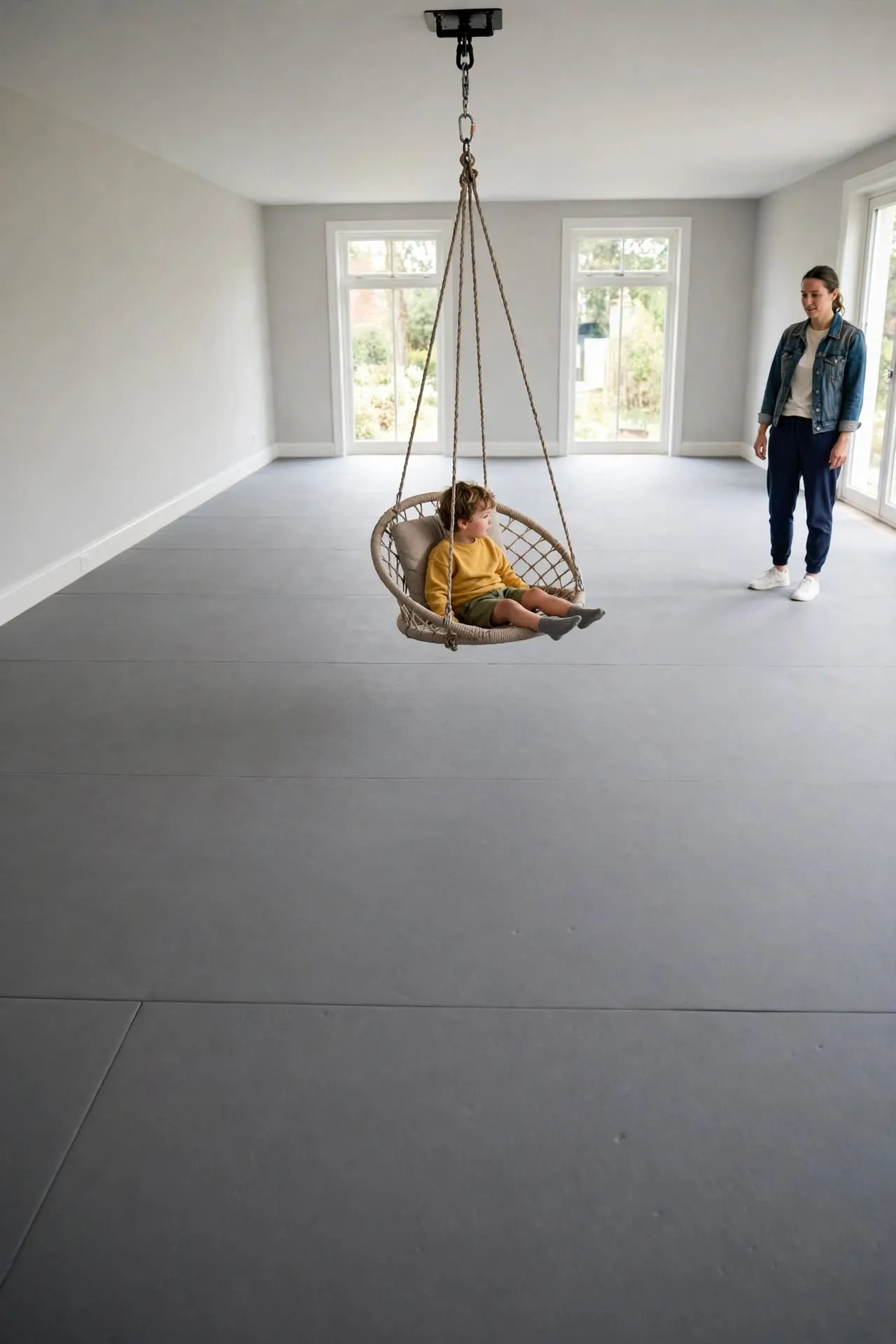
Swings need more clear floor than any other piece, and this is where indoor setups go wrong.
CPSC guidance says the protective surface under a swing should extend in front and behind it twice the height of the suspending bar. A bar eight feet up means roughly sixteen feet of clear, matted floor front to back. Few bedrooms have that. cpsc
If your room doesn’t, hang the swing lower or choose a different idea. Shortening the clear space is not a trade you can make safely.
Keep the sides clear too, and never hang a second swing close enough for two children to collide.
Swing Clearance: Do the Math Before You Buy
Playground guidance: padded floor should extend front and back twice the height of the bar the swing hangs from.
Bar at 7 ft
14 ft clear
Bar at 8 ft
16 ft clear
Bar at 9 ft
18 ft clear
No room for the full clearance? Hang it lower or pick another idea. Shrinking the zone is not a safe compromise.
15. Rope Net Wall Over a Crash Pad (Ages 4 to 6)
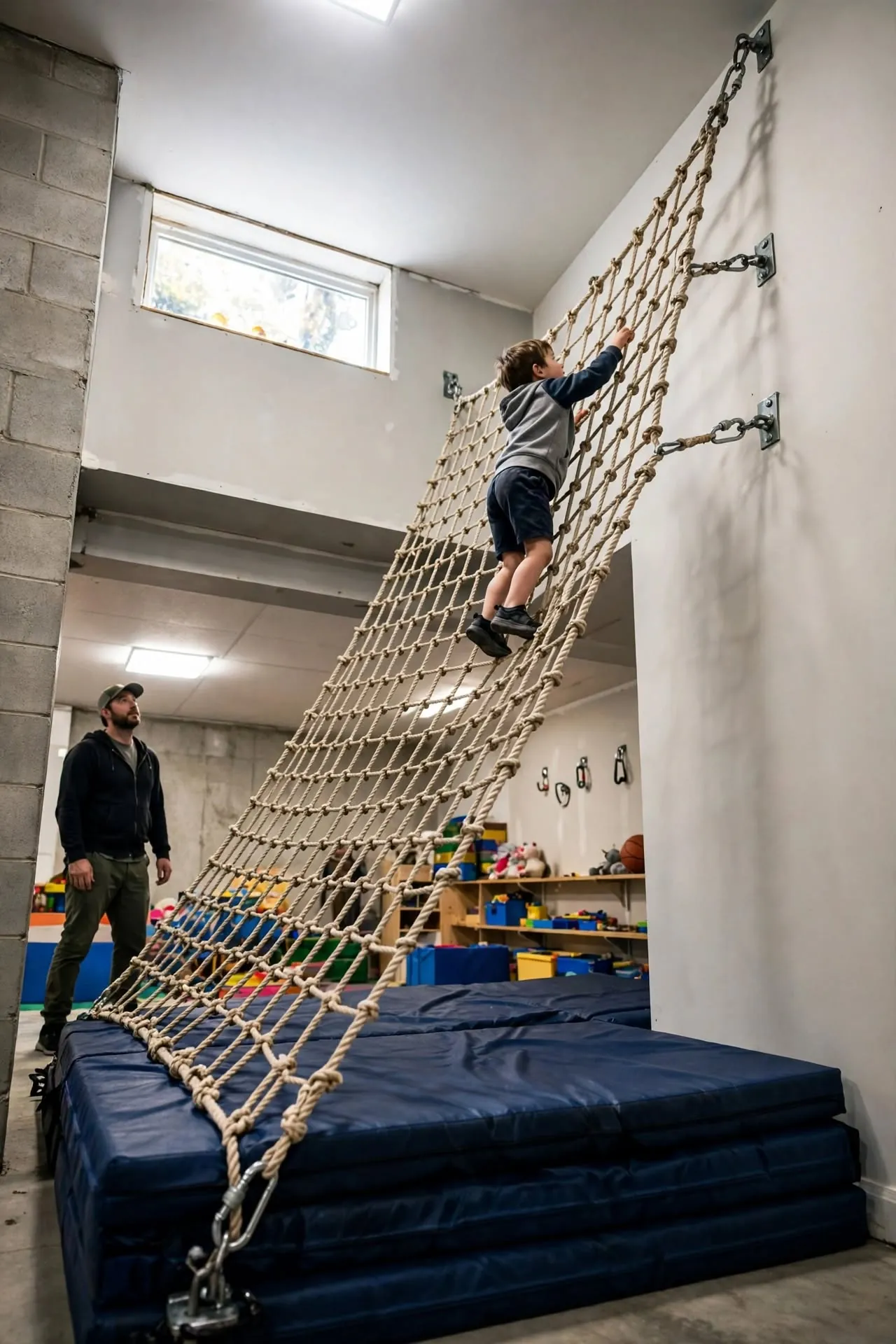
Rope climbs well for older kids because it flexes, which forces small corrections with every reach.
Stretch a net across a corner at an angle rather than flat against a wall, so there’s climbing room behind it, and put a thick crash pad across the entire floor beneath the span.
Check the net’s mesh size. Openings large enough for a head to pass through are the thing to rule out before you buy.
Retighten the anchors monthly. Rope stretches, and a sagging net changes the fall height you planned for.
Check Once a Month
- Rope tension. Stretch raises your real fall height
- Anchor bolts at both ends, tightened by hand
- Mesh openings. Rule out anything a head could pass through
- Crash pad position. It drifts as kids land on it
16. Basement Circuit with Zoned Flooring (Concrete Floors)
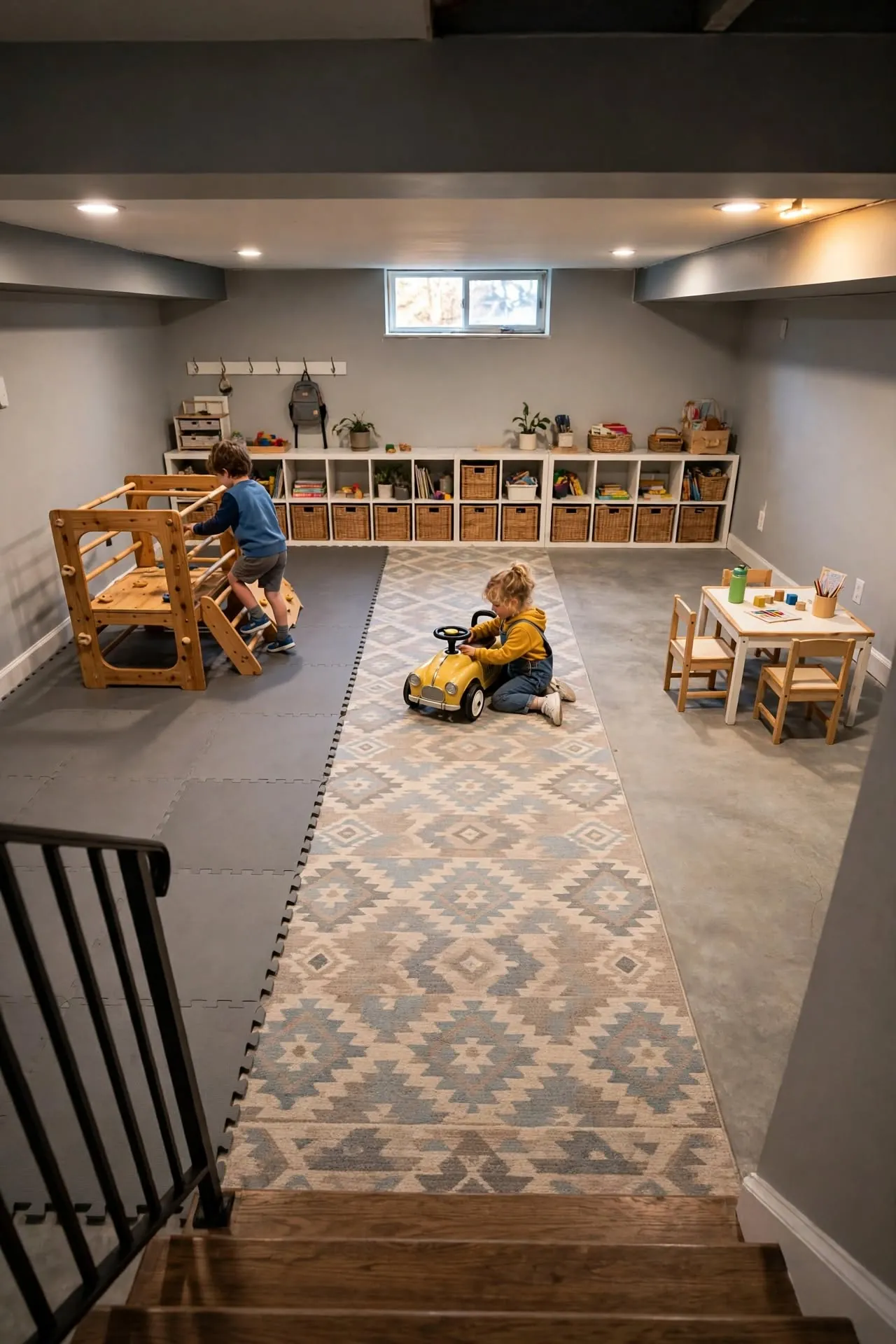
Concrete is the real constraint down here, not space.
Split the room into three visible zones with different flooring: thick interlocking foam under anything climbable, a low-pile rug for ride-on toys, and bare floor for a table. Kids read the floor change as a boundary without being told.
Damp is the other issue. Foam mats trap moisture against concrete, so lift and air them out every few weeks.
For more on making a lower level feel like somewhere kids want to be, these basement playroom ideas for kids ages 2 to 6 cover lighting and storage in detail.
Three Floors, Three Messages
Thick foam
Under everything climbable. Kids read it as the climbing zone without being told.
Low-pile rug
For ride-ons and floor play. Rolls better than foam, softer than concrete.
Bare floor
Table and snacks only. The one zone where climbing is not allowed.
Lift and air the foam every few weeks. Mats trap damp against concrete.
17. Garage Movement Bay for Cold Months
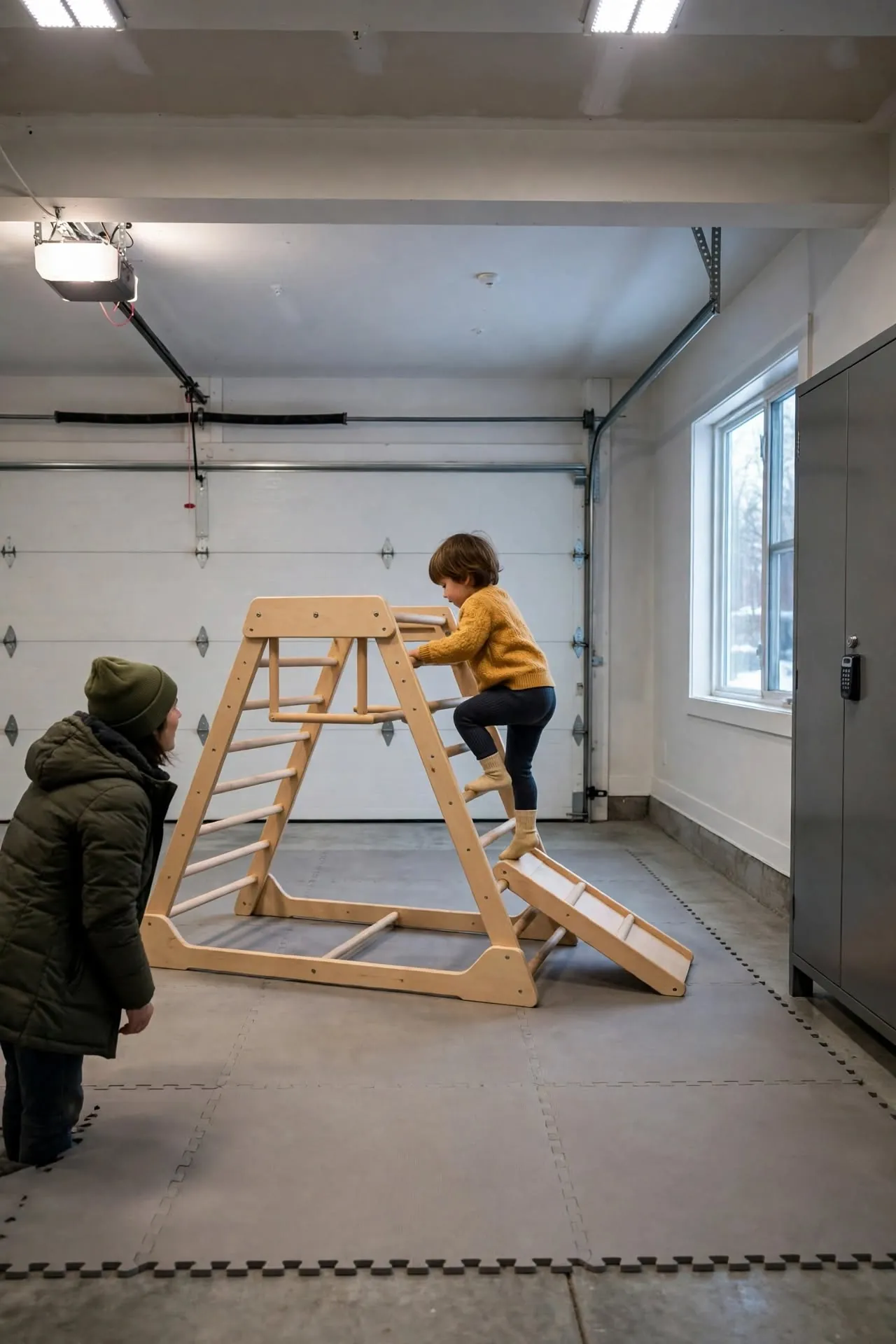
A garage buys you ceiling height most houses don’t have inside, and in winter it’s often the only place left.
Clear one bay, lay foam over the concrete, and keep the setup to one freestanding frame plus a mat so it can be pushed aside.
Things to settle before the first use:
- Temperature. Cold concrete and cold hands make for poor grip
- Everything on the walls. Tools, chemicals, cords, and sharp edges come down or get locked away
- The car. Play happens only when the vehicle is out and the door is shut
- Dust. Sweep before, not after
Before Anyone Plays in the Garage
- Car out, garage door down, opener out of reach
- Tools, chemicals and cords locked away or off the walls
- Floor swept, foam laid, no cold bare concrete
- Warm layers. Cold hands grip badly
18. Low-Ceiling Attic or Bonus Room Crawl Layout
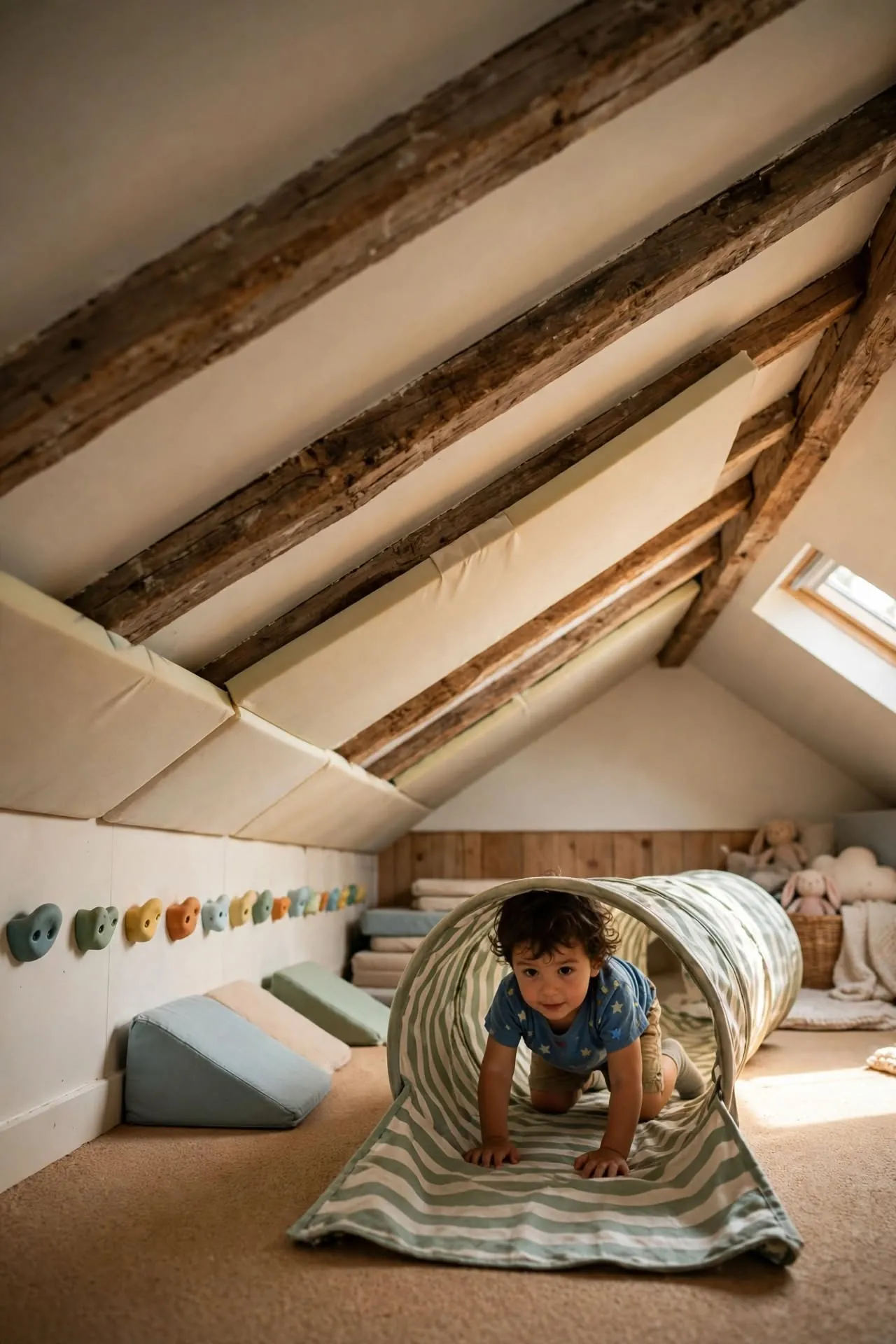
Under eight feet of headroom cancels swings and hanging bars. It does not cancel movement.
Build horizontally instead: a tunnel run, a low traverse of floor-level holds along one wall, cushions to roll over, a crawl-through arch. Children get the same physical workout moving across a space as up it.
Pad the low parts of the ceiling slope where a standing adult would hit their head, because that’s exactly where a jumping five-year-old will.
Attic floors can be bouncier than they look. Check what’s underneath before you let kids jump.
19. Hallway Traverse Wall at Knee Height (Narrow Spaces)
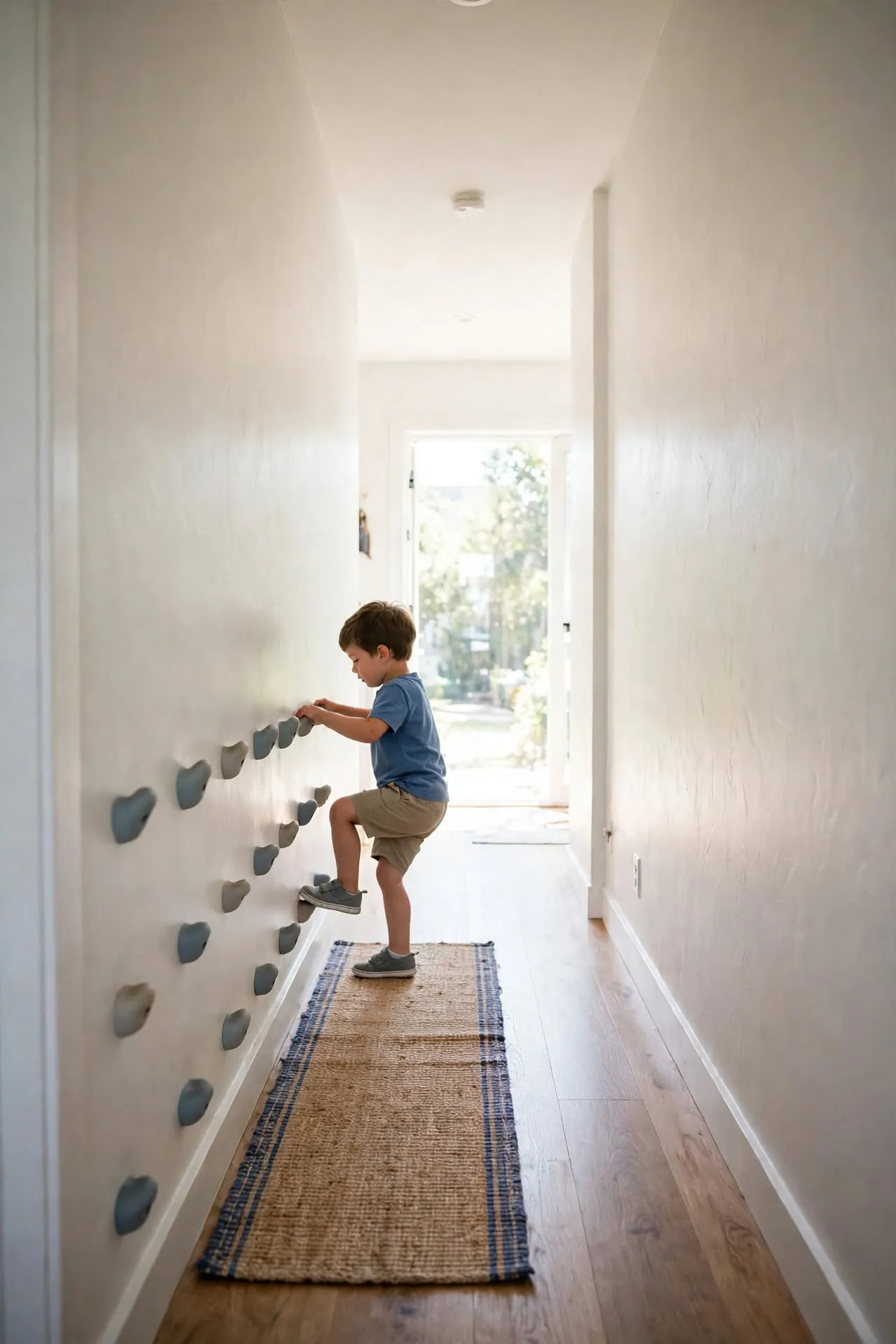
Hallways are the most overlooked square footage in any house.
A row of holds along one wall at knee-to-hip height turns a corridor into a sideways climbing route. Feet stay low, the child moves laterally, and nothing projects far enough to block the walkway.
Keep holds flush and rounded. A hallway gets walked through at speed by people who aren’t looking.
Don’t do this on a wall across from a stairwell or a doorway that opens inward.
Where Not to Put a Hallway Traverse
Skip any wall facing a stairwell, a bathroom door, or a door that opens inward. Keep holds flush and rounded, because this is a space adults walk through fast without looking down.
20. Calm-Down Corner Beside the Gym (All Ages)

This is the piece almost every climbing setup is missing, and the one I’d add first.
Hard physical play winds kids up before it winds them down. A small corner right beside the equipment, with a floor cushion, a basket of books, and lower light, gives a child somewhere to go when their body is done but the room is still loud.
Keep it within sight of the gym, not in another room. A child who has to leave the fun to calm down usually won’t.
Pair it with a few quiet, mess-free indoor activities for the days when a reset is needed mid-afternoon.
What Goes in a Calm-Down Corner
Four things, within sight of the climbing zone.
Soft floor seat
One cushion or a small floor pouf
A few books
In a low basket they can reach alone
Lower light
A lamp instead of the overhead
A clear edge
A small rug marks where it starts
Fall Zones, Mats and Anchoring: The Part Most Guides Skip
Nearly every indoor climbing article says “use mats” and “anchor to studs” and stops there. Here are the numbers behind that advice.
These figures come from CPSC playground guidance. It’s written for public playgrounds and outdoor home equipment rather than indoor rooms, so treat it as a reference point, not a code, and always follow your equipment’s own instructions. CPSC also publishes a home playground handbook intended as guidance for homes and residential child care facilities. cpsc
Fall height is measured from the highest surface a child is meant to stand on down to the floor, and equipment with a fall height of 18 inches or less isn’t required to have protective surfacing under playground guidance. That’s a useful threshold for the youngest kids. isbe
Anchoring has one rule worth repeating: drywall anchors do not hold a child’s dynamic weight. Studs or ceiling joists, found with a stud finder and confirmed by drilling, or a freestanding frame instead. There’s no middle option.
One more piece of guidance that surprises people: sliding poles aren’t considered appropriate for toddlers or preschoolers at all. open-exam-prep
Frequently Asked Questions
At what age can a child use an indoor climbing frame?
Around 12 months for floor-level blocks and ramps, around 18 months to 2 years for a low triangle, and around 4 years before hanging from bars becomes realistic. These are typical ranges, not milestones. A cautious three-year-old and a bold two-year-old may want the same setup.
How much space do I actually need?
Less than you’d think for low equipment, far more than you’d think for swings. A triangle and a mat fit in about a 5 by 5 foot corner. A swing needs clear matted floor extending well beyond the frame in both directions.
Is it safe to put climbing equipment in a bedroom?
It can be, if the equipment is low and the floor around it is padded. The real bedroom risks are usually the furniture: an unanchored dresser, a window with blind cords, and a bed positioned where a child might jump from the frame to the bed.
My toddler climbs the furniture. Will a climbing frame stop it?
Often it reduces it. Climbing is normal at this age, and children who have an approved place to do it tend to use it. Anchor your furniture regardless, because a frame is a redirection, not a guarantee.
One Last Thought
Start smaller than you’re planning to. A low triangle on a thick mat, used daily for a year, does more for a child than an elaborate setup they’re slightly afraid of.
Measure your floor space before you buy anything, pick the one idea here that matches your room and your child’s age, and give it a few weeks before adding a second piece. A good indoor jungle gym playroom grows one piece at a time.
If your climber still has energy left over on a rainy afternoon, these active indoor activities for toddlers need no equipment at all. And for the room itself, there are 22 colorful playroom ideas for kids ages 1 to 6 that still feel calm.
Save this list for the day you finally clear that corner.