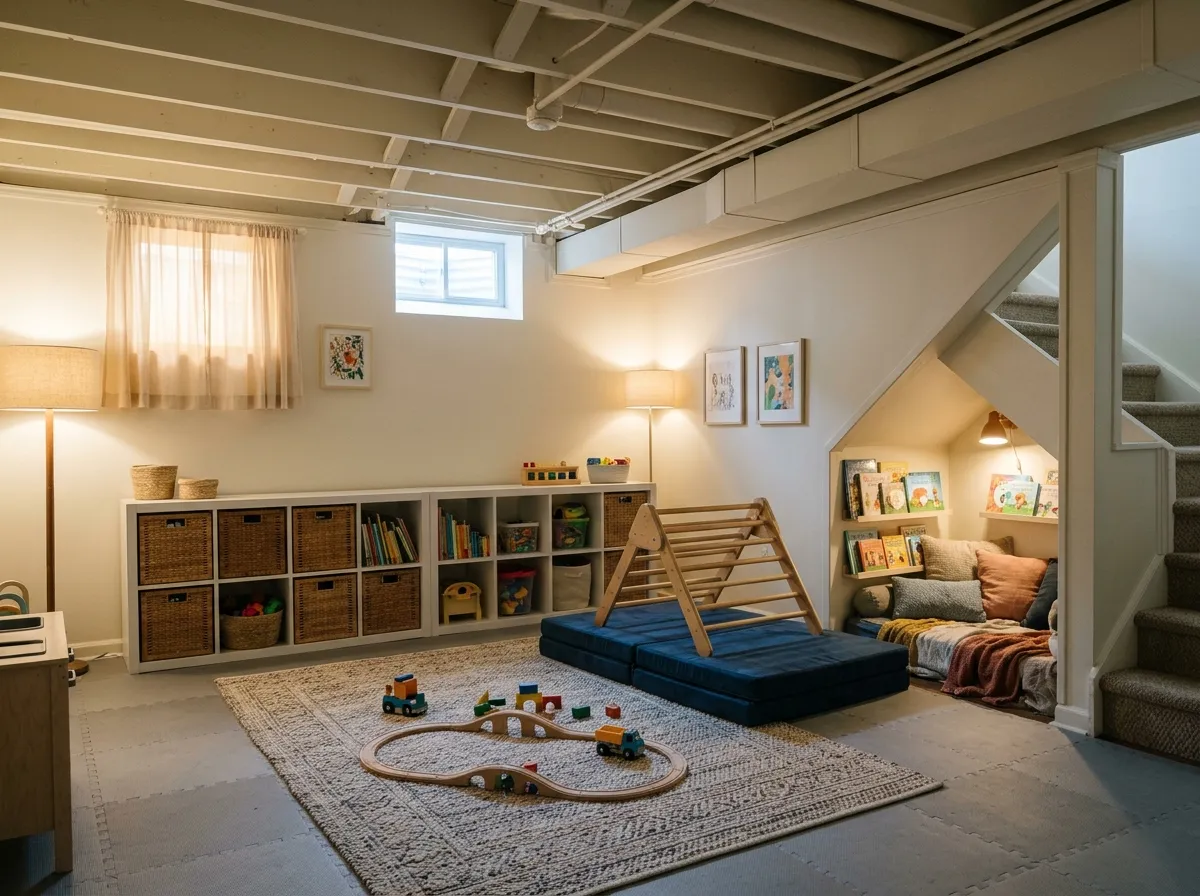
A basement is usually the biggest open space in the house and the least used one. Ours sat half empty for almost a year while the living room filled up with blocks.
Here is the part nobody mentions: a basement does not become a playroom just because the toys moved downstairs. It is darker than the rest of the house, the floor is cold, the ceiling sits low, and there is a furnace humming in one corner. Get those four things wrong and your kids will be back upstairs inside a week.
So these basement playroom ideas start with the room, not the toys.
Planning and lighting come first, because they decide whether the space gets used at all. Then the active corner, the quiet corner, the messy corner, and storage a 3-year-old can manage without calling you. Everything is sized for ages 2 to 6, and there is a safety section near the end covering the checks that matter in a basement specifically.
One more thing. Pick two or three ideas, not all 23. A good basement playroom comes together one corner at a time.
Basement Playroom at a Glance
Quick Facts
| Best for ages | 2 to 6, with swaps noted per idea |
| Check before you spend | Damp, radon, ceiling height, stairs |
| Zones to plan | Loud, quiet, messy, storage |
| Start-small version | Rug, lamp, two low bins, one mat |
| Biggest mistake | Moving toys down with no plan |
Table of Contents
Part 1. Plan the room before you buy anything (ideas 1 to 4)
1. Map Four Zones on Paper First
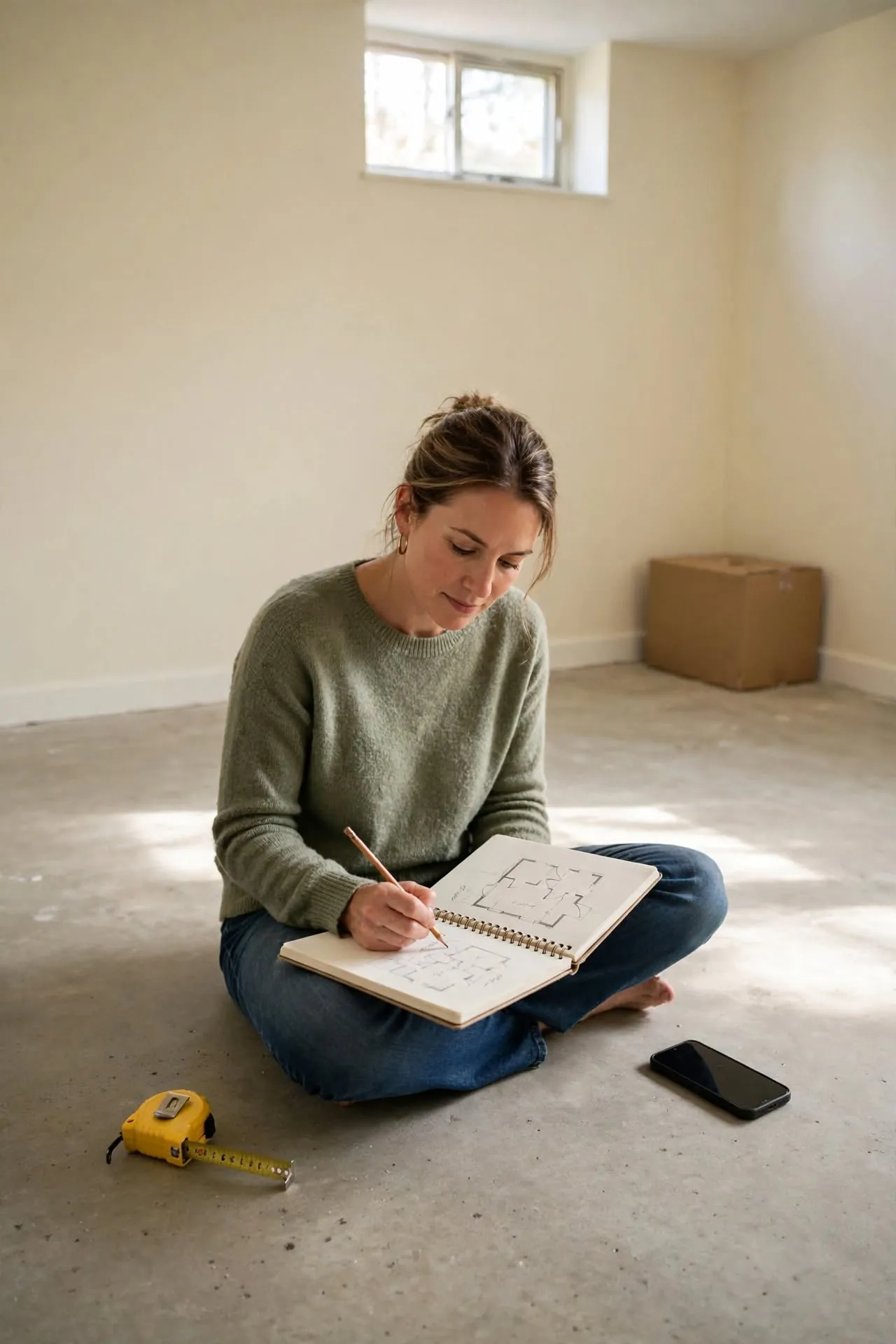
Walk down with your phone and photograph each wall. Then decide which corner gets loud play, which gets quiet play, which gets mess, and which gets storage.
Loud goes furthest from the stairs. Quiet goes near the window if you have one. Messy goes on hard flooring, never on carpet. Storage lines the wall you want to disappear.
Ten minutes of this saves you buying a rug that ends up under the art table.
The Four Zones, and Where Each One Goes
Loud
Climbing, balls, movement. Furthest wall from the stairs, padded floor.
Quiet
Books, cuddles, small-world play. Near natural light, away from the loud zone.
Messy
Art, water, sensory bins. Hard floor only, with a sink or stairs close by.
Storage
One wall, low and open. Keeps the rest of the floor clear.
2. Keep the Middle of the Floor Empty
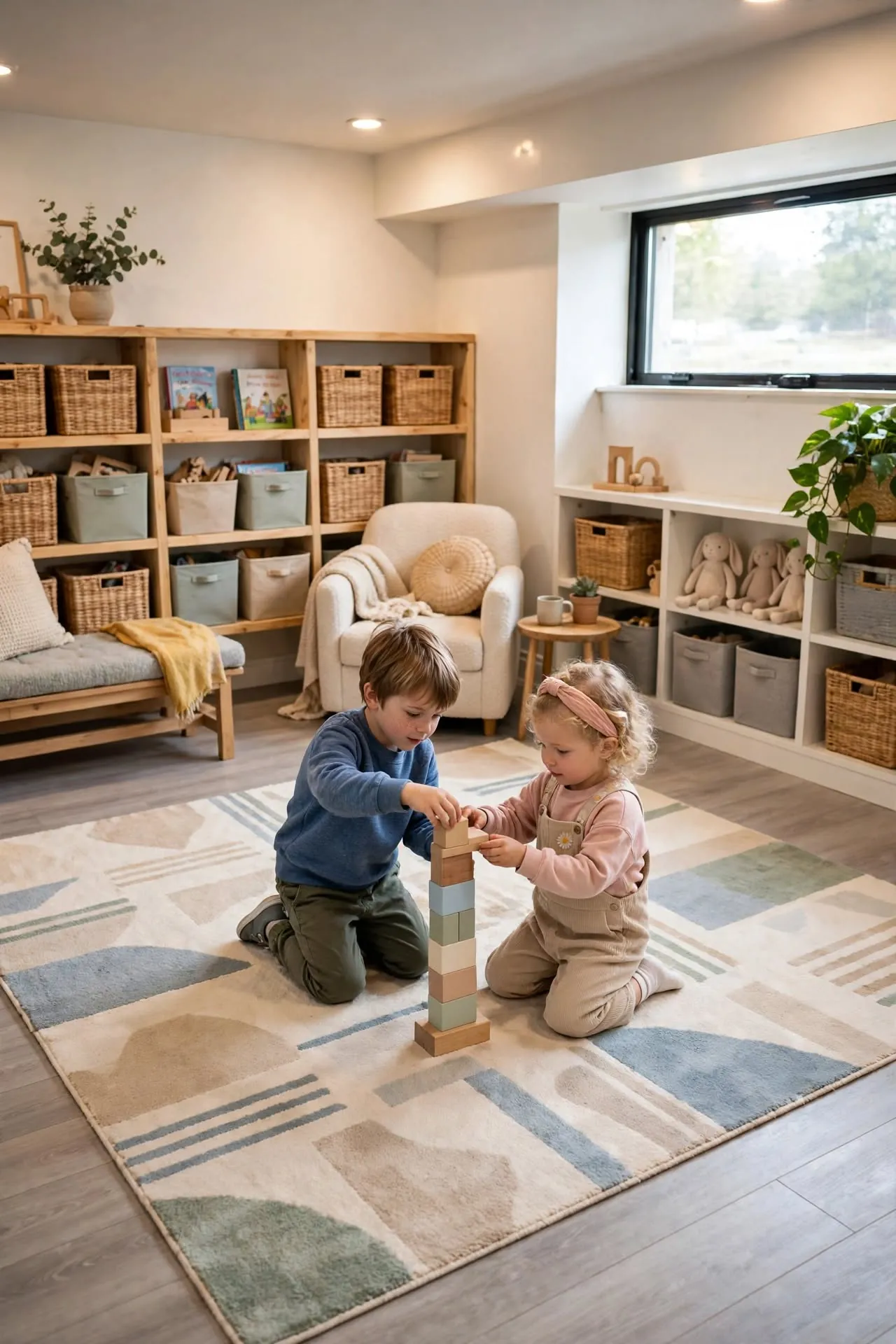
Every photo of a dream playroom shows furniture around the edges and nothing in the center. That is not a styling trick. Young kids need a clear run of floor to build on, spread out on, and tip a basket of blocks onto.
Push everything to the walls. Resist the island storage unit, however nice it looks in the catalog.
If you only follow one idea on this list, follow this one.
One simple rule: leave a clear floor space about the size of a double bed in the middle of the room. Furniture to the walls, play in the middle.
3. Divide with Low Furniture, Not Walls
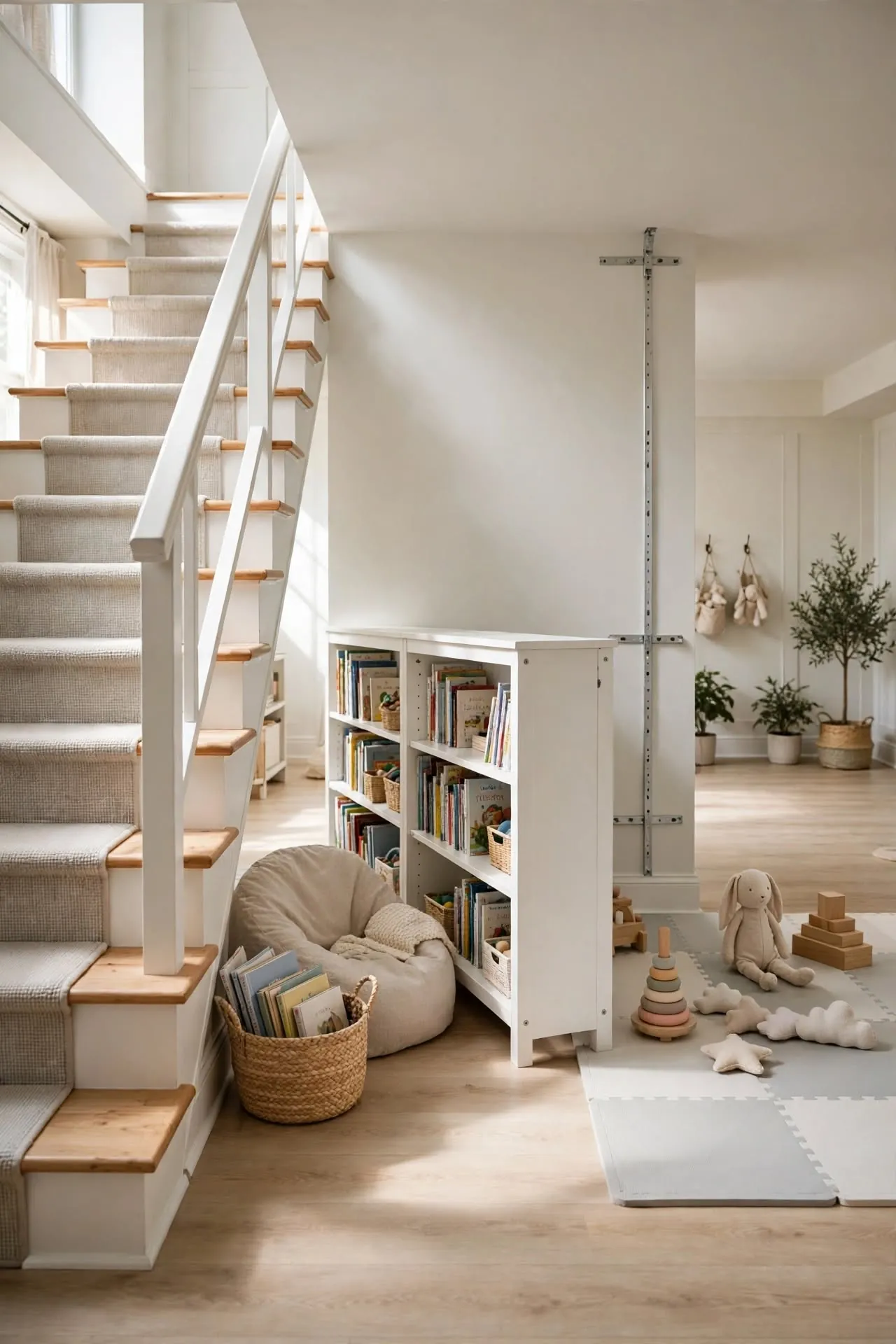
Separating zones is useful. Building partition walls in a basement is expensive and makes a dark room darker.
A bookcase turned sideways at hip height does the same job. So does a long bench, a sofa with its back to the room, or two storage cubes with a gap between them.
The height matters more than the piece. Keep dividers below your shoulder so you can see the whole room from the bottom of the stairs.
✓ Do this
Low bookcase turned sideways, below shoulder height
Sofa with its back to the play zone
A rug to mark where one zone ends
Dividers you can move again in six months
✗ Avoid this
Stud walls that block the only window
Tall shelving that creates blind corners
Curtains on a tension rod a toddler can pull
Anything unanchored that a child could climb
4. Fence Off the Utility Corner Before Anything Else
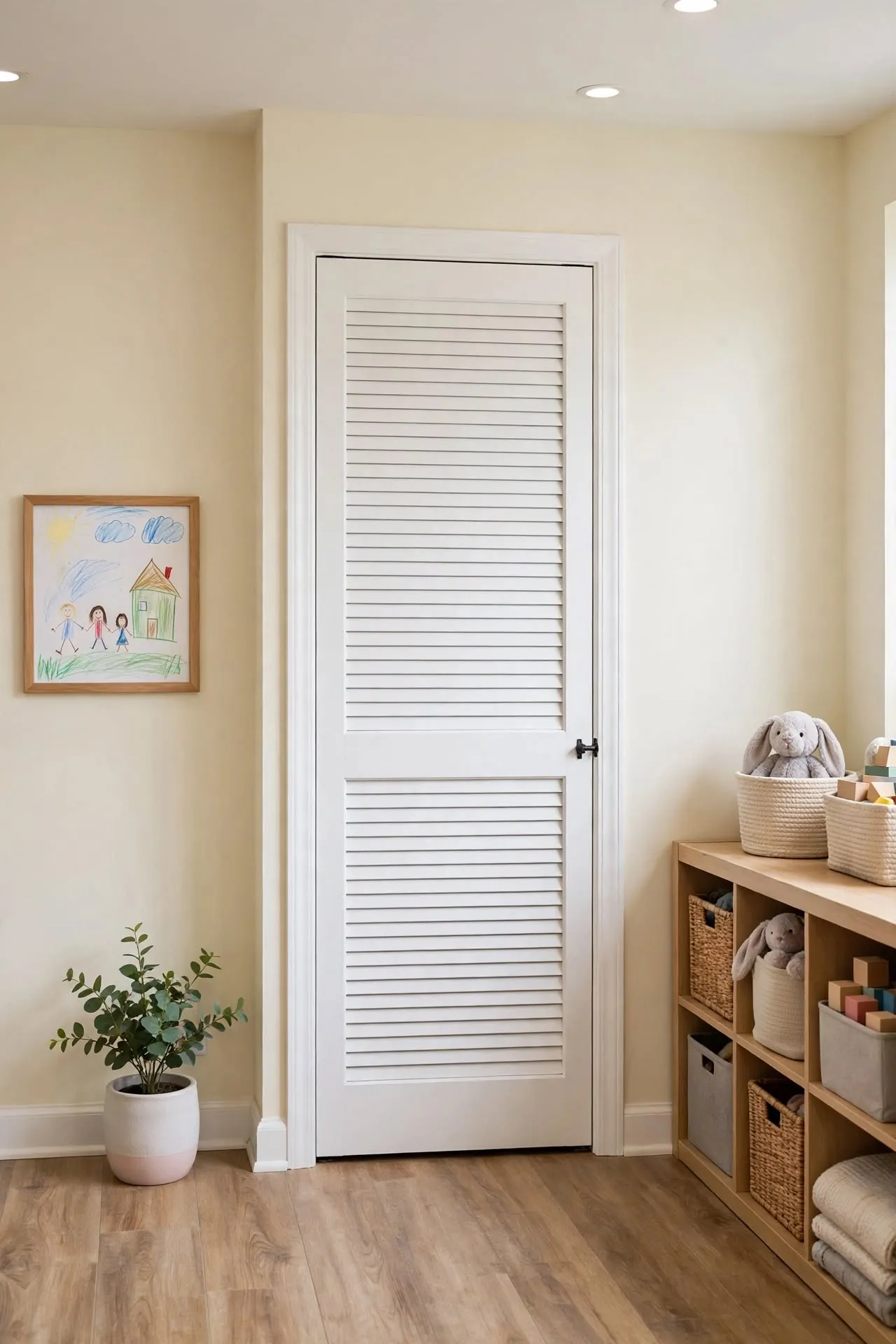
Almost every basement has a furnace, a water heater, an electrical panel, or a sump pump somewhere in it. Most playroom articles skip straight past this.
Deal with it first. A lockable louvered door is best. A fixed gate or a screwed-to-the-wall panel works too. Freestanding screens do not, because a determined 4-year-old will move one.
Keep a clear service path to it, and never store toys in that corner as a way of hiding it.
⚠ Fence or lock off before the toys arrive
☐ Furnace or boiler and any hot pipework
☐ Water heater and its pressure valve
☐ Electrical panel and any exposed wiring
☐ Sump pump pit, with a secured lid
☐ Laundry detergents, pods and cleaning products
☐ Tools, paint tins and stored hardware
Part 2. Fix what makes a basement feel like a basement (ideas 5 to 9)
5. Paint the Walls and Ceiling the Same Pale Color
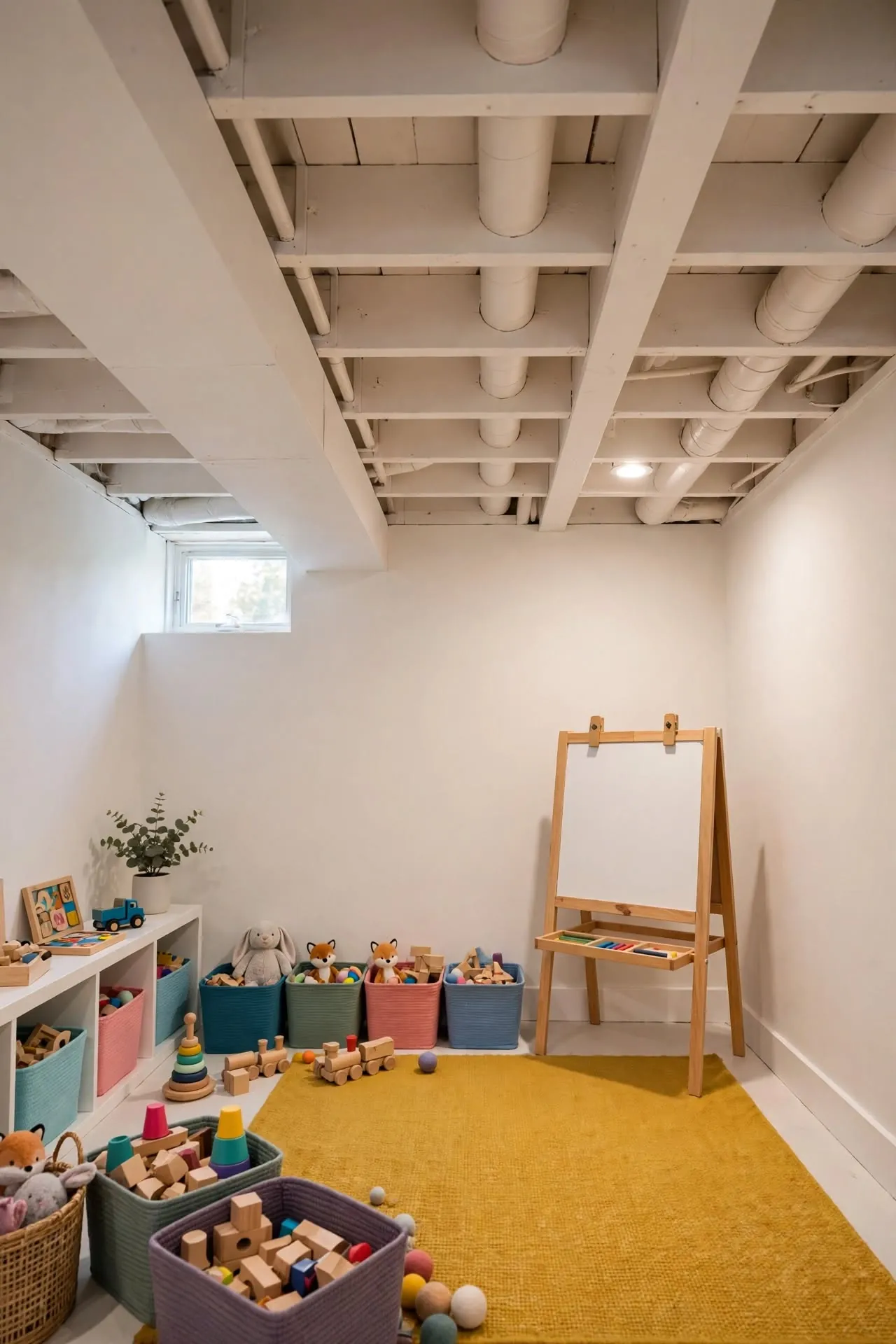
Low basement ceilings look lower when they are a different shade from the walls. Painting both the same soft white or warm cream blurs the line where they meet, and the room reads taller.
If the ceiling is exposed joists and ducting, paint all of it one color, pipes included. Messy becomes deliberate.
Skip bold feature walls down here. Save the color for rugs, bins and artwork, which you can change cheaply.
Before
Gray walls, white ceiling, dark joists
Every pipe draws the eye downward
Reads as storage with a rug in it
After
Walls, ceiling and pipes in one pale shade
The corner line disappears
Reads as a room, color comes from the toys
6. Add Light at Three Heights
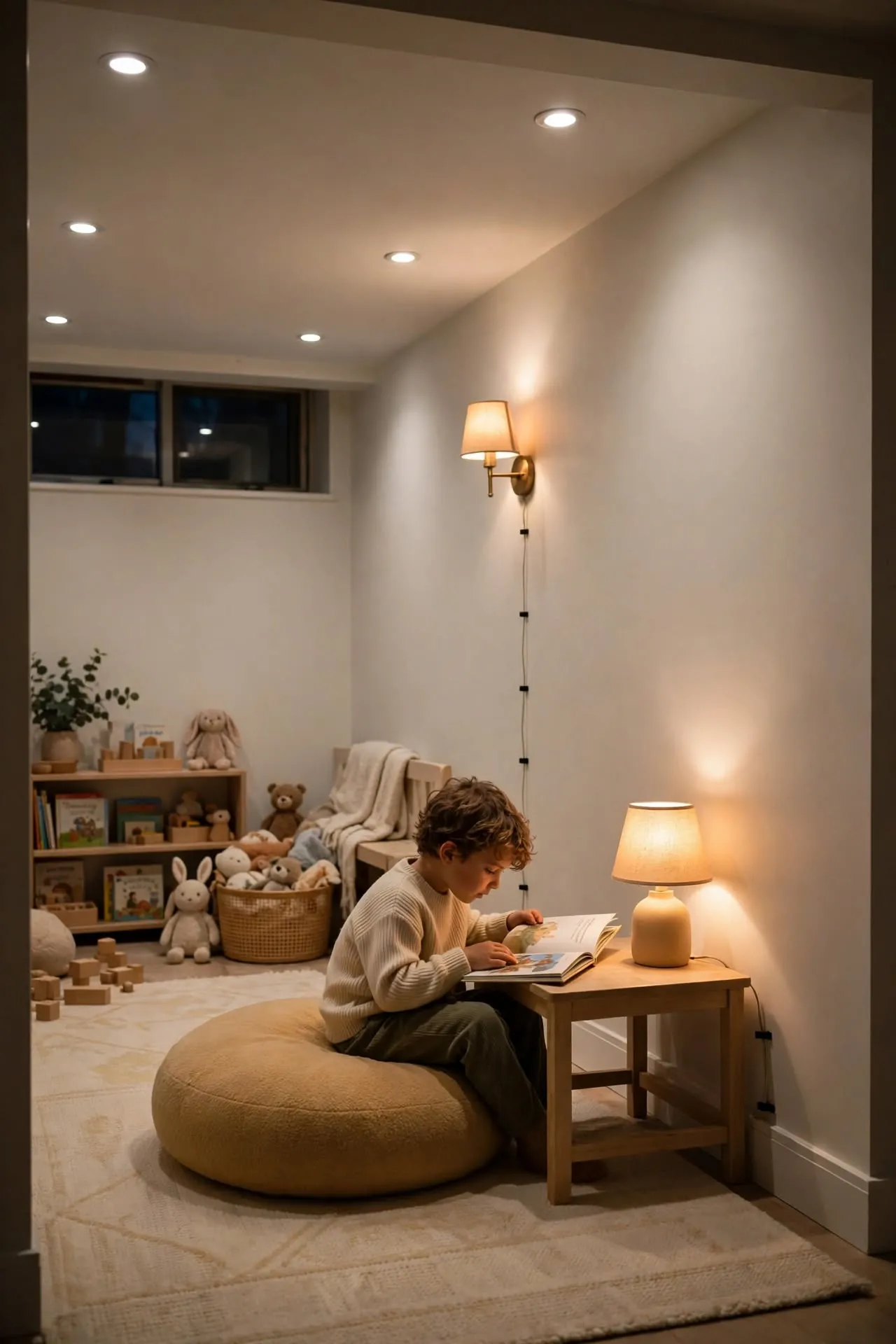
One ceiling fixture is what makes basements feel like basements. It flattens everything and leaves the corners gloomy.
Work in three layers instead. Overhead for general brightness, a lamp or wall light at adult eye level, and something low beside the reading corner.
Flush or recessed fittings are worth it where the ceiling is low, because a hanging shade becomes a target for a thrown ball.
Light it in three steps
1. Overhead: flush or recessed fittings, warm white bulbs, spread across the ceiling rather than one central point.
2. Mid level: a wall light or a lamp on a shelf, aimed at the darkest corner.
3. Low: one soft lamp by the books. Cord clipped flat to the wall, plug behind furniture.
7. Warm the Floor Before You Decorate

Concrete pulls heat out of a child who sits on it, and ages 2 to 6 spend most of their play time on the floor. This is the single biggest reason a basement playroom goes unused.
Something has to go between the slab and your child. Which option you choose depends on how damp the space is and whether it is the messy zone.
Pick Your Floor
Foam tiles
Warmest and softest. Best under the active zone.
Watch: lift them to dry if anything spills underneath.
Washable rug on underlay
Looks like a real room. Best for the quiet zone.
Watch: use a non-slip pad, not tape.
Vinyl plank or sealed floor
Wipes clean. Best for the messy zone.
Watch: cold and hard, so add a mat where they sit.
8. Hang a Mirror Opposite the Window
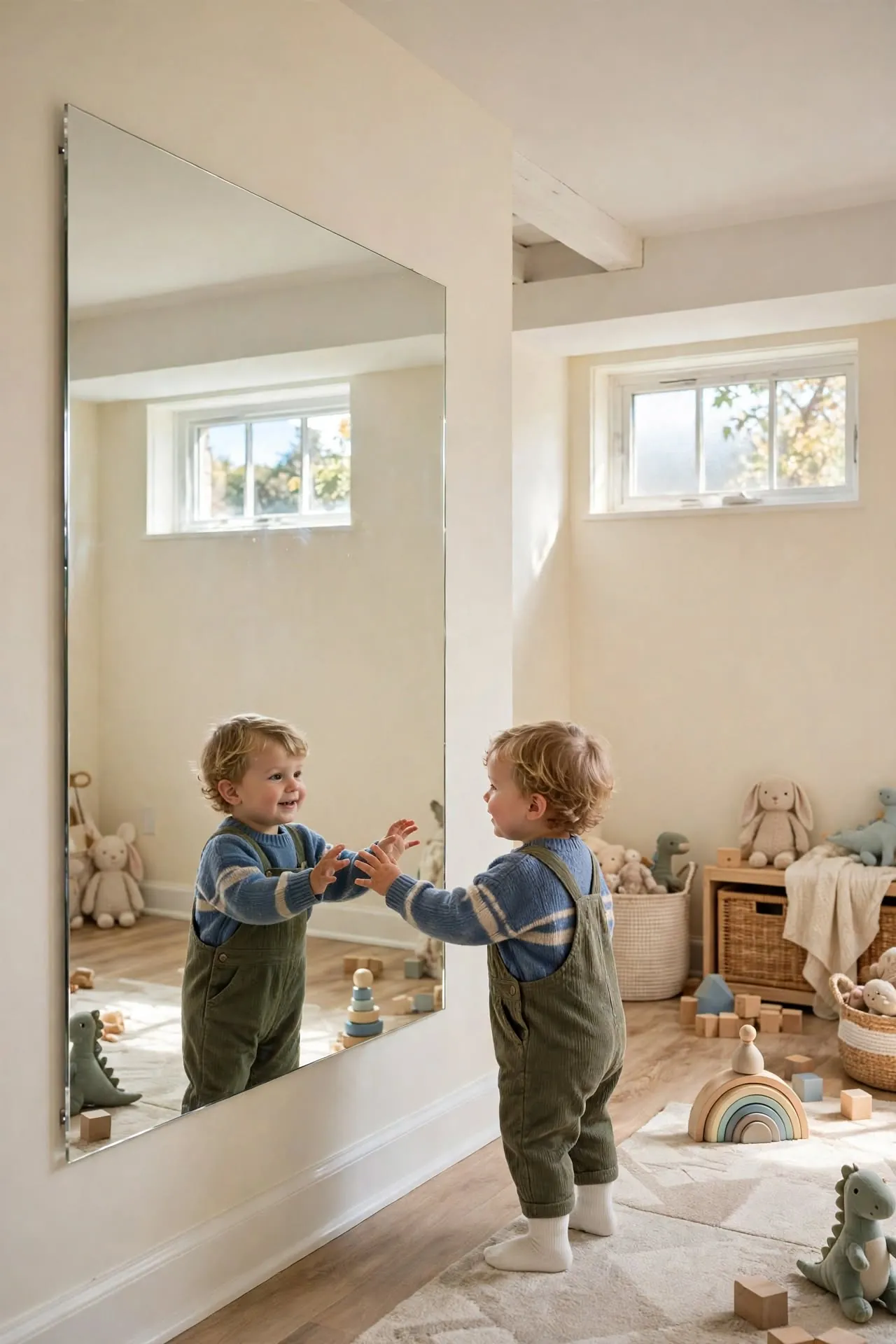
A basement window is usually small and high. A large mirror on the facing wall doubles what light there is and gives the room an apparent second window.
It also doubles as play. Toddlers watch themselves dance, pull faces, and practice animal walks in front of one.
Choose acrylic rather than glass, and fix it to the wall at child height rather than leaning it anywhere.
Safety note: acrylic mirror only, screwed into a stud at child height. A leaning or lightly stuck mirror is a tip and shatter risk in a room where kids run.
9. Sort Out Damp Before Soft Furnishings Go In
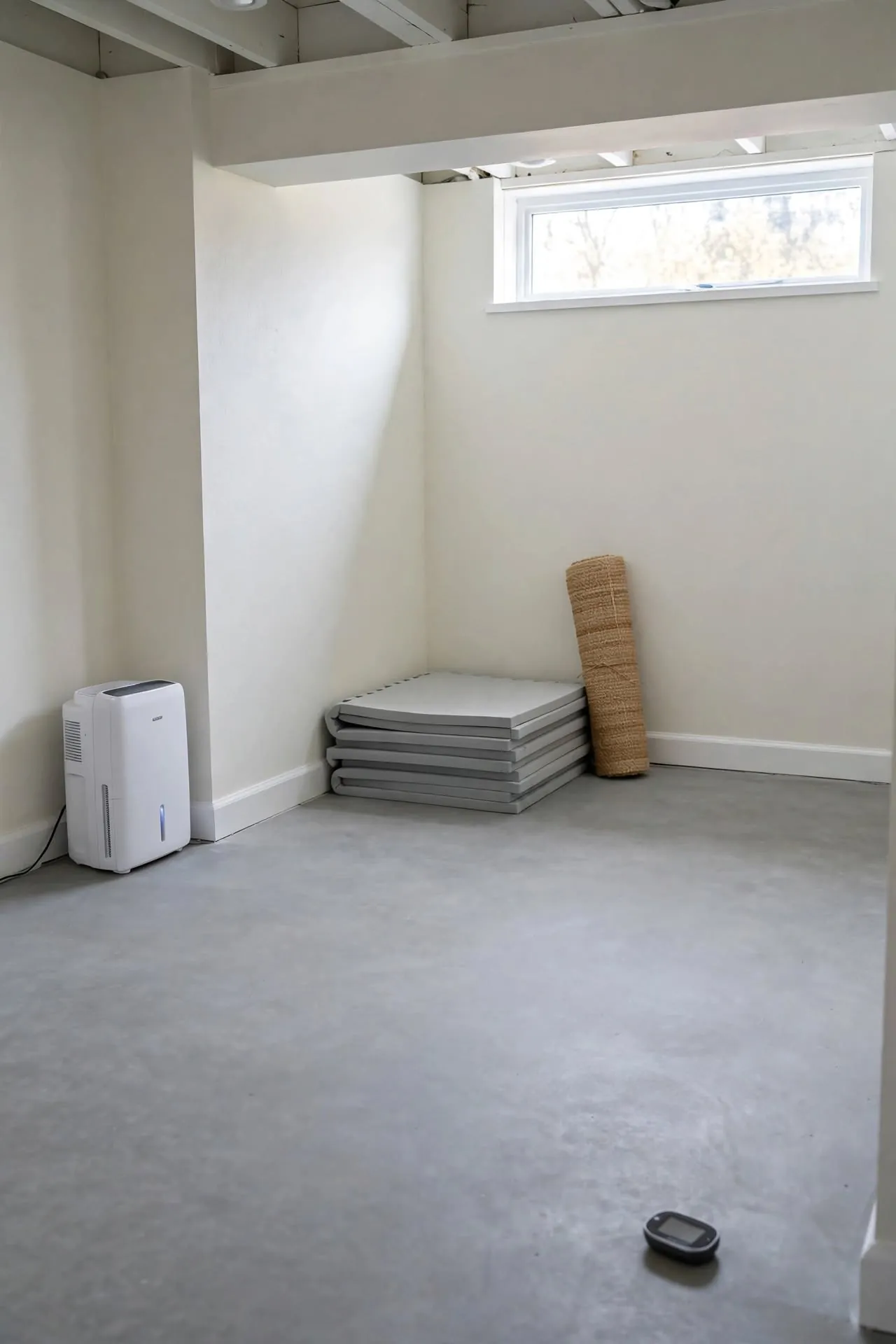
Rugs, cushions, foam tiles and fabric bins all hold moisture. Put them into a basement with a damp problem and you will be throwing them out by spring, with mold behind them.
Give the room a few weeks of attention first. Run a dehumidifier, watch where condensation forms, and look along the base of the walls after heavy rain.
What You See, and What It Means
| Sign | Do this first |
|---|---|
| Musty smell when you open the door | Dehumidifier, aim for 50% humidity or below |
| Chalky white marks on the wall | Moisture moving through masonry, get it looked at |
| Damp patch after heavy rain | Check gutters and ground slope before anything indoors |
| Cold floor, dry walls | Normal. Insulate with flooring and go ahead |
Part 3. Active play that fits under a low ceiling (ideas 10 to 14)
10. A Padded Movement Strip Along One Wall
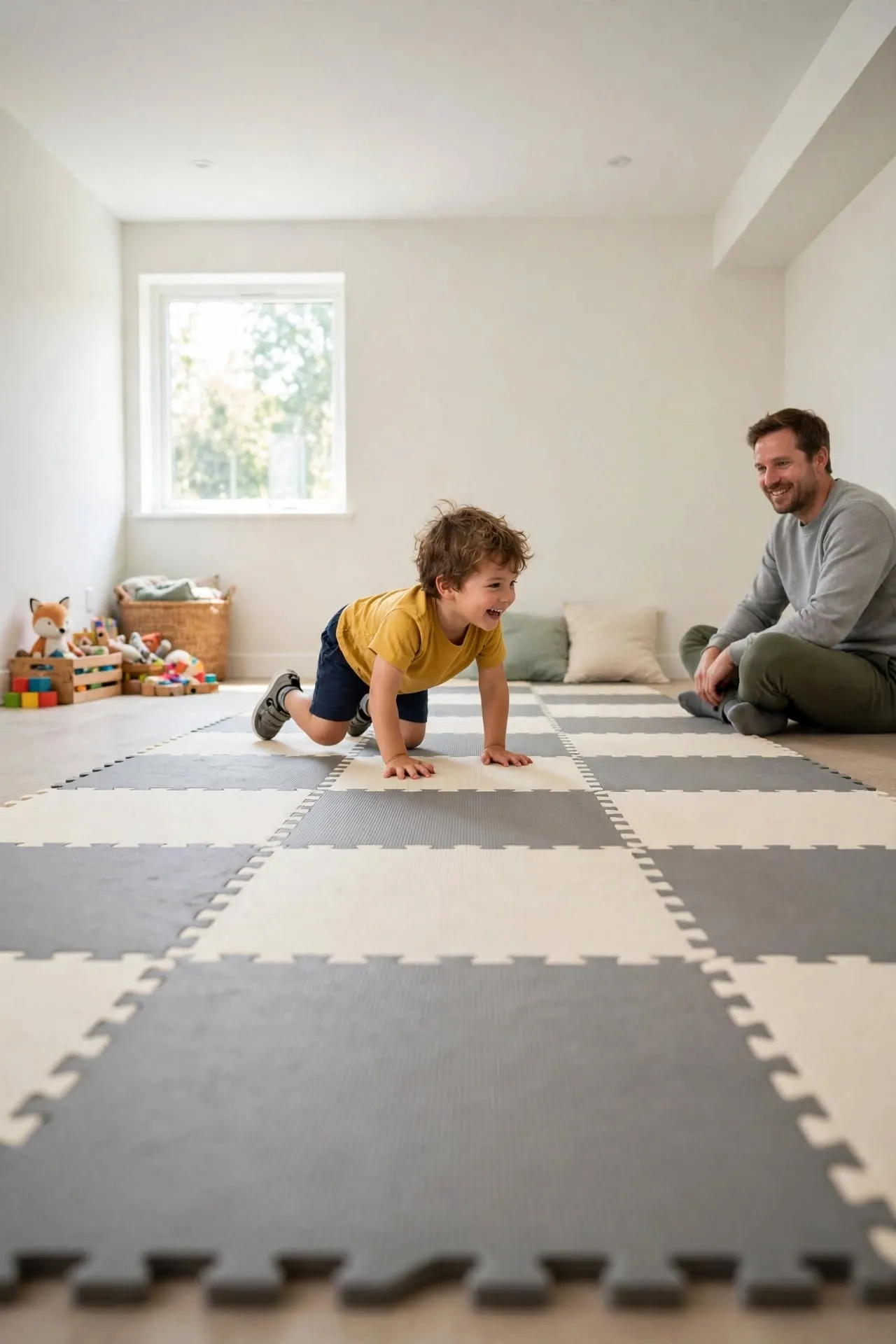
You do not need a climbing frame to give kids somewhere to be physical. A run of interlocking mats along one wall, roughly two mats deep, handles rolling, crawling, jumping and animal walks.
It costs a fraction of play equipment and packs away flat when you want the floor back.
Keep it clear of radiators, the stairs, and anything with corners. For ideas to use on it, my list of active indoor activities for toddlers works well in a space this size.
Gather these
☐ 6 to 8 interlocking foam mats, 2 cm thick or more
☐ One folding gym mat for jumping landings
☐ A floor cushion or two at one end
☐ Clear wall space, nothing hanging above it
11. A Climber Sized to Your Ceiling, Not to the Catalog
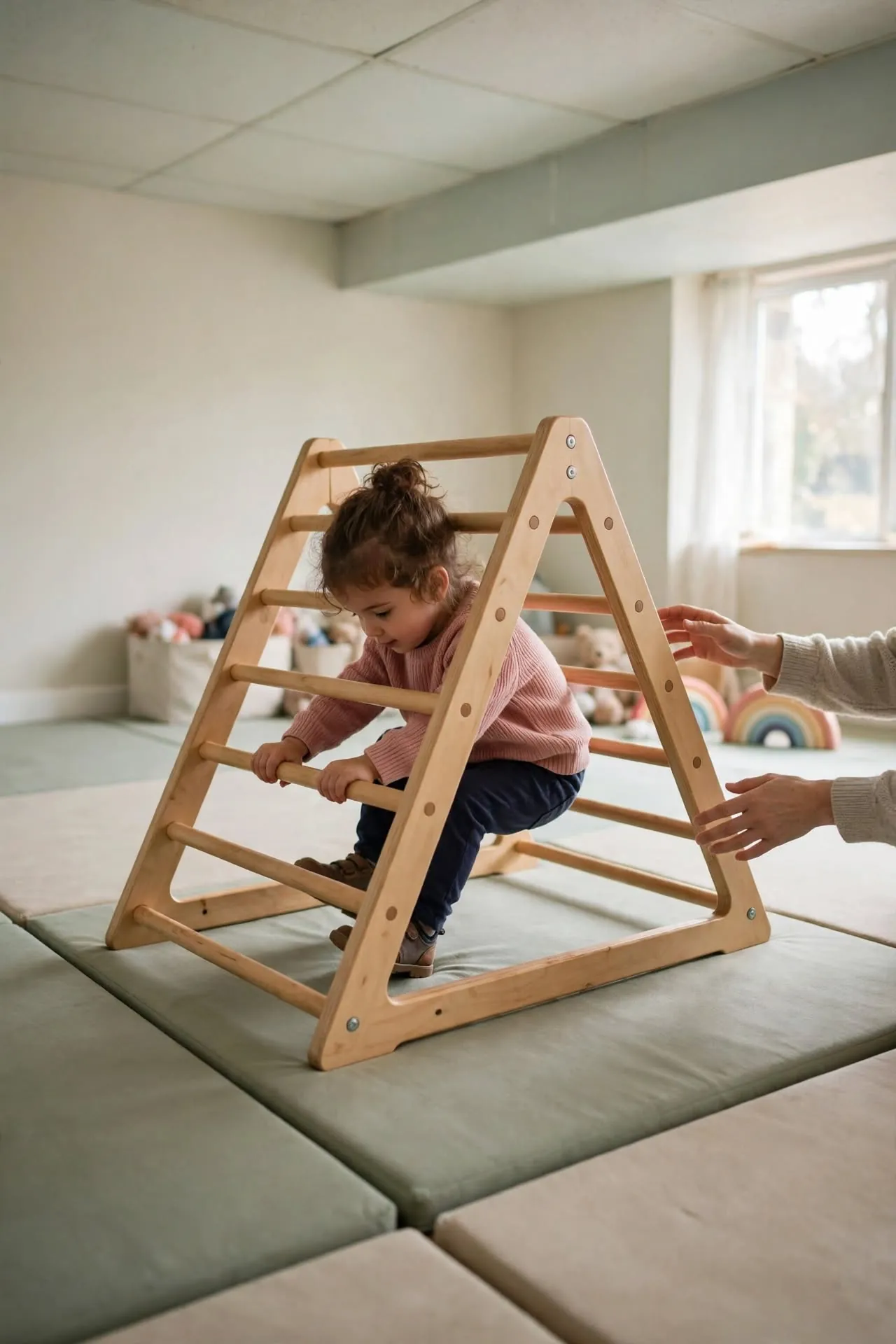
Indoor climbers are sold without reference to basement ceilings, and that is a problem. A child standing on the top rung needs real clearance above their head, plus clear floor around the base for a fall.
Measure first. Height of the frame, plus your child’s standing height, plus a margin. If that total is close to your ceiling, size down.
Then check the landing area, which most families forget entirely.
Measure These Three Before You Buy
1. Headroom
Frame height plus your child standing on the top step, plus clearance above that. Ducts and pipes count.
2. Fall zone
Padded floor extending well past the frame on every open side. No furniture, no walls within reach.
3. Stability
Flat, level footing on hard floor. Follow the maker’s age and weight limits rather than guessing.
12. A Foam Block Pit That Packs Away
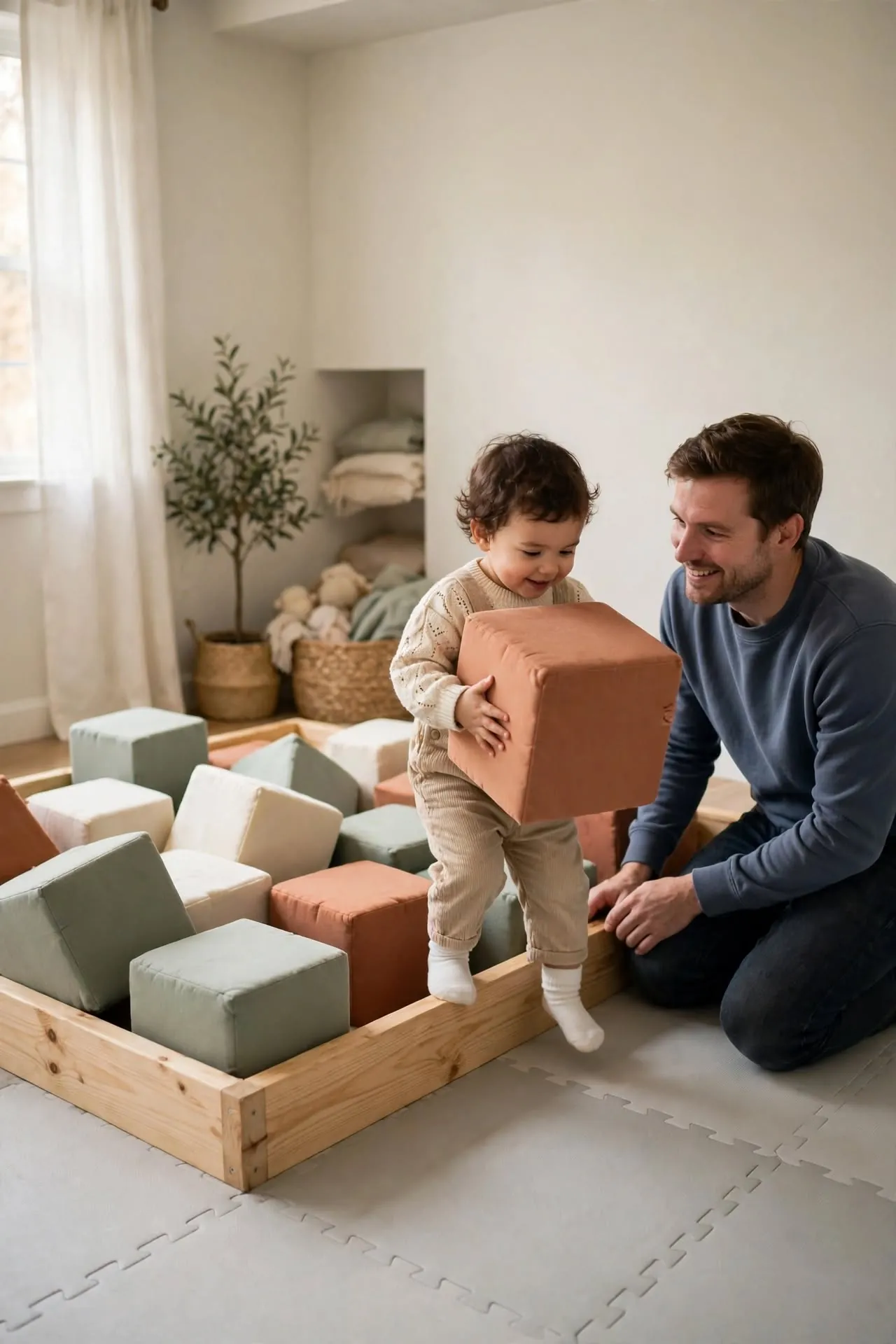
A corner of large foam blocks gives the same appeal as a soft play center without the permanent footprint. Kids build with them, climb on them, and crash into them.
A shallow pool shell or a low wooden frame keeps the blocks contained so they do not migrate across the room.
Blocks need to be large enough that they cannot be mouthed, which matters if a younger sibling joins in.
Make it work for a 2-year-old: skip the deep pit. Use six to eight big blocks loose on a mat instead, so there is nothing to fall into and nothing small enough to go in a mouth.
13. A Low Target Wall for Throwing
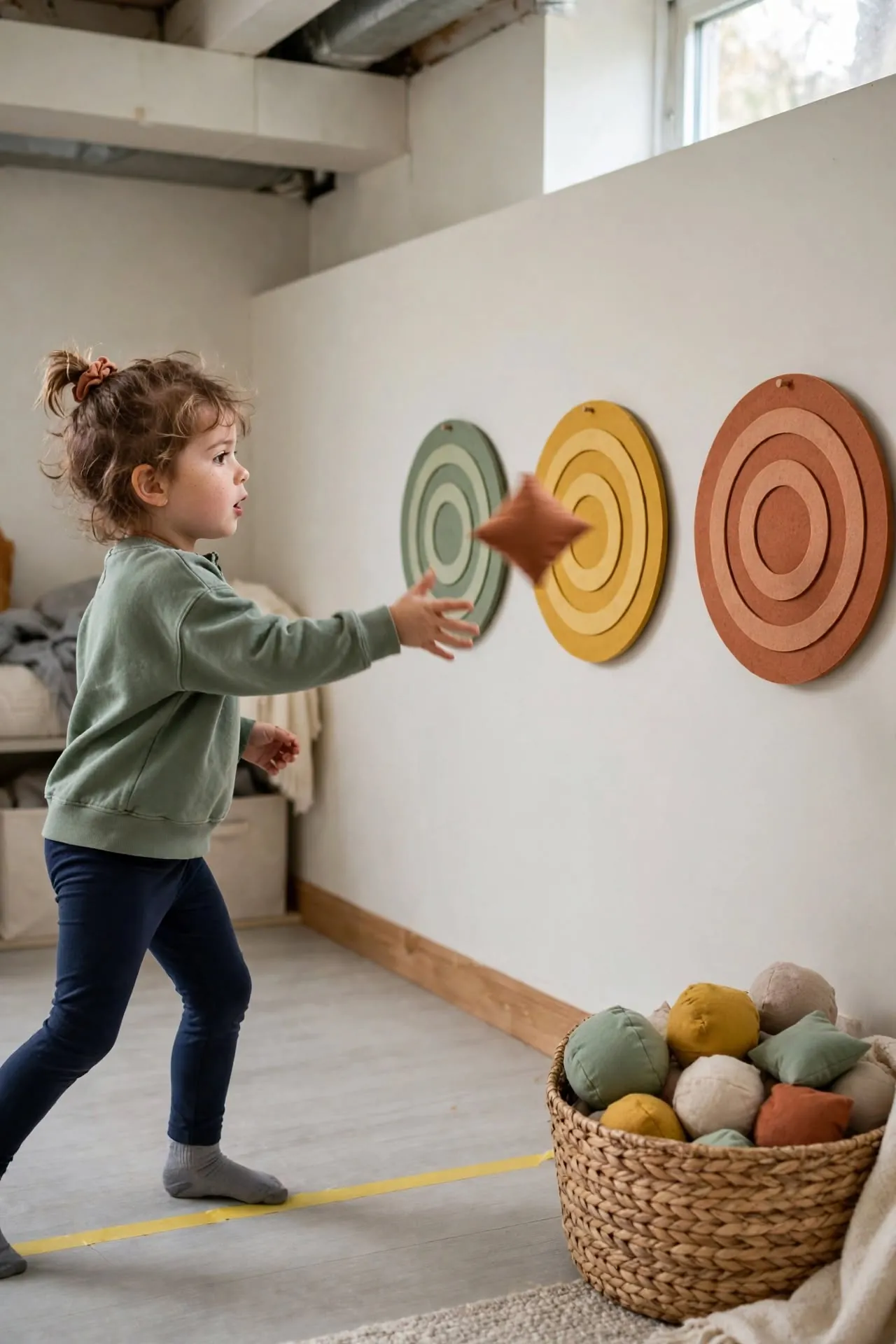
Low ceilings rule out most ball games, but not all of them. Throwing at a wall target keeps the ball below head height and gives kids a way to burn energy indoors.
Fix a few felt circles, a hoop, or a bucket mounted low on the wall. Soft balls and beanbags only.
My favorite part of this one is that it works in a narrow strip of floor, which is often all a basement has spare.
Three Target Setups
Ages 2 to 3
One large bucket on the floor, two steps away. Soft balls. Success every time.
Ages 4 to 5
Three felt circles taped to the wall at different heights. Beanbags that stay where they land.
Age 6
A low hoop or wall-mounted net, plus a taped throwing line to step back from.
14. A Floor-Level Balance and Tunnel Circuit

Nothing here is more than a few inches off the ground, which makes it the safest active idea on the list and the best one for a mixed-age group.
Lay a route: tape line to walk, cushion to step over, pop-up tunnel to crawl through, mat to roll on, back to the start.
Change the order every couple of weeks and it feels new. Rolling it up takes a minute when the grown-ups want the room.
One circuit, five stations
1. Tape line along the floor, heel to toe
2. Cushion to step over, not jump from
3. Pop-up tunnel to crawl through
4. Mat for a log roll
5. Beanbag to carry back to the start
Part 4. Quiet and creative corners (ideas 15 to 20)
15. An Under-Stair Playhouse Nook
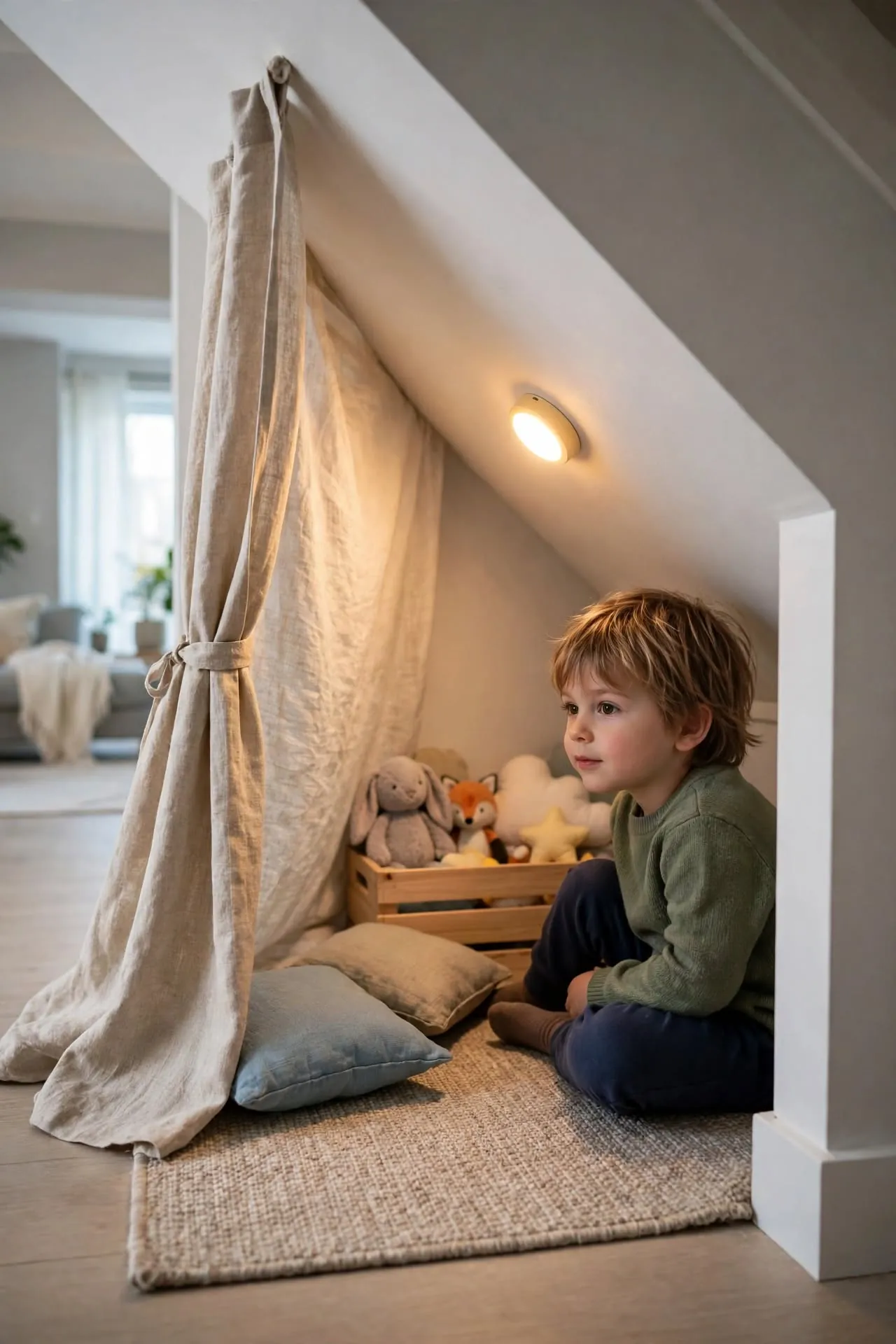
The space under basement stairs is usually holding boxes. Cleared out, it makes the best playhouse in the house, because it is already enclosed on three sides.
Line the floor with a remnant of carpet, add a low shelf, and cut a simple doorway if it is boxed in. A curtain across the front finishes it.
Put a battery light inside rather than running a cord, and leave the entrance wide enough for you to reach in.
Under-Stair Nook: What You Need
Materials
Carpet remnant or foam tiles
One low shelf or crate
Curtain and a tension rod
Battery puck light
Two cushions
Order of work
1. Clear it out completely
2. Check for exposed nails and wiring
3. Floor first, then walls
4. Light at child head height
5. Curtain last, so it stays clean
16. A Reading Corner Lit by a Lamp, Not the Ceiling
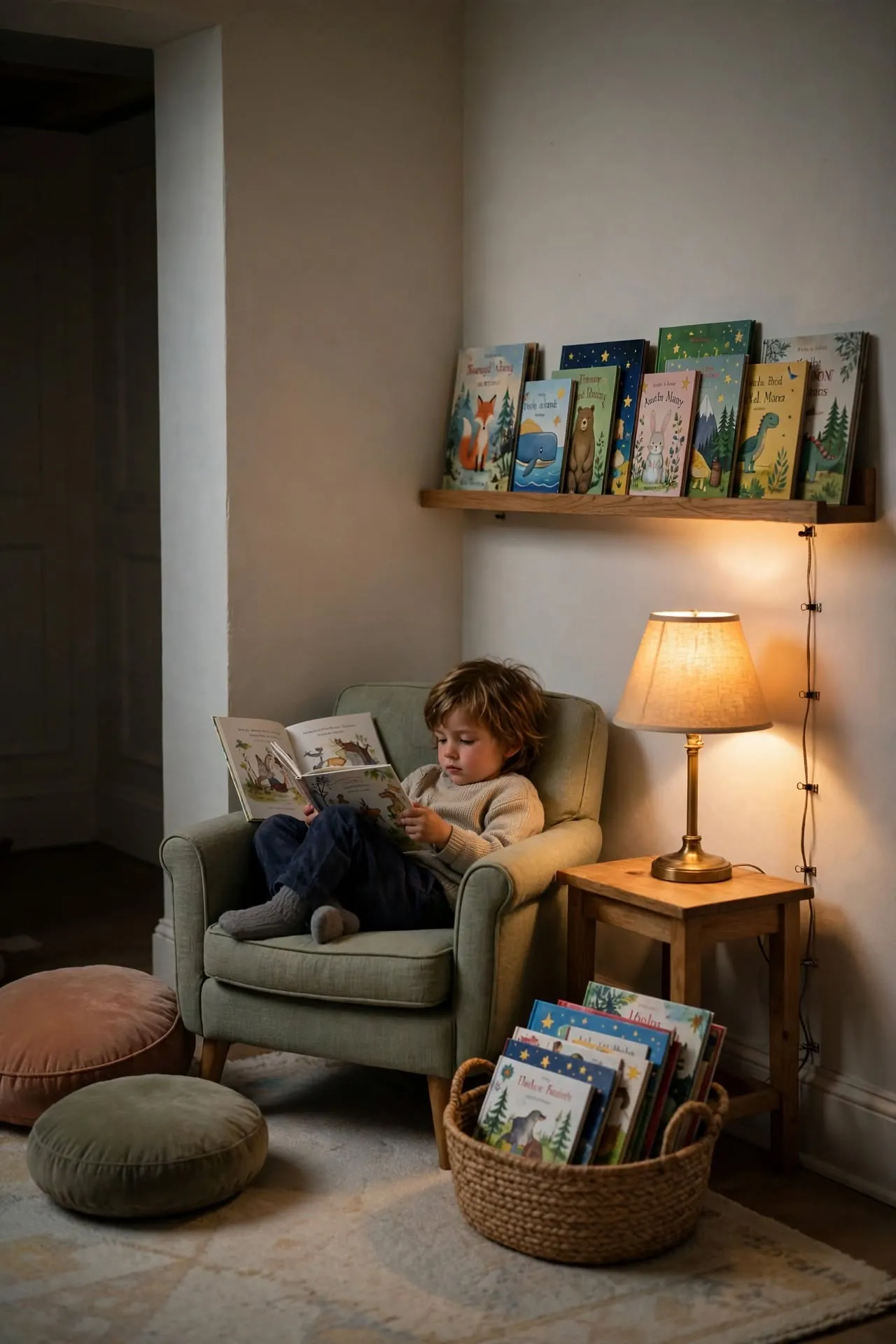
Overhead light makes a corner feel like a waiting room. A single warm lamp makes the same corner feel like somewhere a child wants to sit down.
Add a small armchair or two floor cushions, a basket of books, and a wall shelf that holds covers facing outward. Kids ages 2 to 6 pick books by the picture on the front, not the spine.
Keep this corner near the window if you have one, and far from the active zone.
What makes a reading corner get used
• Lamp light, warm bulb, at sitting height
• Book covers facing out, roughly 10 at a time
• Something soft to sit on at floor level
• A back or side wall, so it feels tucked in
• Lamp cord clipped flat and plug hidden behind furniture
17. A Wipeable Art Wall

Basement walls are the one place in the house where you can let kids draw big without worrying. Chalkboard paint, whiteboard paint, or a roll of paper on a wall-mounted bracket all work.
Vertical drawing asks more of the shoulder and arm than table work does, so it is worth having both.
Protect the floor underneath, because this is the messy zone now. For what to actually put on it, try these indoor drawing and coloring activities for toddlers.
Three Art Wall Options
Paper roll
Cheapest, works for every age, no wall prep.
Best for: ages 2 to 3, crayons and chunky markers.
Chalkboard paint
Reusable and satisfying. Dust settles on the floor.
Best for: ages 3 and up, on wipeable flooring.
Whiteboard panel
No dust, bright colors, wipes to clean.
Best for: ages 4 to 6, with washable pens only.
18. A Craft Table Sized to Your Youngest
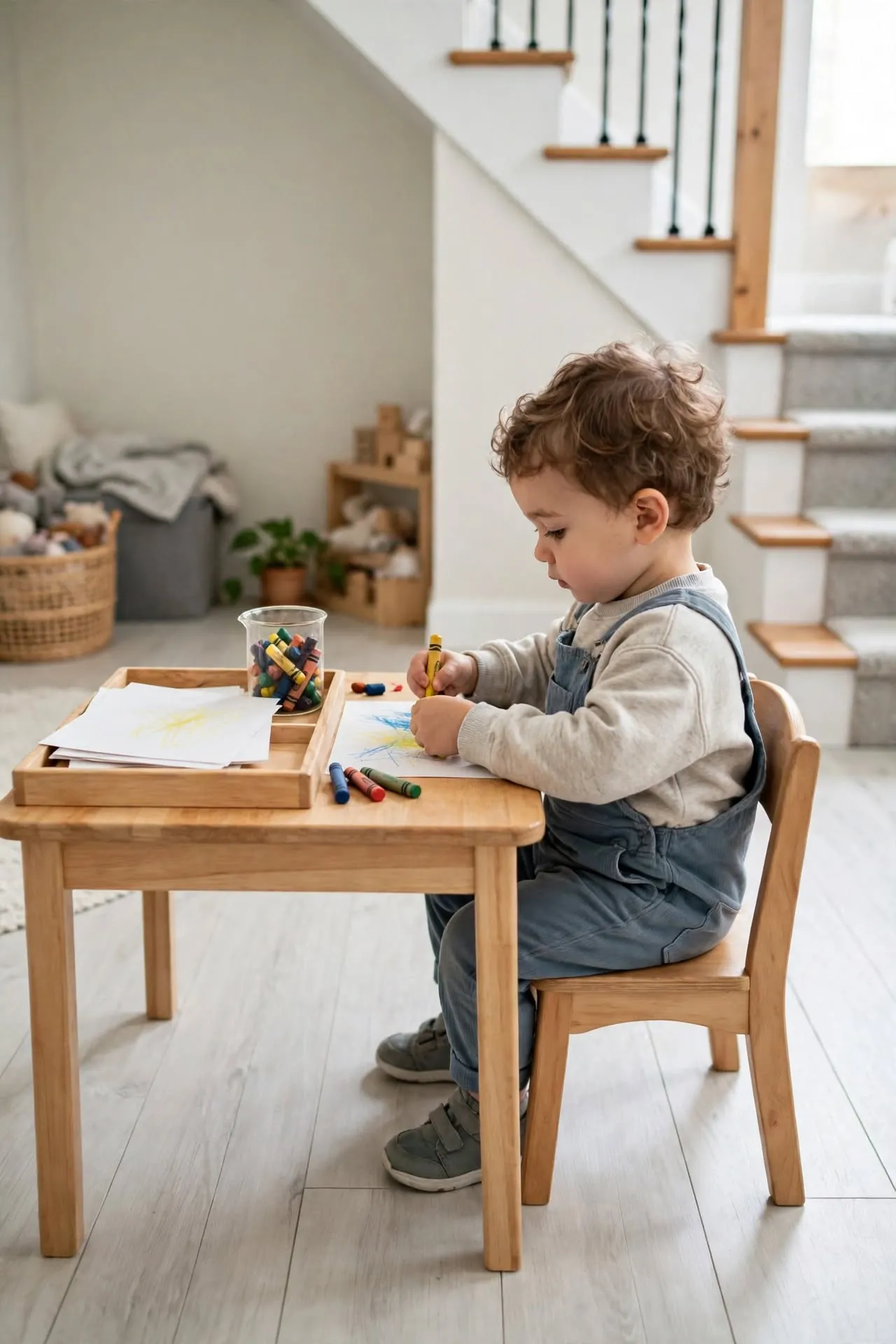
A table that is too tall is a table nobody uses. If your youngest is 2, buy for the 2-year-old and add a booster or a taller stool for the older one. The reverse never works.
Feet should rest flat on the floor and elbows sit comfortably on the tabletop.
Put this table on hard flooring near the stairs, so paint water travels the shortest possible distance.
The test that beats any size chart: sit your child down. Flat feet on the floor, knees clear of the table, elbows resting on the top without lifting their shoulders. If their feet dangle, the chair is too tall, not the table.
19. A Sensory Station on a Washable Mat
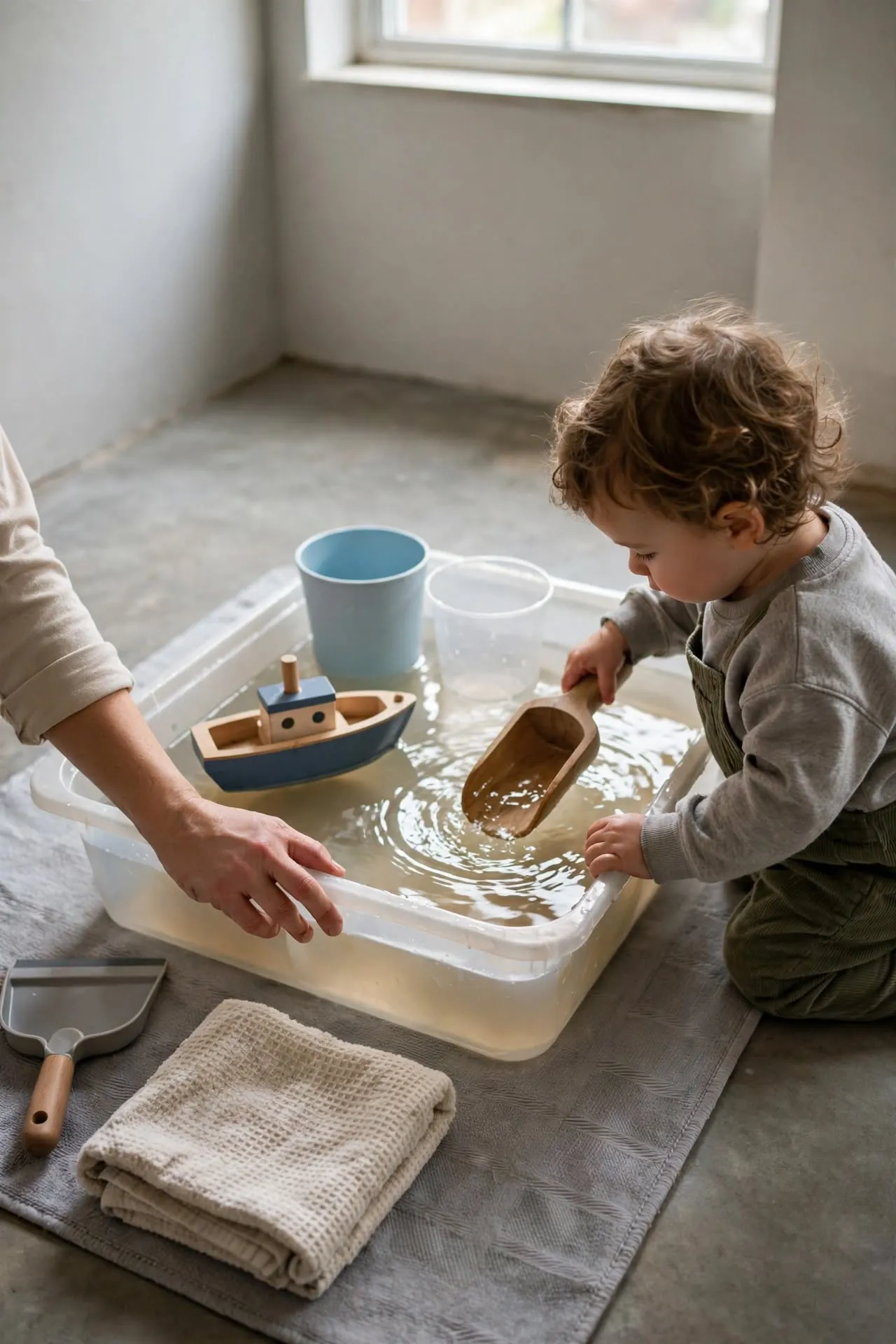
Give sensory play a fixed spot and it happens far more often, because setup stops being a decision. A low table or a bin on a shower curtain is enough.
Keep it in the messy zone, on hard flooring, with a towel and a dustpan within reach.
What goes in the bin matters more than the station itself, so start with sensory bin fillers that are safe for toddlers and read the sensory play safety basics before the first setup.
MESS LEVEL
Moderate to high
SETUP
A few minutes
ADULT HELP
Close supervision
FLOOR NEEDED
Hard and washable
Under 3s need large-piece fillers and an adult alongside. Small dry fillers such as beans, beads and rice are not suitable for children who still mouth things.
20. A Pretend Kitchen or Shop Counter on the Short Wall
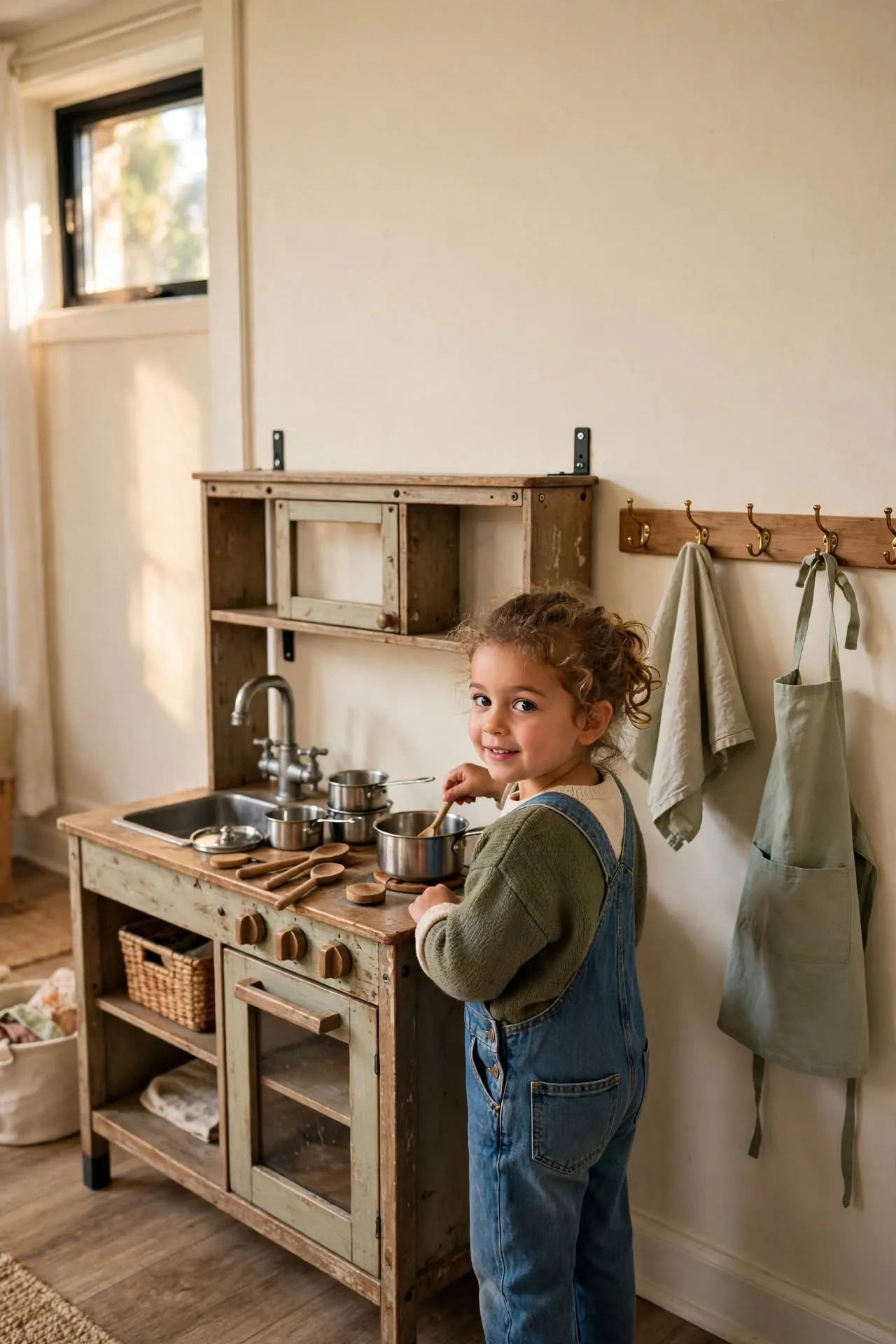
Pretend play needs a backdrop, and a short basement wall is ideal because the counter sits against it and the play spills out into the open floor.
A play kitchen, a shop counter, a repair bench or a vet clinic all work the same way. A secondhand unit and a few props beat an expensive set.
Anchor anything taller than it is wide, and keep the props large. For quiet ideas that suit this corner, see these calm indoor activities for toddlers.
✓ Worth doing
Secondhand cabinet at child height
Real pots, wooden spoons, a cloth
A hook rail for aprons and bags
✗ Skip
Tiny play food for children under 3
Battery sets with lots of small parts
Tall unanchored units with shelves to climb
Part 5. Storage a child can actually use (ideas 21 to 23)
21. Open Bins Low, Lids and Spares Up High
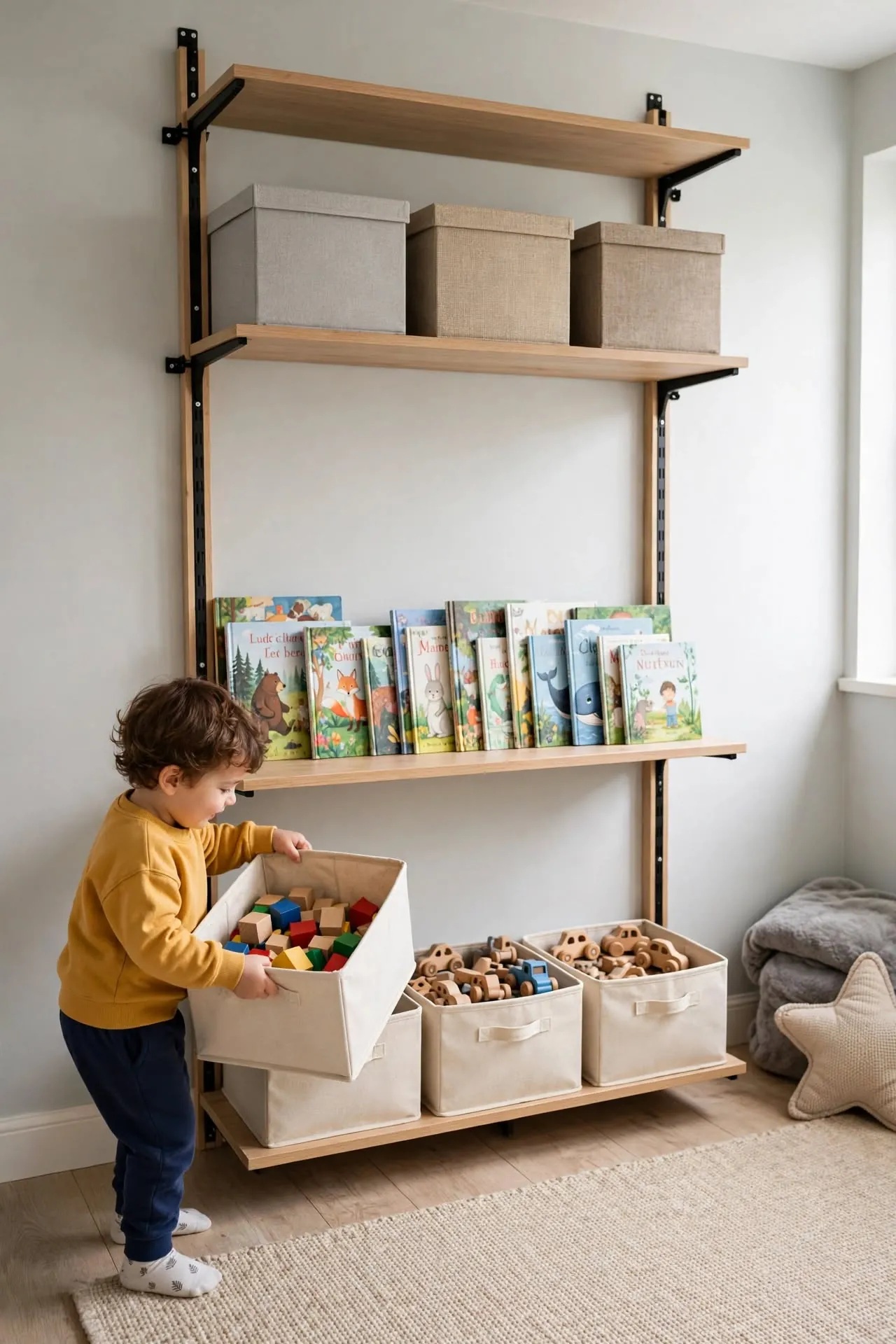
Tidying only happens if a child can do it alone. That means open containers at floor level, no lids, no latches, and no stacking.
Use the high shelves for things you control: refill supplies, paint, games with small pieces, anything you would rather hand out than find scattered.
One rule keeps the system alive. If a bin needs a grown-up to open it, it belongs above child height.
What Goes at Which Height
Floor to knee
Open bins of blocks, cars, animals, dress-up. Everything they get out themselves.
Knee to chest
Books facing out, puzzles, the current favorites. Easy to see, easy to return.
Above their reach
Paint, glue, small parts, refills, anything needing supervision. Shelving anchored to the wall.
22. Label Bins with Photos, Not Words
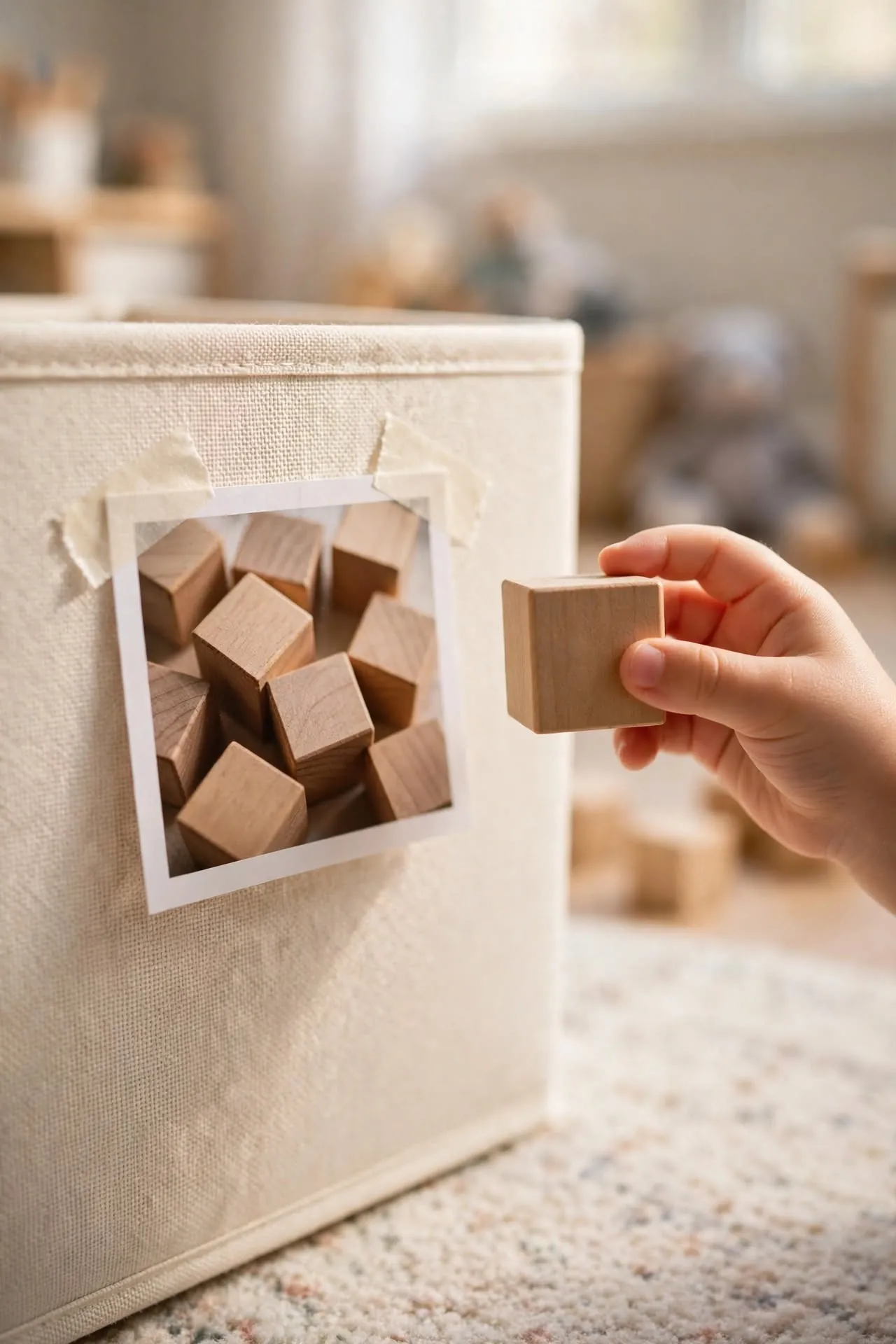
A 3-year-old cannot read “construction.” They can match a photo of blocks to a bin of blocks instantly.
Take a picture of what lives in each container, print it small, and tape it to the front. Tidying turns into a matching game, which is the only version of tidying that works at this age.
Add the written word underneath for the 5 and 6-year-olds, so the label grows with them.
Photo labels in four steps
☐ Tip each bin out and photograph the contents on a plain floor
☐ Print small, roughly playing-card size
☐ Add the word underneath in plain lowercase
☐ Tape to the front of the bin, not the lid or the shelf edge
23. One Grown-Up Corner, So the Room Gets Used
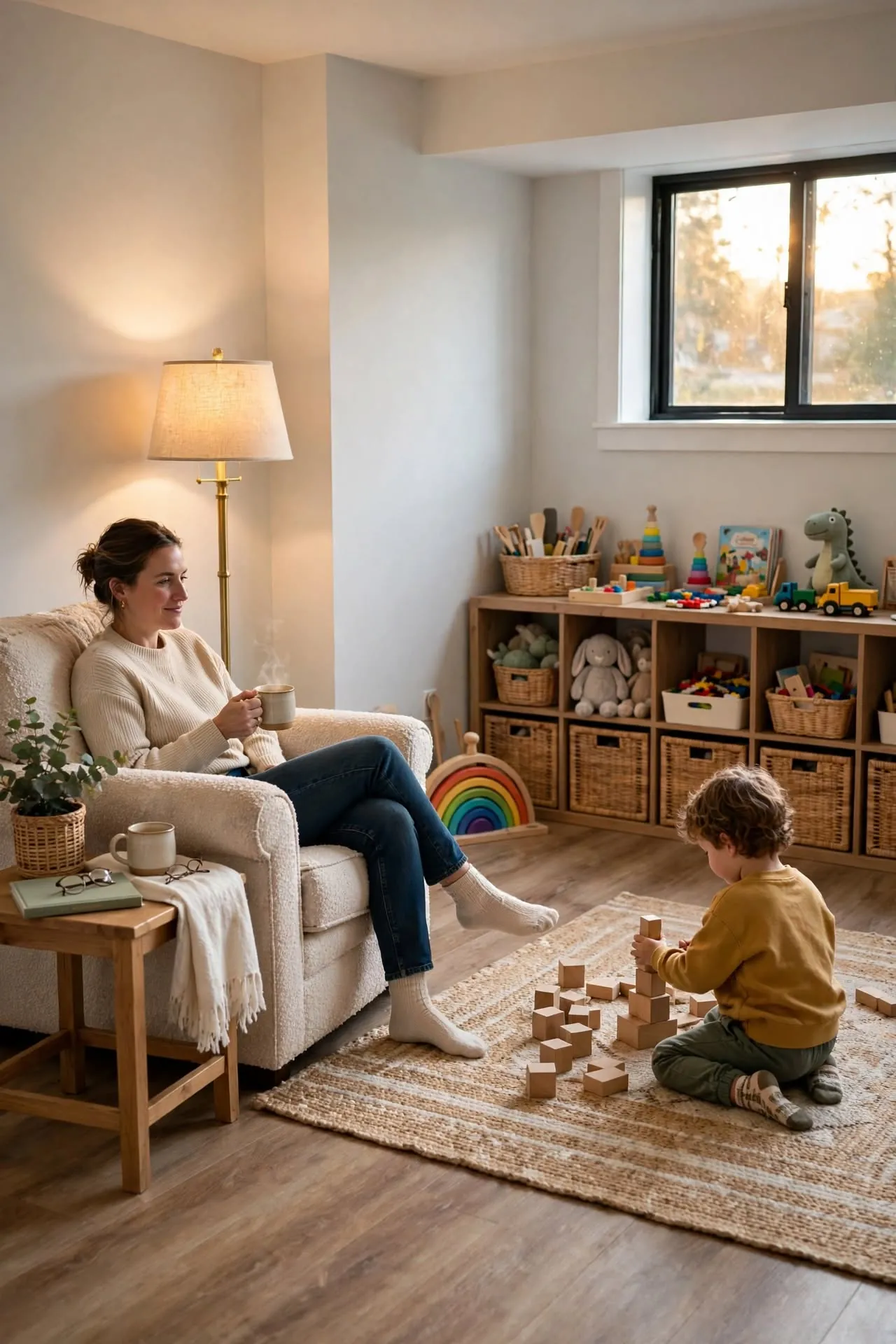
This is the idea that keeps a basement playroom alive. If there is nowhere for you to sit, you will not go down, and if you do not go down, neither will your kids.
An armchair and a side table is plenty. A sofa if you have the space, facing the open floor.
It earns its keep later too. The corner you sit in while a 2-year-old plays becomes the movie corner when they are eight.
THE ONE TO REMEMBER
A playroom nobody supervises is a playroom nobody plays in.
Design one comfortable adult seat into the room from the start. It is the difference between a space your family uses daily and a basement full of toys.
Basement Playroom Safety: The Checks Most Articles Skip
A basement brings risks that an upstairs playroom does not. These are worth working through before the room opens.
Test for radon. Radon collects in rooms that sit against the soil, so basements are the usual hot spot, and testing is the only way to know your level. The EPA recommends fixing a home at or above 4 pCi/L, suggests considering action between 2 and 4 pCi/L, and advises testing before you convert a basement into a space where someone will spend much more time. Kits are inexpensive and sold in hardware stores.
Anchor every piece of furniture. CPSC data shows children account for the large majority of tip-over deaths, and nearly all of those child deaths involve children aged 5 and under. Incidents typically happen when a child climbs onto, falls against, or pulls up on furniture. Anchor bookcases, dressers and shelving to the wall, keep TVs on a low sturdy base, and keep tempting items off the tops so there is no reason to climb.
Gate the stairs at the top, and at the bottom if a child under 2 uses the room. Basement stairs are often steeper and harder than the rest of the house.
Check alarms and the way out. You want a working smoke alarm and a carbon monoxide alarm on the basement level, not just upstairs. Make sure there is a second way out, and know the rules where you live. Most places require an escape window or door for a basement used as living space, so check with your local building department before you finish the room.
Keep the climbing zone honest. Padded floor extending past the frame on all open sides, nothing hard within falling distance, and the manufacturer’s age limit respected rather than stretched.
Cords and blinds. Clip lamp cords flat to the wall, hide plugs behind furniture, and tie up any window blind cord well out of reach.
Supervision is not an add-on to these. A basement playroom is a space you stay in with young children, not a room you send them down to.
Before the Room Opens
☐ Radon tested, result known
☐ Damp dealt with, humidity down
☐ Utility corner locked or fenced
☐ All tall furniture anchored
☐ Stair gate fitted and tested
☐ Smoke and CO alarms on this level
☐ Second exit route checked
☐ Cords clipped, blind cords tied up
☐ Climbing fall zone padded and clear
What to Actually Do Down There
The room is the easy part. Filling the hours is the rest of it.
- Active days: 15 active indoor activities for toddlers
- Calm afternoons: 20 quiet indoor activities for toddlers
- Five-minute setups: 10 creative indoor activities for toddlers
- When nothing is working: 30 easy indoor activities for any day
- Sensory corner, low mess: low mess sensory play ideas for toddlers
Frequently Asked Questions
Is a basement safe for a 2-year-old to play in?
It can be, once you have handled the stairs, tested for radon, anchored the furniture, locked off the utility area, and confirmed your alarms and exit route. A 2-year-old also needs you in the room, not upstairs.
How do I brighten a dark basement playroom?
Paint walls and ceiling the same pale shade, light the room at three heights rather than from one overhead fixture, and hang an acrylic mirror opposite the window. Pale floors help more than pale walls.
What is the best flooring for a basement playroom?
Foam tiles under the active zone, a washable rug on underlay in the quiet corner, and a sealed hard floor where the mess happens. Deal with any damp first, because every soft option traps moisture.
Can I do this in an unfinished basement?
Yes, in stages. Start with dry, warm and safe: moisture under control, utility corner fenced, floor insulated, lighting added. Rugs, soft furnishings and climbing equipment come after that, not before.
How do I stop it turning into a toy dump?
Keep the middle of the floor empty, store roughly half the toys out of sight, and rotate a boxful every couple of weeks. Open bins with photo labels at floor level do more for tidying than any storage unit.
At what age can kids use the basement playroom without me?
There is no age that fits every family. It depends on the stairs, the equipment in the room, and the child. Treat a basement as a together space through the preschool years and reassess as they get older.
One Last Thing
Start with the floor and the light. Everything else on this list works better once the room is warm, bright and dry, and those two fixes cost less than a single piece of play equipment.
Then pick one corner. A reading nook with a lamp, or a padded strip along one wall. Build the next corner when the first one is getting used.
The best basement playroom ideas are the ones that match the room you actually have, low ceiling, odd corners and all.
Save this list for the weekend you finally tackle the basement. Pin it now and you will have the safety checklist when you need it.