Affiliate Disclosure: This post contains affiliate links. If you make a purchase through these links, I may earn a small commission at no extra cost to you. As an Amazon Associate, I earn from qualifying purchases. Thank you for supporting CozyClan!
Introduction
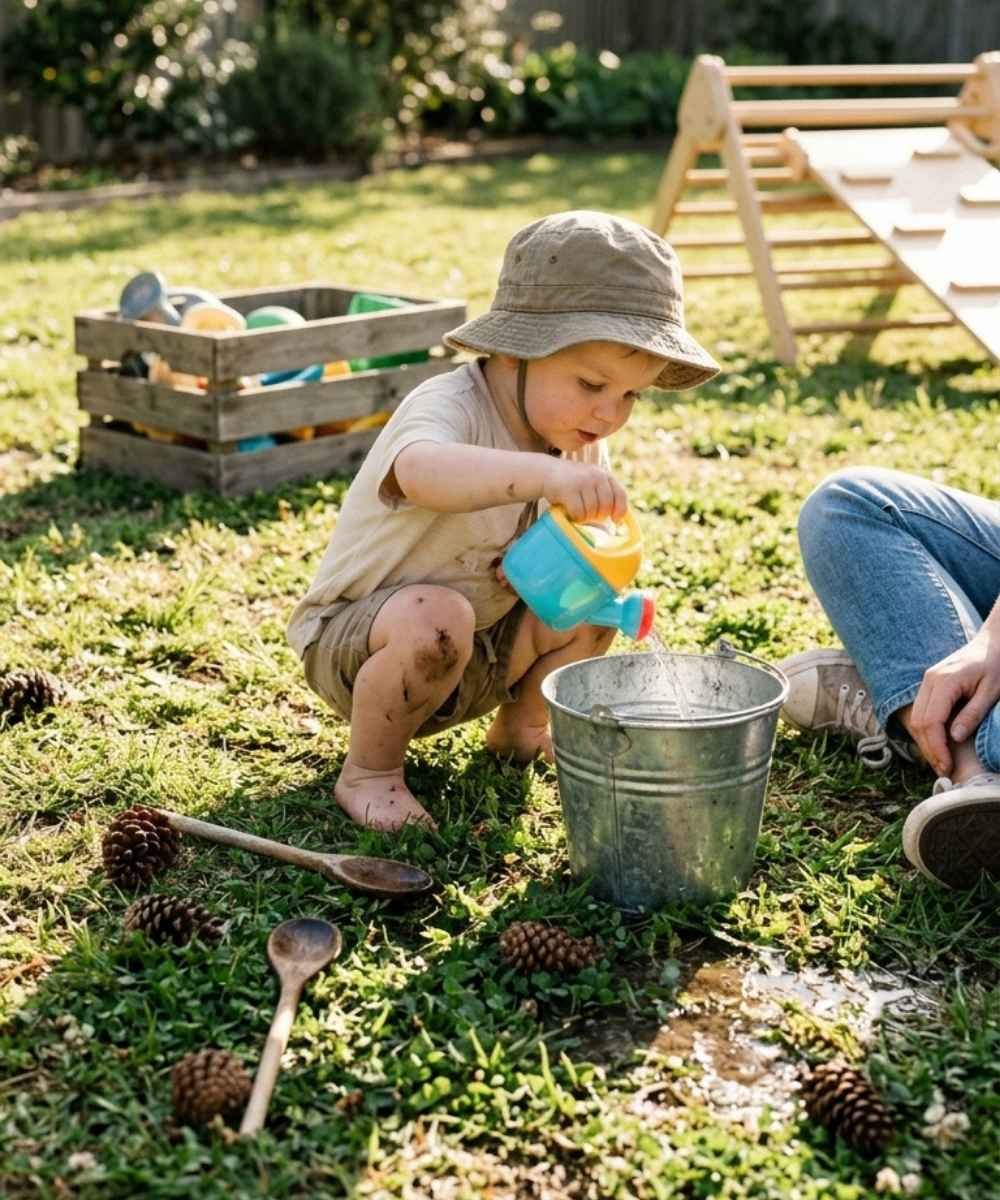
The playset cost more than the sofa. Your toddler climbed it twice, then spent forty minutes pouring water from a yogurt tub into a flowerpot.
That gap between what we build for our kids and what they actually play with is where most backyard frustration lives. Parents assume the yard isn’t working because it needs more equipment, better weather, or a child who stays interested longer. Usually the problem is smaller and much easier to fix: a toy bin locked in a shed, a hose that only comes out on special occasions, a grown-up who keeps suggesting things.
The mistakes parents make with backyard play are rarely about carelessness. They come from good instincts applied slightly sideways, like keeping things tidy, keeping things safe, keeping things fun. Below are twelve of the most common ones, along with the specific change that turns a yard a toddler wanders around into a yard a toddler actually plays in.
Some of these are comfort fixes. Two of them are genuinely about safety, so don’t skip those.
Table of Contents
1. Buying the big structure before buying anything loose
Climbing frames have one script. You go up, you come down, and after a few weeks a toddler has learned everything it has to teach. Loose materials have no script at all, which is exactly why they hold attention longer.
Before spending on fixed equipment, spend ten dollars on things that move: a stack of plastic containers, a few short planks, a bucket, a dustpan, some fabric scraps, a plank-and-crate ramp. Watch what your toddler reaches for over two weeks. If they drag, fill, dump, and stack constantly, a climbing frame may sit unused while a crate of odds and ends gets used daily.
Buy the structure later, once you know which kind of movement your child actually seeks out.
2. Assuming a fenced yard is automatically a safe yard
A fence solves one problem, which is your toddler leaving. It does nothing about the eight or nine things inside the fence that need a second look.
The risks in a backyard are quiet ones. Standing water in a bucket, a pot saucer, a wheelbarrow, or a paddling pool left out overnight. A gate latch at toddler height. Fertilizer or fuel in an unlocked low cupboard. A grill that stays hot long after cooking ends. Small stones and mulch pieces that go straight into mouths.
Walk the yard once at your toddler’s eye level, crouched down, before the first warm week. It takes five minutes and you will find at least two things.
Tip everything that holds water after every single play session, not just at the end of the season.
⚠️ The five minute yard sweep
Do this crouched at your toddler’s height, before the first play session of the season and again after any storm.
☐ Empty every container that can hold rainwater, including plant saucers and toy trucks
☐ Check the gate latch height and that it actually catches
☐ Lock away fuel, fertilizer, pesticide and pool chemicals
☐ Move the grill, fire pit and any tools out of reach
☐ Look for mushrooms, berries and leaves within grabbing distance
☐ Scan for small stones, bark chips and hardware a toddler could mouth
☐ Check for wobble on anything climbable, including garden furniture
Water matters most. Toddlers can drown in very shallow water, quietly and quickly. Any water play, including a paddling pool, needs an adult within arm’s reach the whole time.
3. Putting every single toy out at once
Ten things on the grass sounds generous. For a toddler it reads as noise.
What usually follows is a tour. They touch the ball, abandon the ball, climb into the pool, climb out, push the trike two feet, and then come to you looking for the next thing. Nothing got deep enough to be satisfying, including for you.
Set out three or four things with some relationship to each other instead. Water, containers and a brush. Or sand, a scoop and a few small trucks. The limit is what creates the play, because a toddler with fewer options starts inventing uses rather than browsing.
Rotate what goes out every few days and keep the rest stored away. Old toys come back feeling new.
Four setups to rotate through
Put out one of these at a time. Three or four items each, nothing more.
💧 The pouring corner
Shallow tub of water, two cups, a funnel, a sponge.
Mess: moderate · Setup: two minutes
🚚 The hauling corner
Bucket, small wagon or box, a pile of pine cones or wood offcuts.
Mess: low · Setup: one minute
🖌️ The painting corner
Bucket of plain water, wide brush, a wall or fence to “paint”.
Mess: none · Setup: one minute
🪵 The building corner
Three crates, two short planks, a blanket for a roof.
Mess: low · Adult help: steadying hands
4. Treating mess as the thing to prevent
Most backyard rules trace back to laundry. We say no to the mud patch, move the water away from the dirt, and hand over a toy that keeps hands clean, then wonder why the child drifts back to the hose.
Mud, sand and water are the three materials toddlers consistently choose on their own. They respond to pressure, change shape, make noise, and never do exactly the same thing twice.
The workable fix is containment rather than prohibition. Pick one zone of the yard where mess is allowed. Keep a set of play-only clothes by the back door, plus a towel and a tub of water on the step for a rinse on the way in.
If you want more ideas for the wet end of this, see [backyard water play ideas for toddlers].
🧺 Make the mess easier: the back door kit
Set this up once and mud stops being a decision you have to make every afternoon.
👕 One set of clothes that is allowed to get ruined
🥾 Boots or old shoes that live by the door
🪣 A tub of clean water on the step for rinsing feet and hands
🧻 An old towel on a hook, not in the laundry pile
🧽 A dustpan brush for dry dirt before the wet stage
Pick one mess zone and leave the rest of the yard alone. Saying yes in one place is easier than saying no everywhere.
5. Not looking at what’s underneath anything they climb
This is the one worth being strict about. Falls onto the surface below are the leading cause of injury on playgrounds, which means the ground matters at least as much as the equipment itself.
Grass looks forgiving and isn’t. It compacts, dries hard, and wears to bare dirt exactly where feet land most. Concrete, asphalt and other hard surfaces should never sit under the fall area at all.
The detailed standards were written for public playgrounds rather than home sets, but the principle transfers well. Loose material such as wood chips or sand needs real depth, roughly nine inches, kept raked level and extended at least six feet out in every direction. Loose fill squashes down and scatters, so top it up.
Check the equipment size too. A frame built for a five year old puts a toddler higher than they can control.
What’s under the climbing frame?
Check the landing area, not just the structure.
Better choice
Deep loose fill such as wood chips, engineered wood fiber or sand, plus rubber mats or tiles made for the job.
Keep it working: rake it level, top it up, and spread it well past the edges of the frame.
Not as safe as it looks
Lawn, packed earth, thin bark scattered over soil, a picnic blanket, interlocking foam squares.
Why: these flatten and harden with use, and the worn patch is exactly the landing spot.
Never underneath
Concrete, paving slabs, asphalt, decking boards, tile or compacted gravel.
Also check: that the structure is sized for a toddler, firmly anchored, and free of gaps that trap heads or fingers.
6. Keeping everything where only an adult can reach it
Storage quietly decides how often your toddler plays outside. If the balls, buckets and chalk live in a shed with a stiff door, every play session has to start with you. On the days you’re tired, busy or on a call, it simply doesn’t start.
Lower the barrier. One open crate by the back door, at toddler height, holding six or seven things they can carry themselves. No lids they can’t lift, nothing stacked over their head, no latch.
What changes is initiative. A child who can fetch their own bucket goes outside because they thought of it, not because you organized it, and self-started play tends to run longer.
Keep the bulk in the shed. The crate is the doorway.
✅ What goes in the reachable crate
Six or seven items, all light enough for a toddler to lift and carry on their own.
☐ A small bucket with a handle
☐ Two scoops or large spoons
☐ A chunky ball
☐ Thick sidewalk chalk
☐ A wide paintbrush for water painting
☐ A small watering can
☐ A cloth bag for collecting treasures
Skip: anything with small parts, long cords or strings, or pieces small enough to swallow. Chalk still needs supervision with toddlers who mouth things.
7. Narrating, suggesting and gently taking over
Supervision and direction are two different jobs, and it’s easy to do the second while thinking you’re doing the first.
It shows up as a running commentary. Try the slide. Don’t you want to kick the ball? Look, the flowers. Each prompt is well meant, and each one interrupts a thought your toddler was in the middle of having. A child poking at the same patch of dirt for six minutes is concentrating, not stuck.
Stay close, stay watchful, and stay quiet longer than feels natural. Count to thirty before you speak. Most of the time they solve it, move on, or show you themselves.
Save your words for safety and for the moments they actually turn around and look for you.
8. Heading out at the hottest, brightest part of the day
Timing does more work than any toy in the yard. A toddler taken outside at two in the afternoon in July gets hot, squinty and irritable within fifteen minutes, and the whole thing gets filed under “he doesn’t like playing outside.”
The same child at nine in the morning will happily stay out for an hour.
Shift the window rather than shortening it. Early morning and the hour before dinner are usually the two easiest stretches. When you do go out in the middle of the day, set up in shade, put a water bottle somewhere they can reach it themselves, and watch for the flushed cheeks and short fuse that mean it’s time to come in.
Reapply sunscreen more often than you think you need to.
🕘 When to go out, and what to bring
| Time of day | How it usually goes | Bring |
|---|---|---|
| Early morning | Cool, calm, longest stretches of play | A layer they can take off, water |
| Late morning | Still good, sun climbing fast | Hat, sunscreen, a shaded spot |
| Midday to mid afternoon | Hottest and brightest, tempers go quickly | Full shade, water within reach, short sessions |
| Before dinner | Softer light, good for burning off energy | Insect repellent suited to their age |
Signs to head in: flushed face, unusual clinginess, refusing to drink, or a toddler who suddenly can’t cope with anything.
9. Waiting for a nice day
Waiting for ideal weather shrinks a backyard down to a handful of months a year. Drizzle, wind, cold and damp are all perfectly playable with the right clothes, and toddlers care far less about them than adults do.
Grey days have their own material. Puddles behave differently from a water tub. Wind turns ribbons and plastic bags into something worth chasing. Wet sand packs where dry sand won’t. Frost makes the grass crunch.
The gear is the whole barrier. Waterproof layer, boots, warm hat, spare dry set waiting indoors, and you’ve bought back most of the calendar.
Keep the truly unplayable days for inside, and have a backup list ready for them, like [easy indoor activities for toddlers].
Three setups for the days you’d normally stay in
Each one takes a couple of minutes and uses what you already have.
🌧️ After the rain
Gather
Boots, a stick, a plastic cup, a small boat or leaf
Set up
Find the biggest puddle. Stomp it, measure it with the cup, float things across it.
💨 Windy day
Gather
Ribbon or fabric strips, a paper streamer, light scarves
Set up
Tie strips to the fence and let them run past. Keep strings short and stay with them.
❄️ Cold and crisp
Gather
A warm drink for you, a basket, mittens that actually fit
Set up
Short collecting walk around the yard. Ten minutes outside beats none, then warm up inside.
10. Expecting an hour and giving up at twelve minutes
Twelve minutes is not a failure. For a toddler it’s a reasonable stretch of focused outdoor play, and most of the parents who believe backyard time “doesn’t work” are measuring against an hour that was never realistic.
Three short visits beat one long campaign. Out after breakfast, out again before lunch, out for ten minutes before dinner. Nobody has to be convinced, nothing has to be set up twice, and the total time ends up higher than the single long session you were aiming for.
Attention also stretches with familiarity. The same corner, visited daily, gets played with far more deeply by week three than it did on day one.
Let it be short and let it repeat.
11. Bringing the indoor rules outside with you
Half the point of a backyard is that it permits what the living room can’t. Then we walk out the door still saying don’t climb that, don’t throw it, not so loud, careful with the water.
Sort the no’s before you say them. Some are real: tools, the gate, anything near water, the grill. Most are leftovers from a house with breakable things and neighbours below. Throwing, shouting, banging a stick on a fence, tipping a bucket over their own feet, climbing onto a low wall with you standing beside it. None of that damages anything outdoors.
Decide your genuine limits once, say them clearly, and then let the rest go. A toddler who hears no every ninety seconds stops testing anything, including the things that would have taught them something.
12. Keeping them out of the jobs you’re already doing
Nothing in the toy crate competes with a real broom. Toddlers want the thing you are holding, partly because it’s yours and partly because it’s obviously doing something.
Most yard work has a toddler-sized version hiding inside it. Watering with a small can while you water with the hose. Dropping weeds into a bucket you carry. Sweeping one paving slab. Carrying three things from the step to the shed. The job gets done slower and worse, and that is not the point.
What they get out of it is a stretch of purposeful, self-directed effort that no activity you invent quite matches, plus the feeling of being part of the work rather than parked beside it.
Keep real tools, blades, spray bottles of anything and power equipment entirely out of this.
🧹 Jobs that are actually jobs
Hand over the toddler-sized half of whatever you were doing anyway.
Watering the pots with a small can they refill themselves
Collecting the weeds you pull and dropping them in a bucket
Sweeping one square of patio with a short-handled brush
Carrying toys back to the crate, two at a time
Filling the bird feeder from a cup you’ve already measured out
Digging a patch that is theirs, with a sturdy plastic trowel
Keep well away: pruners, shears, spray bottles of any kind, fertilizer and seed packets, mowers and trimmers. Pack chemicals away before the helping starts, not after.
Before you change anything else
Most of the mistakes parents make with backyard play cost nothing to fix. The yard doesn’t need more equipment. It needs fewer toys out at once, a crate your toddler can reach, a mess zone you’ve already agreed to, and an adult willing to sit down and say less.
If you only do two things this week, do the five minute hazard sweep and move one bin of toys to toddler height. Everything else can follow.
Start with the change that removes the most friction for you, because the backyard setup that actually works is the one you’ll still be using in a month.
📌 Save this list to your toddler play board so it’s waiting the next time the backyard feels like more effort than it’s worth.